


Give the collector a clear picture
For scrap cable collection in London, describe the known cable type, remaining insulation, attached connectors, approximate amount and anything mixed into the load. Add clear photographs, your postcode and access details so the collector can assess suitability and discuss a material-specific rate. Say when information is unknown rather than guessing the metal or grade.
Scrap cable collection in London: what your enquiry should explain
A useful enquiry gives the collector a picture of both the material and the collection task. The description should explain what you have, how much there appears to be and where it is stored. These are different questions, and each deserves a clear answer.
You do not need specialist knowledge to start. An electrician may know the cable specification from a job. A facilities team may have labelled storage containers. A householder may only know that several coils came from a previous refurbishment. Report the information you actually have, without adopting a technical label you cannot support.
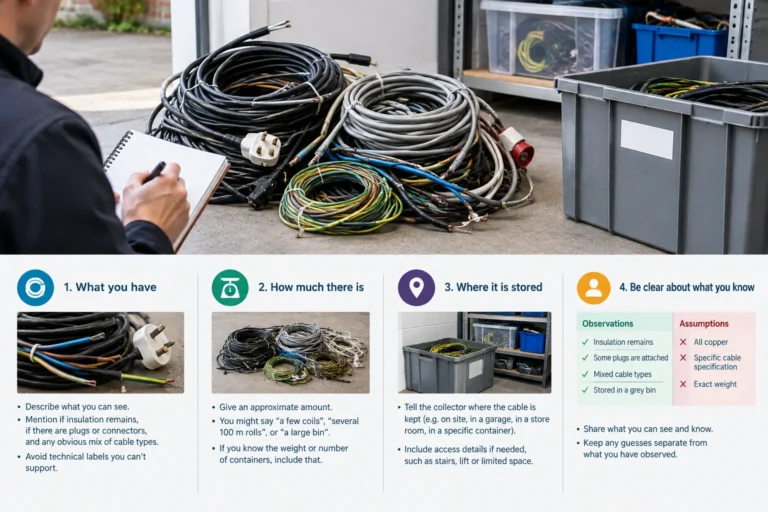
Separate observations from assumptions. For example, “insulation remains and some plugs are attached” describes something visible. “All copper” makes a claim about the contents. If the conductor metal is uncertain, explain that directly. An honest description gives the collector a better basis for follow-up questions.
A scrap cable enquiry should also identify whether the load is one known type or a mixture. State whether different cables are already stored separately and whether other items remain attached. This prevents a general label from concealing details that may affect suitability.
The suggestions below are practical preparation advice, not a mandatory company specification. They help you organise an enquiry without turning it into a technical survey. They do not guarantee acceptance, payment or a collection appointment.
Keep the message focused on cable. If you have other materials to discuss, identify them separately rather than allowing “scrap metal” to stand for everything. The collector can then distinguish the cable assessment from questions about unrelated items.
Describe the cable type without guessing the metal
The company’s scrap cable information discusses insulated copper cable, armoured cable, data and communication cable, aluminium cable and mixed loads. These descriptions provide a useful starting point, but they do not identify every individual cable in a photograph.
Cable cores may be copper or aluminium. A familiar sheath colour, a thick outer covering or a category name does not establish the conductor metal. Use existing labels, records or markings where available, and explain what remains uncertain.
| Cable description | Useful details to report | Uncertainty to disclose |
|---|---|---|
| Cable description Insulated copper cable | Useful details to report Known copper identification, remaining insulation and attached connectors. | Uncertainty to disclose Whether copper identification covers every cable in the load. |
| Cable description Armoured cable | Useful details to report Existing identification or markings, visible condition and how it is stored. | Uncertainty to disclose Unknown conductor metal or an unconfirmed cable type. |
| Cable description Data or communication cable | Useful details to report Readable markings, attached plugs and any known specification. | Uncertainty to disclose Unknown metal content despite a recognisable category label. |
| Cable description Mixed cable | Useful details to report Known types present, existing separation and attached items. | Uncertainty to disclose Unidentified cables and uncertainty about the overall mixture. |
Insulated copper cable and uncertain cores
Use “insulated copper cable” when you have a reliable basis for identifying the copper. Explain whether insulation remains throughout the load and whether connectors are still attached. If only part of the material is known to be copper, distinguish that part from the rest.
You might know the specification of recent offcuts but not an older bundle stored beside them. Do not let the known bundle determine the description of everything else. A statement such as “copper is known for this container; the second container is unidentified” makes the limit of your knowledge clear.
Armoured and communication cable
For armoured cable, report an existing identification or marking rather than assuming the conductor metal from its construction. If you only believe it is armoured cable, say so. Describe its present condition and show the material as it stands.
For data or communication cable, copy readable markings accurately. A marking such as Cat5 can be useful information to pass on, but it should not become a claim about metal content. Mention plugs or connectors that remain attached, especially when they are not obvious in the overview photograph.
Keep the distinction between cable type and metal content throughout your message. One may be known while the other is not. “Data cable with readable markings; conductor metal unknown” is more informative than either an unsupported metal claim or simply “wire”.
There is no need to alter cable to produce a more confident description. Use existing information and already visible features. If those are insufficient, send the enquiry with the uncertainty clearly stated and ask what further detail would help.
Explain your mixed cable load and attached items
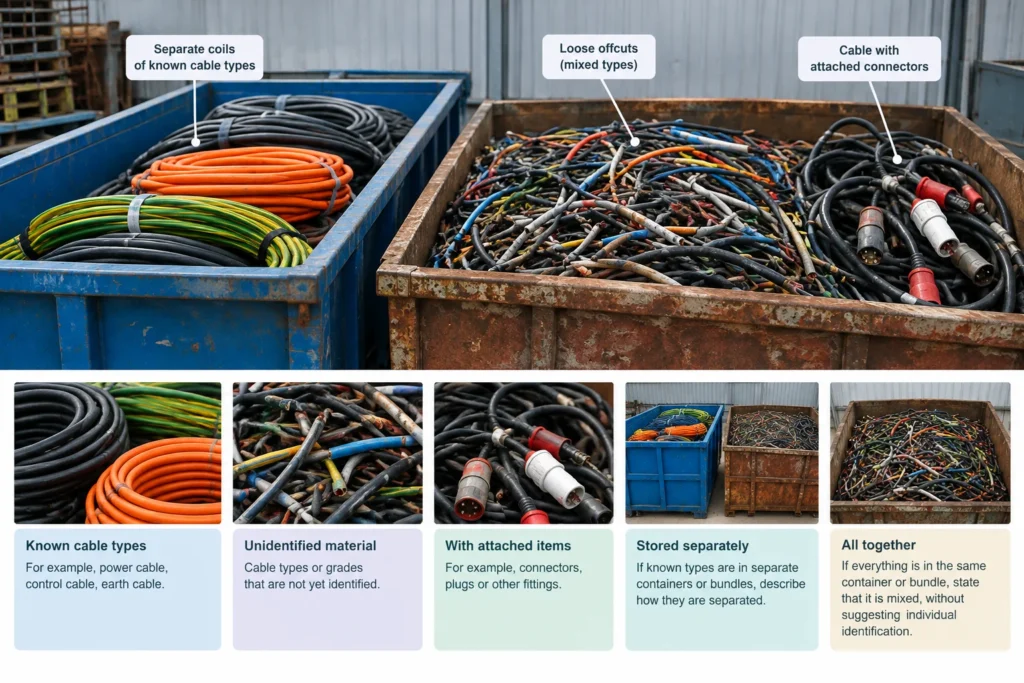
A mixed cable load needs a description of the mixture, not just a single name. The collector needs to understand which types you recognise, which remain unidentified and how they are currently stored. “Several cable types in two containers” is a useful beginning, but it leaves important questions unanswered.
Explain whether the load includes separate coils, loose offcuts or cable with attached connectors. If known types are already stored apart, describe that separation. If everything is together, say so without suggesting that the contents have been individually identified.
These parallel details are worth including where they apply:
- Identify each cable type you know, and distinguish it from unidentified material.
- State whether the different types are already in separate containers or bundles.
- Describe remaining insulation and any obvious differences across the load.
- Mention plugs, connectors or other fittings that remain attached.
- Identify attached equipment or other material that needs separate confirmation.
Condition and sorting are among the assessment factors described on the cable information page. Reporting the current arrangement helps the collector understand the load. It does not mean that sorting guarantees a higher payment, or that every mixed load will be accepted.
Attached equipment deserves particular clarity. Acceptance of a cable category does not automatically establish acceptance of whatever is connected to it. Describe the item and include a photograph rather than treating it as an invisible part of the cable weight.
If the material has anything unusual on it or mixed into it, describe what you can observe and ask the company to confirm suitability. Do not hide an uncertainty behind a broad description such as “clean copper”. Equally, do not assign a condition or grade that you cannot establish.
You can give a useful account without dismantling or changing the load. The purpose is to show what exists now. Keep the written description and photographs consistent, especially if some containers contain a different mixture from the others.
Give an honest estimate of the amount
The cable information page asks enquirers to provide the cable type and estimated weight. This supports discussion of the grade and current material-specific rate. A reliable weight is useful, but an invented figure is not a substitute when you do not know it.
If you have a known weight, state what it covers. Does it refer to all the cable, one container or only a separate bundle? If it is approximate, label it as an estimate. Avoid presenting a rough recollection as a measured total.
When weight is unknown, describe the visible quantity instead. Give the number and kind of containers, coils or bundles and show them together in an overview photograph. Mention whether containers are partly filled, rather than allowing the reader to assume that each is full.
Container count and metal weight are not interchangeable. Two boxes of thin communication cable do not provide a dependable kilogram figure simply because the boxes look familiar. Insulation, connectors and the mixture also form part of what is being described.
For mixed cable, separate the quantities you know from those you do not. You may have an approximate weight for one identified bundle and only a container count for everything else. Report both in their own terms instead of combining them into a falsely precise total.
Make clear whether your quantity description covers cable alone or includes attached items. This helps the collector interpret the estimate without assuming that every part of the load has the same material content or suitability.
There is no need to calculate a payment from an uncertain amount. First establish what the material is and what information the collector needs. A quantity estimate supports that conversation; it does not confirm acceptance, a minimum payment or a particular collection arrangement.
If the load changes after your first message, update the description. Adding another container or removing a separate coil changes what the photographs and estimate represent. A short correction is more useful than leaving the collector to assess an outdated picture.
Show the cable and explain collection access
Photographs should answer practical questions that words alone may leave open. Start with an overview showing the whole load, including separate containers or bundles. Then add close-ups where they reveal useful detail, such as existing markings or attached connectors.
Photograph already visible cable ends where these can be shown without altering the material. Keep any readable labels clear enough to inspect. If a marking is difficult to see in the image, transcribe it in the message and explain which bundle it belongs to.
For a mixed cable load, show the different parts rather than only the most easily recognised cable. A close-up of one known bundle should not imply that it represents every container. Label the photographs in your message if the distinction would otherwise be unclear.
Pictures support an initial assessment, but they cannot establish every material detail. A collector may still need information about conductor metal, attached items or condition. Pair the images with a short description rather than expecting photographs to answer everything.
Access information is equally important. A postcode identifies the location, while a description explains how the stored cable relates to possible vehicle access. Include the practical details that could affect arrangements:
- Give the collection postcode and identify where the cable is stored.
- Explain whether stairs or a change of level separate the storage position from access.
- Mention gates, locked entrances or entry arrangements that need coordination.
- Describe known parking restrictions or limits on vehicle access.
- Explain the distance between the stored cable and the vehicle access point.
For someone preparing an enquiry in Southwark, the useful local detail is the actual postcode and access route, not the borough name alone. A ground-floor store behind a gate presents different questions from material upstairs or far from vehicle access. Ask the company to confirm arrangements for the address rather than assuming coverage or attendance.
Describe constraints as facts, not assurances. If you know there is a gate but do not know how entry will be coordinated, say that. If parking arrangements require confirmation, identify the uncertainty instead of promising unrestricted access.
The company’s collection enquiry page provides a message form with photograph uploads, according to information dated 10 October 2026. Use the written message to connect the images, quantity description and access details into one understandable account.
Ask for an assessment, not a guaranteed cable price
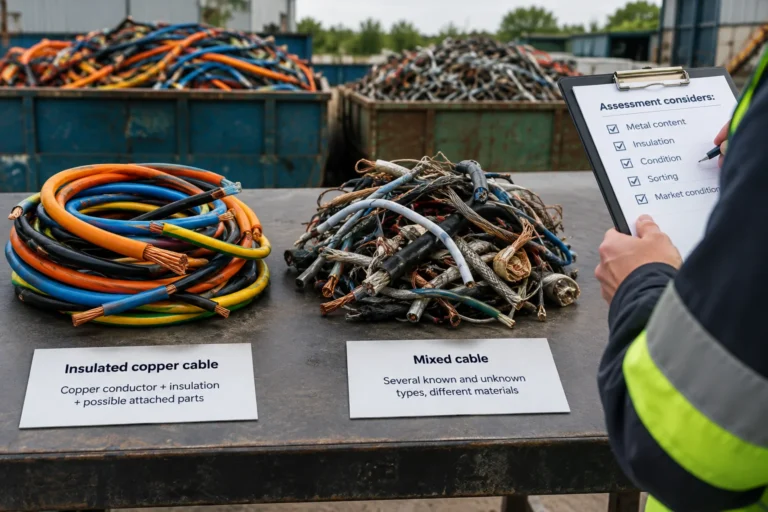
A general cable label is not enough to establish value. The company identifies metal content, insulation, condition, sorting and market conditions as relevant factors.
Two loads described simply as “scrap cable” may therefore need different assessments.
Insulated copper cable contains more than the named conductor alone.
The insulation and any attached parts also matter to the description. Knowing that copper is present does not establish the overall metal content of a load or the applicable rate.
The same distinction applies to mixed cable. A load containing several known and unknown types cannot be assessed accurately by assigning the entire mixture the description of one bundle. Your enquiry should preserve those differences so the collector can ask the right questions.
Separate material-value questions from collection questions. Metal content and condition concern the material itself. Amount, location and access also inform assessment, but they do not identify the conductor or grade. Both kinds of information belong in the enquiry.
Published guide prices are not a guaranteed quote for your particular load. They should not be used to calculate an assured return from a guessed weight or assumed cable grade. This guide therefore does not give numerical rates or predict a payment.
Ask whether the described material is suitable, what further details are needed and what current material-specific rate applies. If part of the load remains unidentified, ask how that uncertainty affects the initial assessment rather than asking for one unconditional figure.
A useful reply may clarify the cable description before discussing arrangements. Keep that clarification with the original photographs and quantity estimate so the conversation continues to refer to the same material.
Neither a photograph nor a recognised category guarantees resale value. Payment depends on the collected material having value, and collection still needs confirmation. The practical goal is an informed discussion about your actual cable, not a promise based on a generic price label.
A hypothetical scrap cable enquiry you can adapt
Hypothetical enquiry — not a customer case. The following message illustrates how to combine known details, uncertainty and access information. It does not describe a completed collection or predict an outcome.
“I have two containers of insulated cable offcuts in Southwark, including some marked Cat5 and a separate coil believed to be armoured cable. Some connectors remain attached. I do not know the total weight or the conductor metal in every cable. The material is stored on the ground floor behind a gate. Photographs are attached. Can you confirm suitability and advise what further details you need?”
The example names what is visible without turning every observation into a technical conclusion. “Marked Cat5” reports a marking. “Believed to be armoured cable” preserves uncertainty. The message also avoids assigning a weight to the containers or claiming that the whole load contains copper.
Its access description gives the collector a starting point, but it does not settle the arrangements. Further questions about the gate, vehicle access or the location may still be necessary. That is a normal reason to provide details, not a failure of the enquiry.
Use this four-step preparation sequence for your own message:
- Record known descriptions and unknowns. Note existing markings, insulation, connectors and any uncertain identification.
- Describe the amount honestly. Give a known or clearly approximate weight, or explain the containers, coils and bundles.
- Take useful photographs and note access. Show the whole load, relevant details and the practical storage situation.
- Send the enquiry and request confirmation. Ask about suitability, further information and the current material-specific rate.
Adapt every detail to your actual load. Do not copy the example’s quantities, markings or location unless they apply. If there are no connectors, or the material is not behind a gate, write the facts instead.
Before sending, check that the photographs match the description and that your estimate covers the material shown. A concise, consistent message is more useful than a longer one containing unsupported labels or conflicting quantities.
Confirm suitability with Premier Scrap Trading Ltd
Premier Scrap Trading Ltd is a family-run business established in 2008, as described on its company background page. Its service information dated 10 October 2026 advertises free mobile scrap metal collection in London for homes, businesses and construction sites across Greater London.
That general service description does not confirm an individual cable load, address or appointment. Your enquiry still needs an assessment of the material and practical arrangements. Include the postcode and access details even when you are enquiring from within Greater London.
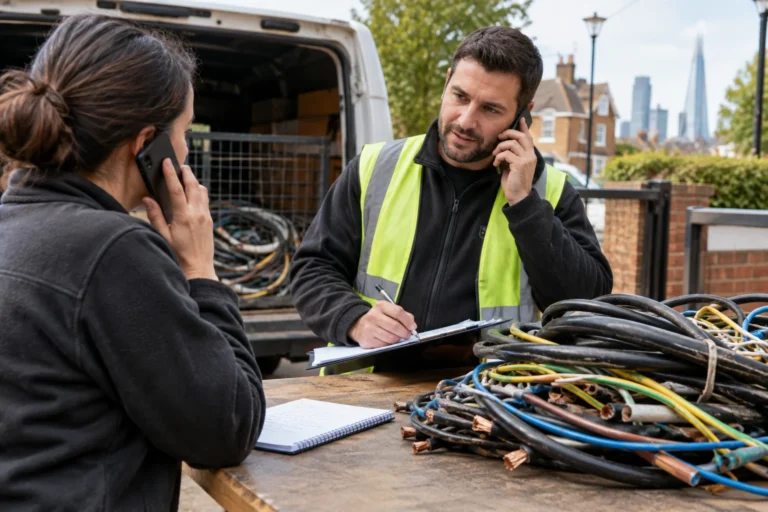
The accepted materials page, dated here to 10 October 2026, lists cables and describes a collection-only service. Do not assume that you can take material to a drop-off location. Confirm the collection arrangements directly.
Old washing machines and fridges are not accepted. A cable enquiry should not imply that these appliances can be included alongside the load. Other attached equipment or uncertain items also need explicit confirmation rather than being treated automatically as accepted cable.
Payment applies where collected material has resale value. Neither the listed category nor the free collection description means that every item earns a payment. Ask about the current assessment for your material without assuming a fixed price, minimum return or attendance time.
A clear scrap cable enquiry keeps the important facts together: known type, uncertainty, condition, amount, photographs and access. That gives the company a practical basis for discussing suitability and identifying anything else it needs to know.
Call 07931 361034 or book a collection with Premier Scrap Trading Ltd to confirm materials and current prices.
Cable collection questions
Can I enquire about cable collection without knowing the weight?
Yes. State that the weight is unknown, describe the number and type of containers, coils or bundles, and provide an overview photograph. Do not turn container counts into guessed kilogram figures.
Does a Cat5 marking prove that a cable contains copper?
No. Report the marking as useful identification information, but do not treat it as proof of conductor metal. State that the metal is unknown unless you have reliable information.
Should I remove insulation before sending an enquiry?
You do not need to alter cable to describe it. Explain the insulation already present and photograph existing markings or visible ends. Ask the collector what further information is needed.
Can mixed cable be assessed from photographs?
Photographs can support an initial assessment, but they may not establish every cable type, conductor metal or condition. Describe the mixture in writing and ask for suitability to be confirmed.
What should I say about plugs and attached equipment?
Describe any plugs, connectors or equipment that remain attached and show them clearly in photographs. Do not assume that acceptance of cable also covers an attached device.
Does a published cable guide price guarantee my payment?
No. Cable value depends on metal content, insulation, condition, sorting and market conditions. Ask for the current rate applicable to your described material; payment depends on resale value.
Can I take my cable directly to Premier Scrap Trading Ltd?
The company information dated 10 October 2026 describes a collection-only service. Contact Premier Scrap Trading Ltd to discuss your cable and confirm collection arrangements rather than assuming a drop-off option.
Can old washing machines or fridges be included with cable?
No. Premier Scrap Trading Ltd does not accept old washing machines or fridges, according to its accepted-materials information dated 10 October 2026. Describe other attached or additional items separately for confirmation.