


An office scrap metal collection works best when it is planned as a metal-only clearance, rather than a catch-all route for everything left in a workplace. Filing cabinets, shelving, desk frames and suitable fittings may be candidates for recycling. Computers, batteries, paperwork, appliances and mixed waste require separate decisions.
For an office scrap metal collection, the aim is a clear item list, safer access and a confirmed scope before collection day. For office managers, landlords and facilities teams, the seven checks below help distinguish recyclable metal from items needing another route. They also reduce the chance of discovering confidential files, electrical equipment or building fixtures in a pile described simply as metal.

Office Scrap Metal Collection: Start With a Clear Scope
Before anything is moved, define the job in practical terms: which items are intended as metal-only scrap, where they are located, how they can be accessed and what must remain on site. This prevents a collection area becoming a mixture of furniture, electrical equipment, confidential paperwork and general rubbish. A collector needs an accurate description of the material, not an assumption that every heavy or metallic-looking item belongs in the same load.
Premier Scrap Trading Ltd provides mobile scrap metal collection in London across Greater London for domestic and commercial customers. Mobile collection across Greater London and the business’s booking arrangements were checked on 21 September 2026. Actual acceptance, timing and collection arrangements must still be confirmed for the particular items, quantities, condition and access at the time of booking.
Start by dividing the project into four working groups: items to retain or reuse, metal-only scrap, electrical or battery items, and non-metal waste. This simple approach supports office metal recycling without turning a metal collection into an unplanned full-office disposal exercise. It also gives colleagues, contractors and building management a shared understanding of what is being removed.
A scope note does not need to be lengthy. Record the address, floors involved, intended collection area, broad material types, approximate item numbers and access limitations. Photographs can be useful for large cabinets, shelving runs, radiators or awkward furniture. Avoid showing personal, client or confidential information in photographs.
Once the scope is drafted, check it against what is actually in the rooms. An apparently simple desk clearance may include pedestal drawers, cable trays, screens, leased equipment or fixtures attached to the building. Identifying these details early makes the eventual collection request clearer and helps keep excluded material out of the agreed area.
Check 1: Inventory Items and Confirm Ownership
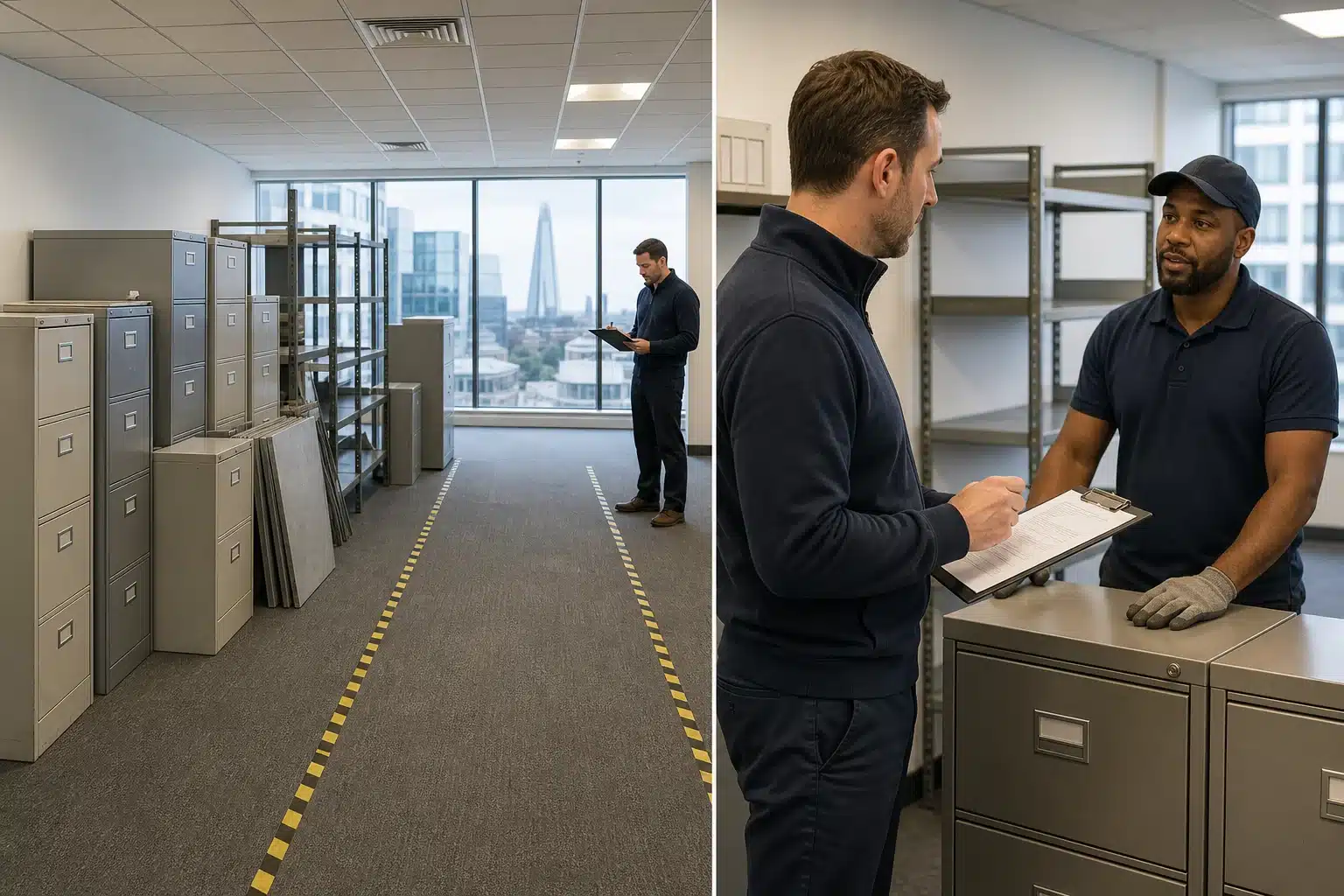
A room-by-room inventory is the foundation of a sensible business scrap metal collection. Begin with visible items such as filing cabinets, metal desks, shelving, chair frames, storage racks, radiators and loose fittings. Then note cable, electrical equipment, batteries, appliances, paper records and items made from a mixture of metal, wood, plastic or glass.
For each item, record the room, approximate quantity, general size and whether it can be moved safely. A basic spreadsheet, checklist or annotated floor plan is usually sufficient. The office inventory should describe the metal items, without asking staff to assign precise scrap grades. It is to give a realistic outline when discussing the proposed collection and to avoid late changes to the plan.
Ownership must be checked before removal. A tenant may not own fixtures supplied by a landlord, while a serviced-office operator may have rules for shared furniture or meeting-room equipment. Leased printers, telecommunications hardware, security devices and network equipment can belong to a supplier rather than the business occupying the premises. Equipment issued to an employee may also require internal approval before it leaves the site.
Ask the person responsible for property, procurement or facilities to confirm what has been authorised for removal. Where records must be retained, arrange that first. Empty cabinets and desks before they enter the metal pile. Keys, documents, stationery, IT equipment and personal possessions are easily overlooked during an office move or refurbishment.
Businesses have a duty of care in relation to waste arrangements. The government’s guidance on business and commercial waste explains the importance of using suitable arrangements and retaining relevant documentation. An accurate inventory helps an organisation describe its material properly and decide on an appropriate route for each item.
When the list is ready, use the Premier Scrap Trading Ltd contact page or call to discuss the metal part of the load. Share photographs and access details where requested, and flag anything that may be electrical, battery-powered, mixed or unusually bulky. A clear description is more useful than an estimate based only on the number of rooms being cleared.
Check 2: Consider Reuse Before Recycling
Recycling is often appropriate for damaged, obsolete or surplus metal items, but it need not be the first decision for furniture or fittings that remain useful. Before arranging office metal recycling, separate items that could be retained, redeployed or passed on through an appropriate reuse route. This is an asset-management decision as well as a waste-management decision.
Start with a straightforward question: does the item still have a safe, useful purpose? A matching set of shelving may be useful on another floor. Serviceable metal desks may suit a temporary project room. Fixtures could be required by the landlord at the end of a tenancy. A building manager may also need to approve the removal of attached items, even where they appear redundant.
Use a simple sequence to make the decision easier:
- Retain: keep items needed for operations, records or property obligations.
- Reuse: consider internal redeployment, resale or a suitable donation arrangement for functional items.
- Choose the appropriate route: identify electrical equipment, batteries, confidential material and non-metal waste that need separate handling.
- Prepare metal-only scrap: once the earlier decisions are complete, list the metal items intended for collection.
This order prevents a rushed clear-out from combining materials with different requirements. It also avoids treating a computer, printer or telephone as ordinary scrap because its casing contains metal. Data-bearing equipment needs its own internal process, and any specialist requirements should be confirmed with the relevant provider rather than assumed.
Do not make claims about the outcome of a particular collection without evidence for the actual materials and route. The practical point is simpler: separating reusable items and material streams gives the organisation more control over what happens next. It can also make the collection area easier to manage because only the agreed metal items are placed there.
Clear labels help when several people are involved. Use signs such as “retain”, “reuse review”, “metal collection”, “electrical review” and “do not remove”. Nominate one person to approve label changes. This reduces the risk that a cabinet set aside for records, or a leased device awaiting return, is removed by mistake.
For a business scrap metal collection, the agreed metal pile should be a defined boundary, not a convenient place for unwanted office contents. That distinction supports a more orderly clearance and a better record of the disposal decisions made by the organisation.
Check 3: Separate Metal Furniture, Fittings and Cable
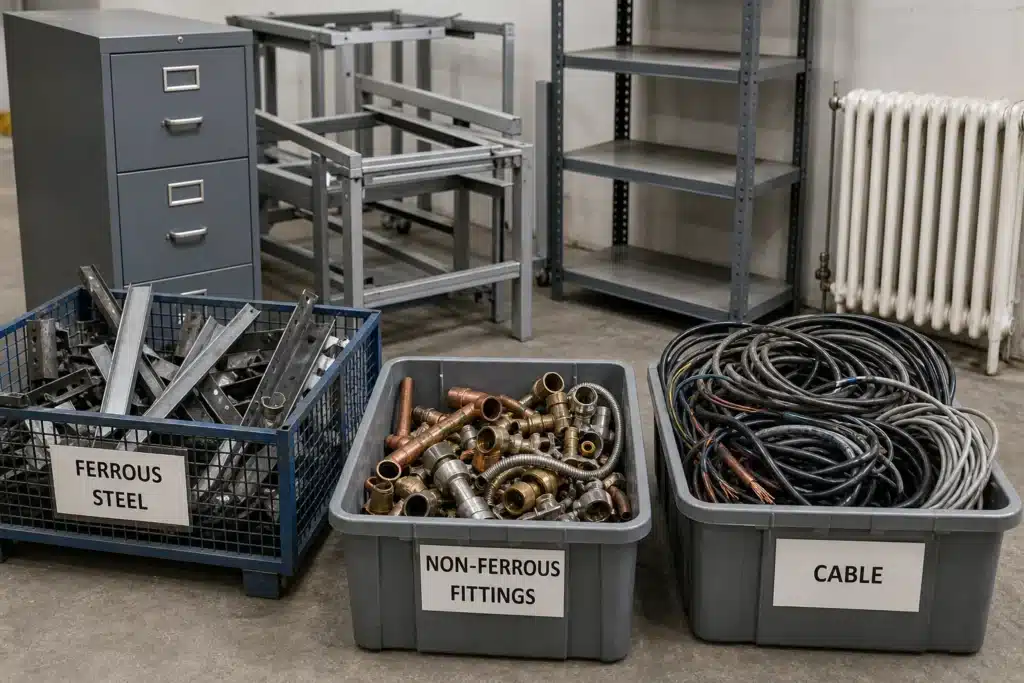
Preparing an office scrap metal collection does not require staff to identify exact metal grades. It means grouping items sensibly so their composition, condition and handling needs can be described clearly.
Likely metal-only candidates can include steel filing cabinets, metal desk frames, shelving, racking, radiators, frames and suitable loose fittings. Each category remains subject to confirmation.
In plain language, ferrous metals contain iron and are commonly attracted to a magnet; steel furniture is a familiar example. Non-ferrous metals include copper, brass, aluminium and lead. Stainless steel is an iron-based alloy, so it belongs to the ferrous group.
They may occur in fittings, cable, pipework or specialist equipment. The difference matters because materials may be assessed and handled differently, and a mixed pile can be less straightforward to describe.
Simple preparation for metal items
- Remove files, personal belongings and loose contents from cabinets and desks.
- Make labelled piles for metal furniture, loose fittings and cable where space allows.
- Leave items intact unless a competent, planned process requires otherwise.
- Keep corridors, fire exits and loading routes clear while preparing the collection area.
- Take clear photographs and provide approximate quantities if requested.
Good sorting supports office metal recycling because it reduces uncertainty without asking staff to make technical decisions beyond their knowledge. It also reveals items that do not belong in the metal-only scope, such as furniture with significant non-metal components or equipment that is still connected to a power or data supply.
Check 4: Identify WEEE and Batteries Separately
Many workplace clearances include items that are not simply metal scrap. Computers, monitors, printers, servers, telephones, docking stations, routers, kitchen appliances, lamps and other powered equipment may fall within waste electrical and electronic equipment rules. Their metal content does not make them ordinary mixed-metal items.
The official guidance on how to classify WEEE is a useful starting point for considering the correct route. Classification can depend on the equipment and circumstances, so a workplace should not rely on a quick visual judgement. Keep electrical equipment separate, identify data-bearing devices and establish suitable internal and external arrangements before anything is removed.
Batteries need the same disciplined approach. Do not put loose batteries in a general metal pile, do not attempt to open battery packs and do not dismantle equipment to remove batteries unless this forms part of a safe, appropriate process. Tell the relevant provider that batteries are present and obtain confirmation of the right route. Damaged or unusual items require particular care.
Premier Scrap Trading Ltd does not accept old washing machines or fridges. The business does not present itself as a data-destruction service or as a provider for every WEEE stream, so a computer clearance, server removal or appliance disposal should not be assumed to fall within a metal collection. Confirm exclusions and any separate arrangements before booking.
For general questions about material categories and collection boundaries, the company FAQ is a useful reference. For an office project, identify electrical and battery items early, keep them out of the metal-only pile and make the collection request only after the intended scope is clear.
These WEEE disposal checks are not administrative extras. They help prevent a regulated or data-sensitive item being handled as ordinary furniture and reduce collection-day delays caused by powered equipment appearing in a pile described as scrap metal.
Check 5: Plan Safe Handling and Loading Access
Heavy filing cabinets, long shelving sections and metal desks can be awkward even when they do not look especially large. Safe preparation begins with the route from the item’s current position to the loading point. Consider floor level, lifts, stairs, narrow corridors, door widths, sharp turns, loading bays, vehicle access, parking restrictions and building-management rules.
The Health and Safety Executive states that employers should avoid hazardous manual handling where reasonably practicable. Where it cannot be avoided, the risk should be assessed and reduced. Its manual handling guidance is relevant to office clearances because the risk is influenced by the load, task, environment and people involved.
Do not ask staff to lift a heavy cabinet simply because it has been emptied. Do not drag furniture across unsuitable surfaces, balance loads on stairways or disassemble bulky items without suitable planning. A cabinet can be top-heavy, a shelving unit can become unstable once moved and a route that appears clear in the morning may be blocked by deliveries or normal office activity later in the day.
Give the person arranging the office scrap metal collection the access details in advance: floor number, lift dimensions and availability, whether there are stairs, the distance to the loading point, any loading-bay booking system, site induction requirements and restrictions on vehicle access. Photographs of tight corners, bulky items and the loading area can help establish whether the proposed scope is workable.
An Enfield office manager can reduce avoidable delays by separating metal-only items from electrical equipment and confirming loading access before arranging collection. This is a practical Greater London takeaway, rather than a statement about local demand or a promise of a particular collection time.
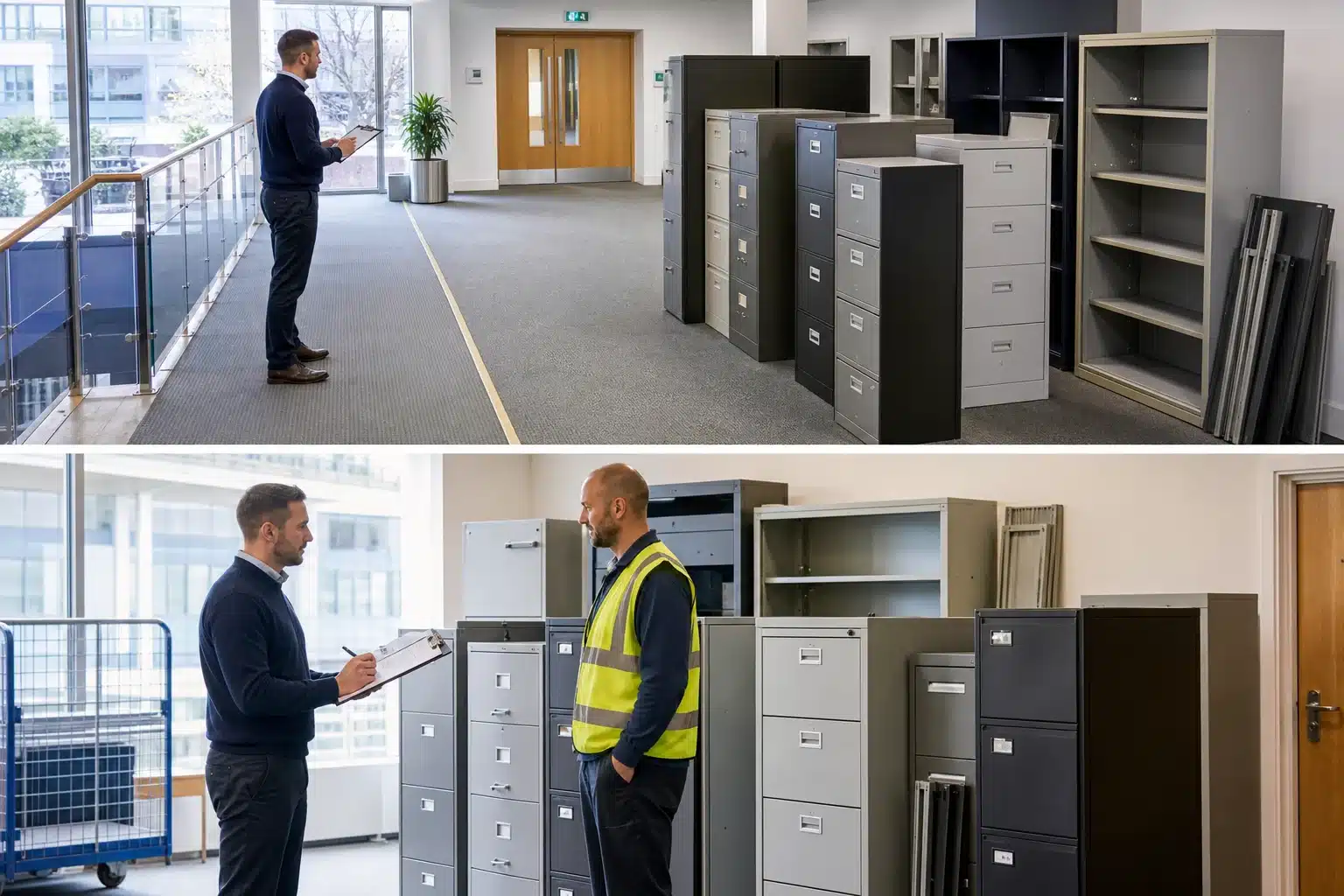
Assign one responsible site contact for the day. That person can meet the collector, confirm which labelled pile is in scope, communicate with reception or building management and stop unapproved items being added at the last moment. Clear roles are often more valuable than trying to move every item in advance.
Check 6: Confirm the Collector and Paperwork Requirements
Compliance should be part of the discussion before a collection, not an afterthought after material has left the premises. Businesses should ensure their waste arrangements are appropriate for the material and discuss the description of the load, required information and transfer documentation relevant to the job. Government business-waste guidance provides the wider duty-of-care context.
Ask practical questions. What material description is needed? Is the proposed load metal-only or mixed? Are there exclusions? What records should the business keep? Who on site can authorise removal? Does the building require contractor sign-in, a loading booking or its own documentation? Clear answers help everyone understand what is being collected and what lies outside the arrangement.
If an organisation needs to check a scrap-metal dealer registration, it can use the official scrap metal dealer registration finder. This is preferable to making assumptions based on advertising or informal recommendations. The extent of any check should be proportionate to the organisation’s policy and the nature of the material.
Premier Scrap Trading Ltd states that materials are weighed and that, where material has resale value, eligible payments are made by bank transfer with a printed receipt. This does not mean every load has value or that a price is fixed before assessment. Weight, material type, grade, condition and current demand can affect the outcome. It also does not remove the need for a business to meet its own waste and record-keeping obligations.
For a broader explanation of the company’s approach to material recovery, see scrap recycling in London. Use that information alongside a direct discussion of the proposed load, rather than treating a general webpage as confirmation that every office item is accepted.
Strong WEEE disposal checks belong here too. If the inventory includes monitors, IT equipment, batteries or appliances, say so before booking. Separating those items and documenting the intended route is more responsible than adding them to a metal collection without confirmation. A clear paper trail begins with a clear material description.
Check 7: Confirm Collection Scope Before Booking
The final check is a booking-readiness review. Read the inventory again and compare it with the proposed collection. Remove anything that is reusable, leased, landlord-owned, confidential, electrical, battery-powered or plainly outside the metal-only pile. Then confirm the items, access and paperwork questions directly with the collector.
Final booking checklist
- An item list with approximate quantities and photographs where helpful.
- Separated metal furniture, fittings and cable, with non-metal contents removed.
- A clear note of electrical items, batteries, appliances and other exclusions.
- Floor level, lift, stairs, loading point, parking and building-management details.
- A named site contact and a preferred collection window to discuss.
- Questions about material scope, weighing, receipt arrangements and relevant paperwork.
Mixed material is where most assumptions arise. A metal desk may have a wooden top. A cabinet may contain records. A printer may contain metal but still need a separate route. A fitting may be attached to the building. Raise these details early rather than relying on a broad label such as “office clearance”. The clearer the description, the more useful the answer about whether the items fit an office scrap metal collection.
Collection scope must be confirmed before booking, particularly for unusual items, large quantities, mixed loads and potential exclusions. Do not rely on an earlier job, a photograph of a similar item or a general list of material types as confirmation. Conditions on site can change, and a responsible plan allows for that.
Once the scope of the office scrap metal collection is agreed, keep the designated metal area organised. Leave clear routes, make sure authorised staff know what is being removed and keep excluded items visibly separate. If new items are added after the original discussion, flag them rather than assuming they can be included.
For a metal-only office clearance in Greater London, the aim is not to make the pile as large as possible. It is to make the agreed material easy to identify, safe to access and appropriately documented.
That approach supports a smoother business scrap metal collection and reduces the risk of the wrong item leaving the workplace. Call 07931 361 034 or book a collection with Premier Scrap Trading Ltd to confirm materials and current prices.
Related London scrap services
- Packaging EPR 2026: What Aluminium and Steel Rules Mean for London Businesses
- UK Critical Minerals Strategy 2035: What the Recycling Ambition Means for London
- WEEE Recycling 2026: A London Guide to Electrical Scrap & Lithium Battery
- How to Report Illegal Scrap Collectors in London: A Complete Step-by-Step Guide
Office scrap metal collection FAQs
What office items may count as scrap metal?
Steel filing cabinets, metal desks, shelving, frames, radiators and suitable fittings may be suitable, subject to confirmation of the material, condition, access and collection scope.
Can electrical equipment go in a metal collection?
Do not assume so. Computers, monitors, printers, servers and other powered equipment may require a separate WEEE route and should be confirmed before booking.
What should happen to office batteries?
Keep batteries separate from general metal and do not dismantle them. Confirm the appropriate handling and disposal route before arranging collection.
Should we empty filing cabinets first?
Yes. Remove papers, personal belongings, keys, files and loose contents before collection, while retaining records your organisation must keep.
Do we need to separate cable?
Separate cable where practical and describe it when discussing the load. Do not strip cable or take apart equipment unless this can be done safely and appropriately.
What access details should we provide?
Provide the floor level, lift availability, stairways, corridor width, loading point, parking restrictions, building rules and photographs of bulky items where helpful.
Is every metal item valuable?
No. Value depends on material, grade, condition, weight and current demand. Some items may have no resale value or may fall outside the agreed scope.
What paperwork should a business discuss?
Ask what material description and transfer documentation are appropriate for the load, and retain relevant records in line with your organisation’s waste arrangements.