


Packaging EPR 2026 matters to London businesses because packaging responsibilities and everyday scrap handling are connected, but they are not the same process. If your organisation uses, fills, imports, sells or supplies packaged goods, check the current official rules. If you are clearing metal packaging or other metal waste from a site, practical separation can make collection safer and simpler.
For aluminium packaging, the published 2026 business recycling target is 62%. For steel packaging, it is 81%. Those figures sit within the wider UK producer-responsibility system. They are not a rule that every shop, office, building or construction site must personally recycle that percentage of its own metal bins.
This guide gives practical information for retailers, hospitality operators, manufacturers, landlords, property managers, contractors and other Greater London organisations. It is not legal, tax or compliance advice. For an eligibility decision, reporting submission or budget decision, use the latest GOV.UK guidance and seek appropriate professional advice where necessary.
Packaging EPR 2026: the practical starting point for London businesses
Extended Producer Responsibility for packaging is a UK-wide framework designed to make organisations that place packaging on the market contribute towards recycling and waste-management costs. It is not a London-only scheme, although businesses across Greater London may need to organise packaging data, storage and collections locally.
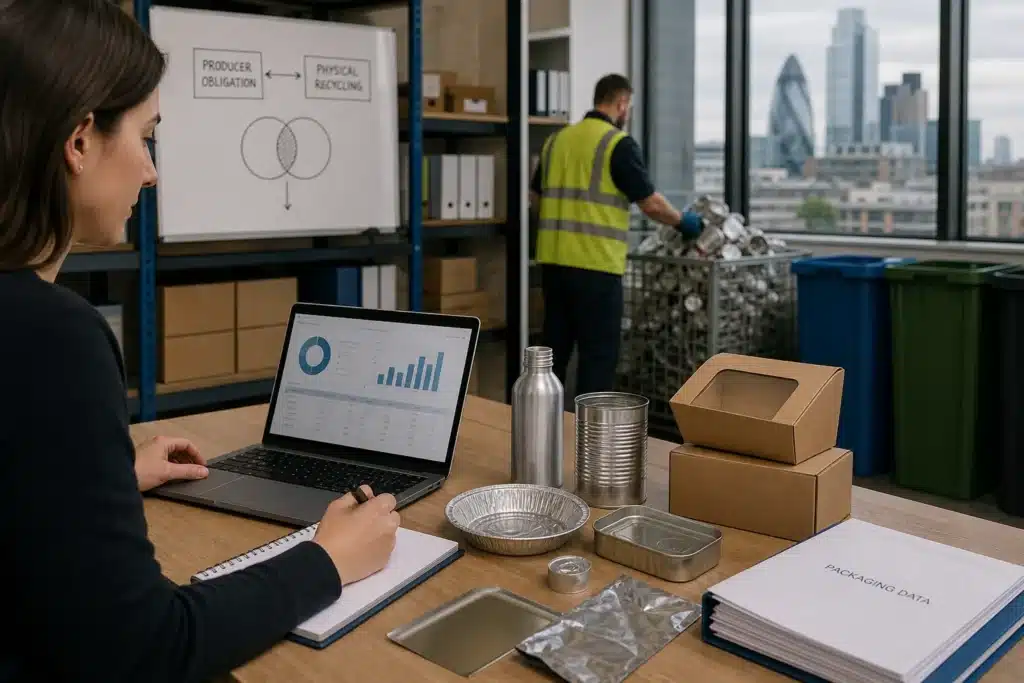
The first useful distinction is between a producer obligation and physical recycling. A producer may have duties because of its role in a supply chain and the packaging it handles. A site may also have practical waste-management duties when it accumulates empty cans, foil, steel tins, metal closures, trays or other discarded materials. The two matters can overlap, but one does not automatically prove the other.
Premier Scrap Trading Ltd provides scrap metal collection in London and can discuss the practical suitability of a metal load, access and preparation. It does not claim to provide Packaging EPR compliance services, make regulatory submissions or issue PRNs or PERNs. A collection should therefore be treated as a material-management activity, not as automatic proof that a packaging obligation has been met.
This distinction is particularly important on busy sites. A restaurant may accumulate aluminium cans and foil alongside food-contaminated waste. A contractor may have steel packaging from deliveries alongside structural offcuts and stripped-out metal. A managed building may contain packaging waste generated by occupiers as well as maintenance scrap generated by contractors. Clear records and separate material streams help each party understand what it is dealing with.
It is also useful to separate operational questions from compliance questions. A site manager may need to know whether a load is accessible, reasonably sorted and suitable for collection. A director, finance team or compliance adviser may need to establish whether the business is a producer, what data is required and whether evidence is needed. Treating these as different questions helps prevent an ordinary collection record from being given a regulatory meaning it does not have.
Who may have Packaging EPR responsibilities?
Do not assume that a business is outside Packaging EPR 2026 because it is small, rents its premises or sends waste to a third party. Whether an organisation has responsibilities depends on its role, packaging activity, turnover and tonnage, as well as current classifications and thresholds. These details can change, so businesses should verify them against official guidance rather than relying on a general description.
Businesses likely to need an early review include manufacturers packing their own products, importers bringing packaged goods into the UK, online sellers, brand owners, wholesalers, retailers, drinks businesses and organisations that supply packaging to another party. Hospitality venues may also need to understand whether they are simply discarding packaging or have a role in supplying packaged products.
Landlords, facilities managers and construction firms should take particular care over who generated each material. Tenant waste, client waste, subcontractor waste and the organisation’s own packaging activities may not be identical. For example, a building manager arranging a clear-out may be dealing with discarded metal packaging from a communal area, while a contractor’s fabrication offcuts are non-packaging metal from works.
Keep a sensible audit trail. Record the source of packaging, the material type, quantities where applicable, the organisation’s role and the destination of material. This supports internal decision-making and makes it easier to answer questions from advisers, customers or regulators. It also reduces the temptation to use one vague description, such as mixed metal, for materials with different operational and regulatory implications.
Where several organisations share a site, assign responsibility for gathering information before reporting periods arrive. A retailer in a managed building, for example, may need its own packaging records even where a facilities provider arranges general waste collections. Conversely, a contractor removing material from a project should not assume that it can decide a client’s producer position from the material it sees on site.
The GOV.UK Packaging EPR collection page brings together current programme information. It was checked for this article on 3 August 2026. Use it as a starting point, then follow the guidance relevant to your business type and reporting position.
Aluminium and steel packaging targets and material-specific evidence
The published business recycling targets for 2026 are 62% for aluminium packaging and 81% for steel packaging. They are framework-level targets supporting Packaging EPR 2026. They should not be represented as a site-specific recycling guarantee, a fixed requirement for every bin, or a percentage that one business can demonstrate merely by arranging a collection.
Aluminium and steel are separate packaging material categories. That matters because the evidence system is material-specific. If an organisation needs PRNs or PERNs, evidence associated with aluminium cannot be used to meet an obligation for steel, and the reverse is also true. Sorting accurately at source can therefore be commercially and administratively helpful, even where a site is not itself responsible for obtaining evidence.
Aluminium packaging recycling obligations may be relevant to drinks cans, foil, trays, lids and closures, depending on the item and its role. Steel packaging may include food tins, aerosol containers, paint tins and other steel-based packaging. The exact classification of a particular item may require closer checking, especially for composite, contaminated, hazardous or unusually designed packaging.
Steel packaging recycling obligations should likewise be considered separately from general ferrous scrap. A steel delivery drum, a tin that held a product and a steel fabrication offcut may all be made from steel, but they can arise from different activities. Retaining a clear description of material at source is more useful than trying to reconstruct its origin after it has been mixed with general waste.
For practical purposes, teams do not need to turn every bin area into an administrative exercise. The aim is to make sensible distinctions where they can be made safely and consistently. A clearly labelled container for aluminium packaging, a separate container for steel packaging and a different area for maintenance or construction metal may provide better information than a single mixed load.
The official guidance on recycling obligations and waste disposal fees sets out the current targets, the role of evidence and the distinction between small and large organisations. It was updated on 7 April 2026 and checked for this article on 3 August 2026.
PRNs, PERNs and ordinary metal recycling are not the same thing
A Packaging Recovery Note, known as a PRN, and a Packaging Export Recovery Note, known as a PERN, are forms of evidence used within the packaging waste system. In plain terms, they relate to qualifying packaging waste recycling or export activity within a regulated evidence framework. They are not standard paperwork generated by every collection of metal waste.
Only accredited reprocessors and exporters, or an organisation that is itself accredited, can issue PRNs or PERNs. Large organisations that need evidence must obtain the appropriate material-specific PRNs or PERNs. A surplus for one packaging material cannot be used to cover an obligation for a different material.
This is why a collection of aluminium or steel scrap does not automatically satisfy reporting or evidence requirements. A collection record may still be valuable for operational records, site housekeeping and understanding where material went. However, it is not the same as a PRN or PERN, and it should not be presented to colleagues or customers as compliance evidence unless the relevant regulated process has been confirmed.
Accredited reprocessors and exporters have their own registration, waste-balance and reporting responsibilities. The GOV.UK guidance on recording and reporting packaging waste for reprocessors and exporters explains that accredited operators report monthly, while registered-only operators have quarterly reporting duties. Those obligations belong to the relevant operator category; they should not be assumed to apply to an ordinary business arranging a collection.
For site teams, the practical lesson is straightforward: identify the material accurately, retain appropriate internal records and ask the right question of the right party. Ask a collector whether material is suitable for collection. Ask a compliance specialist or consult the official guidance when determining whether your organisation has a reporting or evidence duty. Keeping those conversations separate avoids costly misunderstandings.
Reporting dates, published fees and what to check for 2026
Reporting frequency depends on an organisation’s classification. According to current GOV.UK guidance, large producers normally report packaging data every six months: by 1 October for data from January to June, and by 1 April for data from July to December. Small producers normally report yearly by 1 April. Confirm that your organisation is in the applicable category before treating these dates as your own deadline.
The packaging data reporting periods and deadlines guidance was updated on 16 December 2025 and checked on 3 August 2026. Put reporting dates into a compliance calendar, but also allow time beforehand to validate supplier information, material classifications and internal ownership of the submission.
Businesses may see published figures of £266 per tonne for aluminium and £259 per tonne for steel. These are explicitly described in official guidance as 2025 to 2026 year-one base fees, based on packaging placed on the market in 2024. They must not be treated as confirmed fees for packaging placed on the market in 2026, a current price for scrap, or a quote for an individual London business.
For budgeting, use the latest official position at the time of the decision. For physical metal, values can also vary by grade, contamination, preparation, weight and current market demand. A packaging fee and a scrap-metal value are different figures serving different purposes. Keeping them separate makes it easier for purchasing, operations and finance teams to discuss the right cost or value.
| Activity | What it involves | Key practical point |
|---|---|---|
| Producer data reporting | Packaging information submitted by an organisation within the relevant category. | Check classification, reporting period and deadline on GOV.UK. |
| PRN or PERN evidence | Material-specific recycling or export evidence in the packaging system. | Large producers may need it; aluminium and steel evidence are not interchangeable. |
| Accredited reprocessor or exporter activity | Regulated recycling or export operations with distinct reporting duties. | Accreditation is required to issue PRNs or PERNs. |
| Ordinary metal collection | Physical removal and recycling of suitable metal material. | Useful operationally, but does not automatically create Packaging EPR evidence. |
How to separate aluminium and steel packaging for collection
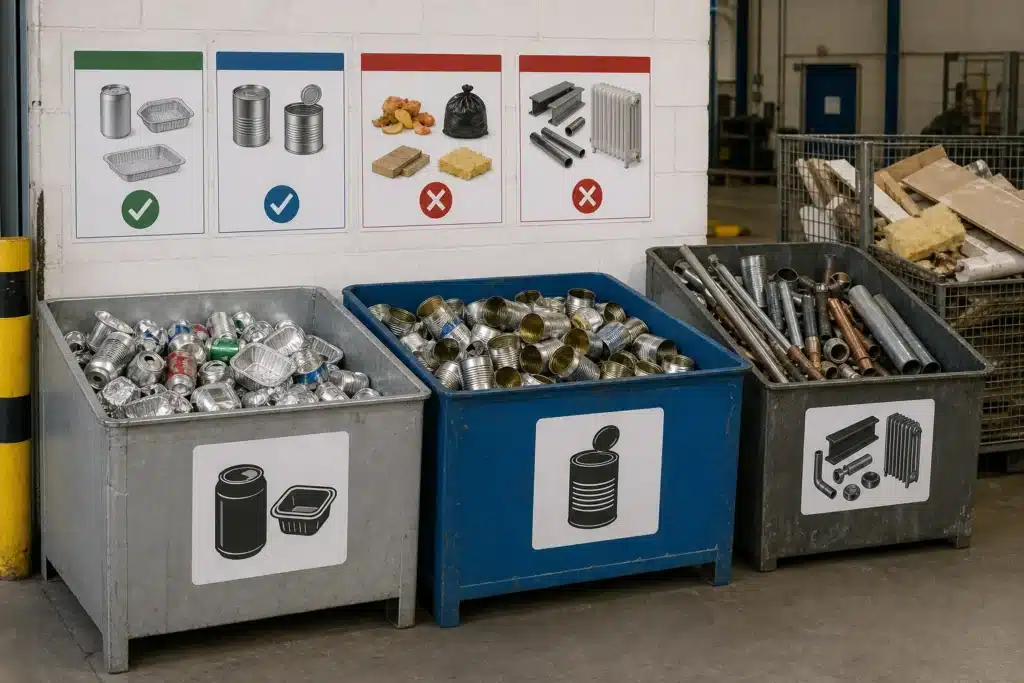
Good segregation begins where waste is generated. Where practical, keep clean and dry aluminium and steel packaging away from food waste, general rubbish, timber, plasterboard, insulation and other non-metal materials. This can reduce contamination and help a site describe what it has before arranging a collection.
Keep packaging metal separate from non-packaging scrap. Maintenance teams may produce cable, pipe, radiators, fittings, steel frames or fabrication offcuts. Construction and strip-out work can produce larger mixed loads. These materials may have different grades, handling needs and origins from empty packaging, even when they are made from the same broad family of metal.
Label containers or storage zones simply and visibly. For example, one area might be for clean aluminium packaging, another for steel packaging and a separate area for non-packaging metal. The right arrangement depends on volume, space, fire controls, manual handling and the materials involved. A small café will need a different setup from a warehouse or construction compound.
- Brief staff, cleaners and contractors on what belongs in each container.
- Remove obvious food residue and non-metal contamination where it is safe and practical.
- Keep sharp edges, loose tins and heavy items in a stable, accessible area.
- Do not crush, bale or dismantle items unless suitable equipment, procedures and competence are in place.
- Photograph unusual loads before booking so collection suitability can be discussed clearly.
- Ask for confirmation before including mixed, hazardous or unfamiliar materials.
Old washing machines and fridges must not be included in a proposed load for Premier Scrap Trading Ltd, as they are not accepted. This is one reason a quick description and photographs can prevent an unsuitable collection request. The same caution applies to anything containing unknown residues, pressurised components or mixed construction waste.
For metal packaging recycling London sites, good preparation is not about making a regulatory claim. It is about giving staff a manageable routine, reducing avoidable contamination and making material easier to assess. If material has resale value, this can only be confirmed after assessment; condition, grade, weight and market demand all matter.
Storage arrangements should also reflect the realities of the site. Do not create a separate stream that staff cannot reach safely or that blocks an escape route, loading bay or shared access area. A modest, well-understood system is often more useful than an elaborate one that is difficult to follow. Review the arrangement after a busy period and adjust labels or collection frequency if contamination is recurring.
Drinks containers: Packaging EPR in 2026 and the planned Deposit Return Scheme
Retailers, venues and drinks businesses should not confuse Packaging EPR 2026 with England’s planned Deposit Return Scheme. Packaging EPR is already a producer-responsibility framework. The Deposit Return Scheme is a separate, future arrangement with its own operational requirements.
In England, the Deposit Return Scheme is due to begin on 1 October 2027 for single-use aluminium and steel drinks containers from 150ml to 3 litres. It is therefore not operating as that scheme during 2026. Businesses should not redesign their 2026 collection arrangements on the assumption that deposits, returns or retailer duties are already in force.
The official Deposit Return Scheme producer and retailer guidance should be used for current details. It was updated on 30 January 2025 and checked on 3 August 2026. In the meantime, venues can still improve ordinary handling by keeping drinks containers as clean and dry as reasonably possible and by separating them from food-heavy waste.
For hospitality businesses, this is also a practical housekeeping issue. A simple routine for emptying, draining where appropriate and placing containers in the right stream can make storage more orderly. It does not determine a business’s Packaging EPR position, but it can make it easier to identify materials and discuss a load accurately.
A practical collection checklist for Greater London sites
Before arranging a collection, take a few minutes to define the load. This is useful whether you are clearing a back-of-house area, a workshop, a managed property or a construction site. It also helps avoid mixing suitable metal with unsuitable appliances or non-metal waste.
- Identify the material. Is it aluminium packaging, steel packaging, mixed metal scrap, or non-packaging metal from works or maintenance?
- Describe the condition. Note contamination, moisture, food residue, paint, attachments or mixed materials.
- Estimate the amount. A rough volume, number of bags, pallets or containers is helpful.
- Check access. Explain stairs, gates, loading restrictions, parking arrangements and whether material is already at ground level.
- Store safely. Keep the load stable, accessible and away from unnecessary handling risks.
- Confirm suitability. Share photographs where possible and ask about unusual items before they are included.
- Ask about current value. Eligible payment, where material has resale value, depends on assessment and current market conditions.
Premier Scrap Trading Ltd has provided mobile collection across Greater London since 2008 for householders, tradespeople, landlords, workshops, offices, shops, construction sites and commercial properties. Service coverage and operating arrangements were checked on 3 August 2026. For practical material information, see the company’s scrap recycling in London guidance, scrap metal price information and Greater London coverage page.
When a site has both packaging waste and metal from maintenance or construction, describe those streams separately when making contact. That does not replace the need to check compliance duties, but it gives the collection discussion a clearer starting point. It can also help a site plan safe storage and avoid booking a load that includes materials requiring separate handling.
Official sources
For compliance decisions, use current official information rather than a general recycling guide or a collector’s assessment.
The following sources support the regulatory points in this article:
- Extended producer responsibility for packaging: recycling obligations and waste disposal fees.
- Packaging data: check reporting periods and submission deadlines.
- Record and report packaging waste: reprocessors and exporters.
- Extended producer responsibility for packaging.
- Deposit Return Scheme: drinks producer and retailer responsibilities.
Book a collection
Packaging EPR 2026 does not turn ordinary metal collection into regulatory evidence, but careful sorting can make day-to-day recycling more orderly and help you describe a load accurately. Keep aluminium packaging, steel packaging and non-packaging scrap distinct where practical, then confirm any reporting or evidence duty through the latest GOV.UK guidance.
For scrap metal collection in London, call Premier Scrap Trading Ltd on 07931 361 034 or book a collection online to discuss your scrap metal, confirm what can be collected and ask for current prices.
Related guidance
Official sources
- Extended producer responsibility for packaging: recycling obligations and waste disposal fees
- Packaging data: check reporting periods and submission deadlines
- Record and report packaging waste: reprocessors and exporters
- Extended producer responsibility for packaging
- Deposit Return Scheme: drinks producer and retailer responsibilities
Frequently asked questions
What is Packaging EPR 2026?
Packaging EPR 2026 is part of the UK producer-responsibility framework for packaging, covering data reporting, recycling obligations and waste-disposal fees for relevant organisations.
What are the 2026 aluminium and steel packaging targets?
The published 2026 business recycling targets are 62% for aluminium packaging and 81% for steel packaging.
Does a scrap metal collection create a PRN or PERN?
No. A normal scrap collection does not automatically create a PRN or PERN, which can only be issued by an accredited reprocessor or exporter, or an organisation that is itself accredited.
Can aluminium evidence cover a steel packaging obligation?
No. Packaging evidence is material-specific, so aluminium evidence cannot be used to meet a steel obligation.
When do large producers report packaging data?
Large producers normally submit January-to-June data by 1 October and July-to-December data by 1 April, subject to confirming their current classification.
Are published aluminium and steel base fees confirmed for 2026 packaging?
No. The published £266 aluminium and £259 steel figures are described as 2025 to 2026 year-one base fees based on 2024 packaging placed on the market.
When will England’s Deposit Return Scheme begin?
England’s Deposit Return Scheme is due to begin on 1 October 2027 for single-use aluminium and steel drinks containers from 150ml to 3 litres.
Can Premier Scrap Trading Ltd collect old washing machines or fridges?
No. Premier Scrap Trading Ltd does not accept old washing machines or fridges.