What the announcement changes for scrap holders
The Northfleet copper sampling plant prepares copper-bearing waste for chemical analysis and subsequent processing and refining; it is not a new full-scale copper refinery. Its opening does not establish higher prices, public drop-off access or a new destination for your copper scrap collection. For households and businesses, the practical priority remains confirming what a collector accepts and how the material will be assessed.
What does the Northfleet copper sampling plant mean for scrap holders?
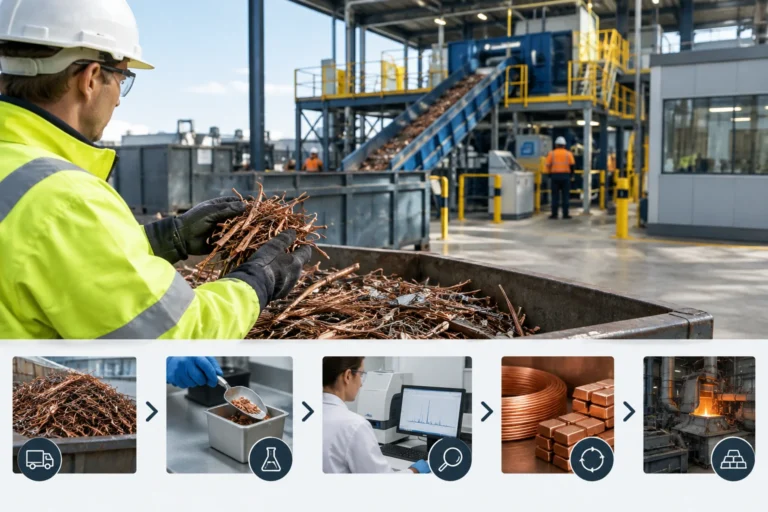
Britannia Refined Metals, part of Glencore, opened the £41 million facility on 17 October 2025, according to trade reporting on the Northfleet opening. This is an explanation of that investment, not an announcement of a newly opened plant in October 2026. The information about the industrial development was reviewed on 15 October 2026.
The important distinction is between preparing waste for analysis and turning its metal content into a refined product. A sampling facility supports a recycling chain. Its stated function does not mean that every stage happens at the same site, or that members of the public can deliver material there.
That matters when a headline reaches someone clearing a workshop, managing a refurbishment or holding a small quantity of loose copper. A large industrial investment can sound like an immediate change to local collection options. The announcement alone does not establish such a change.
Instead, read the story as information about industrial recycling infrastructure. It tells us about a facility designed to assess copper-bearing material before further treatment. It does not provide a quotation for your pipes, confirm acceptance of your cables or describe the route your collector will use.
Those customer questions still need separate answers. You need to know whether your particular material is suitable, what information the collector needs and how any eligible payment is calculated. Keeping those questions separate from the plant announcement makes the news more useful and reduces the chance of making an unsupported assumption about your own scrap.
The opening date also provides important context. An announcement from October 2025 describes the development at that time. Without subsequent operating figures, it cannot establish how much material the facility has handled since opening or what commercial arrangements apply today.
Why sampling is different from collecting or refining copper
A recycling story can mention collection, preparation, sampling, processing and refining in a few lines. These words describe different functions. Treating them as interchangeable can give the wrong impression about what a facility actually does.
Glencore’s description of the Northfleet copper sampling plant identifies preparation for chemical analysis and subsequent processing and refining. Chemical analysis means examining the material’s composition. The announcement supports that role without establishing a complete production route for every batch.
For a scrap holder, collection is the familiar first interaction: discussing material and arranging its removal. Sampling answers a different question about what material contains. Refining concerns producing refined metal through later treatment. An agreement covering the first function is not evidence that the same business performs all the others.
| Stage | Main role | What that stage alone does not establish |
|---|---|---|
| Stage Collection | Main role Arrange the receipt or removal of suitable scrap. | What that stage alone does not establish The eventual processing destination or refined-metal output. |
| Stage Sampling and preparation | Main role Prepare copper-bearing material for analysis. | What that stage alone does not establish That the material has already become refined copper. |
| Stage Subsequent processing and refining | Main role Treat material further to recover and refine metal. | What that stage alone does not establish The route taken by any particular customer’s scrap. |
This table compares functions, not a verified itinerary. It should not be read as a promise that your material will pass through Northfleet, or through three separate businesses in that order. The available information does not identify a customer-specific chain.
The distinction also explains why a sampling plant can be relevant to copper recycling without being described as a copper refinery. Understanding material before further treatment serves a different purpose from producing the finished metal. Both belong to the broader recycling story, but they are not the same operation.
There is no need to speculate about particular machinery, laboratory techniques or recovery yields to understand this point. The operator’s description is clear: the facility prepares copper-bearing waste for analysis and later treatment.
When discussing a collection, concentrate on the service being offered to you. Ask how your material will be identified and weighed, and what records you will receive. If a processing destination matters to your organisation, raise that separately rather than treating a news report as confirmation.
For a broader explanation of the collection side, Premier Scrap Trading Ltd provides information about metal recycling in London. That service information should remain distinct from Glencore’s description of its industrial facility.
What the stated copper-bearing waste capacity actually measures
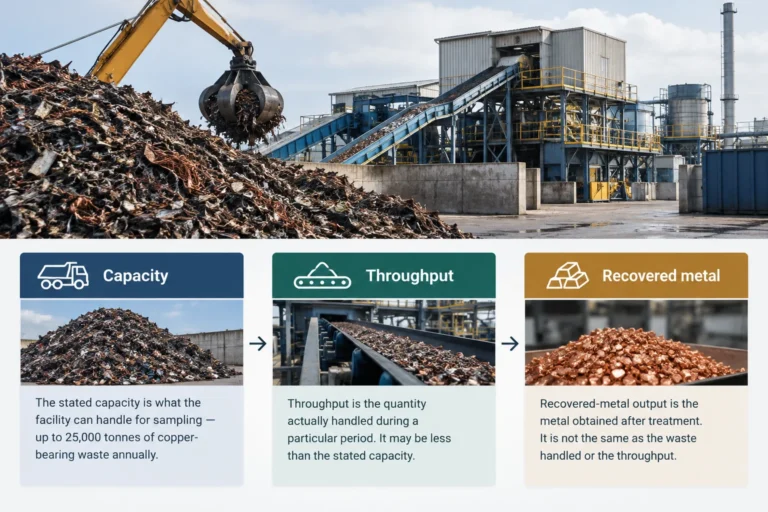
Glencore states that the facility can sample up to 25,000 tonnes of copper-bearing waste annually. The words surrounding the number matter as much as the number itself. This is a stated capacity for handling waste for sampling, not a reported weight of copper produced.
Three measures need to stay separate: capacity, actual throughput and recovered metal. Capacity describes what the facility is stated to be able to handle. Throughput means the quantity actually handled during a particular period. Recovered-metal output concerns the metal obtained after treatment.
The opening announcement supplies the first measure. It does not establish that the plant subsequently handled its full stated capacity in a year. Nor does it turn that waste-handling figure into an annual copper production figure.
Material described as copper-bearing contains copper, but its full weight cannot simply be counted as copper. Other contents form part of the incoming material. The announcement does not provide a copper concentration or recovery percentage that would allow a reliable conversion into recovered-metal tonnage.
For the same reason, the figure cannot tell a London scrap holder how much of the incoming material comes from Greater London. It does not identify the share originating from households, construction work or any particular collector.
A useful way to read the announcement is to retain its wording: up to a stated annual quantity of copper-bearing waste for sampling. Removing “up to”, replacing waste with copper or presenting capacity as a completed annual result would each change the claim.
This is not a minor technical qualification. It prevents comparisons between unlike figures. A waste-handling capacity and a refined-copper output may both use tonnes, but they measure different things.
For practical collection decisions, the headline number therefore has limited direct use. It helps explain the scale envisaged for the industrial facility. It does not tell you whether your load is accepted, how much it weighs or what offer a collector will make. Those answers depend on your material and the arrangements agreed for it.
Industrial feedstock does not mean whole appliances are accepted
Glencore identified expected feedstocks including materials recovered from recycled appliances, electronic scrap and automotive wires. Feedstock means material entering an industrial process. These were announced expectations, not verified current proportions of the plant’s incoming material.
The wording “materials recovered from” is important. An industrial material stream derived from appliances is not interchangeable with an intact appliance awaiting removal from a home. The announcement does not establish that every appliance, electronic item or vehicle is suitable for delivery.
That distinction also applies to a separate collector’s acceptance policy. A business can collect certain metals without collecting every product that contains them. The presence of copper inside an object does not, by itself, make the complete object an accepted collection item.
Premier Scrap Trading Ltd lists copper and cables among its material categories. Its published material information, checked on 15 October 2026, also states that old washing machines and fridges are not accepted. The Northfleet story does not change those exclusions.
Do not dismantle an appliance to try to make it fit a collection category. If the item is outside the collector’s stated scope, ask about an appropriate alternative route. Keep the distinction between loose, suitable scrap metal and complete equipment clear when making an enquiry.
The same care is useful with electronic scrap and automotive wires. Mentioning those streams in an industrial announcement does not prove that a mobile collector accepts complete electronics, vehicles or every cable type. Different descriptions can refer to very different material presented in very different conditions.
When you are uncertain, describe the item as it actually stands. Say whether it is loose cable, a length of pipe, an intact product or a mixed container. Do not describe a complete object only by the metal you believe it contains.
Photographs can help explain that distinction if the collector requests them. Include the surrounding attachments or mixed contents rather than showing only the most valuable-looking part. The aim is an accurate acceptance decision, not a guess based on a partial description.
Above all, treat the plant’s expected industrial feedstock and your collector’s acceptance list as separate information. One explains the recycling development; the other determines whether a particular collection can go ahead. Confirm unusual, mixed or potentially hazardous contents before arranging removal.
Does the investment mean a better price for your copper?

The evidence does not demonstrate a price increase for London scrap holders. A £41 million investment is the reported cost of an industrial development. It is not a price offer for a household’s copper pipe or a contractor’s cable offcuts.
Likewise, sampling capacity does not establish additional demand for your particular batch. The announcement does not identify a local purchasing arrangement, a collection premium or a supply relationship with Premier Scrap Trading Ltd. None should be inferred from the plant’s location.
A useful price enquiry starts with the material itself. Describe what you have, its grade if genuinely known, its condition and the approximate quantity. If you do not know the grade, say so. An accurate description of uncertainty is more useful than a confident but incorrect label.
Keep these details available when asking for an indication:
- The type of loose metal or cable, including any uncertainty about identification.
- Visible attachments, mixed contents or other features affecting its condition.
- An approximate quantity, clearly distinguished from a measured weight.
- Whether you want an initial indication or confirmation for an agreed collection.
Prices move with grade, condition, weight and current market demand. An initial discussion therefore needs to be distinguished from confirmation based on the material actually presented and weighed. Neither the Northfleet investment nor an online headline removes that distinction.
Premier Scrap Trading Ltd’s scrap metal price information, checked on 15 October 2026, describes weighing and bank-transfer payment for eligible materials. This article does not quote a numerical rate because a figure without a specific material and applicable date could mislead.
Not every item necessarily has resale value. Avoid planning a clearance around an assumed return before the collector has enough information to assess the load. Ask how any mixed material will be considered and how the eventual weight relates to the offer discussed.
For a business comparing collection arrangements, consistency matters more than the size of an industrial headline. Give each prospective collector the same accurate material description and access information. Otherwise, apparent differences may reflect different assumptions about the load rather than directly comparable offers.
A description can also become outdated if more material is added before collection. Tell the collector about a changed load, rather than assuming an earlier indication covers it. This is particularly useful when several trades or occupants contribute to the same clearance.
The useful conclusion is modest: the plant announcement explains infrastructure, while your collector assesses your material. Keep those two conversations separate when budgeting for a clearance or deciding whether an indicative offer meets your needs.
Prepare copper and cable for a collection enquiry
Consider a property manager arranging a refurbishment clearance in Westminster. Loose copper pipe and cable offcuts may be left alongside other materials. The practical task is to establish what can be collected and how to describe it, not to choose an industrial destination based on the Northfleet announcement.
This is a Greater London preparation example, not evidence that the investment has changed local prices or collection availability. A clear enquiry helps the collector understand the load and reduces avoidable uncertainty before arrangements are agreed.
- Identify the material as accurately as possible. Describe loose pipe, cable or other metal in ordinary language. Give a grade only if you know it, and explain when identification is uncertain.
- Separate already-loose materials where safe. Keep readily distinguishable copper, cables and other metals apart if this can be done without dismantling equipment or disturbing installed services. Leave uncertain items for discussion.
- Record approximate quantities and access constraints. Explain how much material there appears to be and where it is stored. Mention stairs, restricted access or arrangements needed to reach the collection point.
- Send the details and confirm acceptance. Ask whether the particular materials are suitable, how they should be presented and what further information is needed before a collection is arranged.
These steps concern describing and organising material that is already available for removal. They are not instructions to remove installed wiring, open appliances or handle hazardous contents. If preparation would require unfamiliar or potentially dangerous work, stop and discuss the situation rather than improvising.
Uncertainty is worth mentioning early. A pile may contain several metals, cable may remain attached to equipment, or a container may include unrelated waste. Calling everything copper can conceal information the collector needs. A straightforward account is more helpful than attempting to make the load sound simpler.
Approximate quantities should remain clearly labelled as estimates. A visual impression, a count of lengths and a weighed quantity are not interchangeable. If no weight is available, give the description you can support and ask what the collector needs next.
Access deserves equal attention. The material itself may be suitable while its location requires discussion. Explain the route from storage to the proposed collection point, and identify any building-management arrangements relevant to that route. Do not assume that a collection enquiry automatically confirms every practical detail.
For the refurbishment example, the person making the enquiry may not be the person meeting the collector. Share the agreed material description and access arrangements with whoever will be present. This helps prevent confusion between the load discussed beforehand and other items remaining at the property.
Before agreeing arrangements, ask how weighing works and how any eligible payment is handled. Confirm which details will appear on the printed receipt described in the service information. These questions concern the service you are arranging, rather than the separate industrial sampling process.
For general questions about collection preparation and arrangements, use the business’s published guidance alongside a discussion of your actual load. A general answer cannot settle every unusual item or site constraint.
For anyone arranging scrap metal collection in London, this preparation is more actionable than the plant’s capacity figure. It gives the collector relevant information without assuming acceptance, a premium for sorting or a Northfleet destination.
Confirm your copper scrap collection arrangements
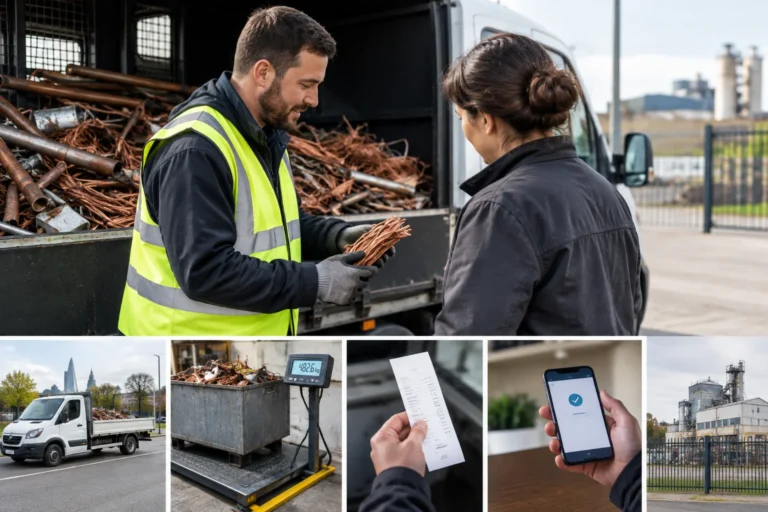
Premier Scrap Trading Ltd is a family-run business established in 2008. Its service information, checked on 15 October 2026, describes free mobile collection across Greater London, on-site weighing, a printed receipt and bank-transfer payment where material has resale value. Availability and suitability still need confirmation for your enquiry.
Free collection and eligible payment describe different parts of the service. Confirm that the particular load fits the service before making arrangements, especially where mixed contents or unusual items need assessment.
The business’s role in your collection agreement should not be confused with Britannia Refined Metals’ industrial operations. No supply relationship between the businesses is established here. There is also no promise that material collected from you will enter the Northfleet copper sampling plant.
When discussing a booking, resolve any remaining questions about the specific load rather than relying on a broad category name. Copper and cables appear among the listed materials, but an unusual attachment, mixed contents or an intact product can require a more precise acceptance decision.
Collection timing also needs direct agreement. A news report about recycling infrastructure cannot confirm a slot, and a general service description does not settle access arrangements for a particular property. Make sure both sides understand the material and the practical circumstances before treating the collection as arranged.
If your enquiry includes value, ask for current information applicable to the material described. Keep any initial indication separate from the assessment of what is actually presented and weighed. This helps avoid treating an estimate as a fixed return.
The central lesson is straightforward. Northfleet’s investment concerns sampling copper-bearing waste before further processing and refining. Your collection concerns suitable material, clear identification, access, weighing and agreed payment arrangements. Understanding the first does not replace confirming the second.
Call Premier Scrap Trading Ltd on +44 7931 361 034 or book a collection online to discuss your scrap metal, confirm what can be collected and ask for current prices.
Useful collection information
Questions about Northfleet and copper collection
When did the Northfleet copper sampling plant open?
Trade reporting records the opening on 17 October 2025. Britannia Refined Metals, part of Glencore, invested £41 million in the facility.
Does the Northfleet facility produce 25,000 tonnes of copper annually?
No. Glencore describes capacity to sample up to 25,000 tonnes of copper-bearing waste annually. That is not recovered copper output or verified actual annual throughput.
Can householders take scrap directly to the plant?
The opening announcement does not establish public drop-off access. Do not travel to the facility without confirming its arrangements directly.
Does Premier Scrap Trading Ltd send copper to Northfleet?
The information supporting this article does not establish a supply relationship. A collection agreement alone does not identify the material’s subsequent processing destination.
Will sorting copper guarantee a higher offer?
No. Separating suitable, already-loose materials can help identification, but any offer depends on the material, grade, condition, weight and current market conditions.
Are old washing machines and fridges accepted?
Premier Scrap Trading Ltd’s material information, checked on 15 October 2026, excludes old washing machines and fridges. Industrial feedstock recovered from appliances does not change that policy.
What if I cannot identify my copper or cable?
Describe the loose material accurately and provide clear photographs if requested. Ask the collector to confirm suitability rather than guessing its grade or dismantling equipment.
How are eligible scrap payments recorded?
Premier Scrap Trading Ltd’s service information, checked on 15 October 2026, describes on-site weighing, a printed receipt and bank-transfer payment where material has resale value. Confirm the arrangements for your load before collection.