A recovery licence, not a collection service
Gold and copper recovery from e-waste is the subject of an Edinburgh technology licence, not a newly announced collection service. The University of Edinburgh has licensed a specialist metal recovery process to Lithium Universe, but the announcement does not establish an operating London facility. Households and businesses should still identify unwanted electronics separately and confirm an appropriate collection route before arranging a clear-out.
What gold and copper recovery from e-waste means
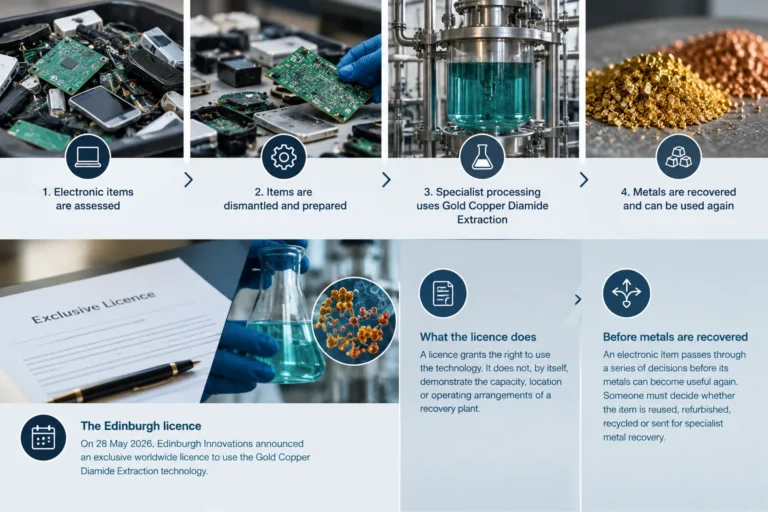
Edinburgh Innovations announced the exclusive worldwide licence on 28 May 2026. The technology is called Gold Copper Diamide Extraction. It concerns recovering metals from electronic waste through specialist processing, rather than collecting unwanted equipment from homes or workplaces.
The university’s licensing announcement is a dated development in commercialising research. It should not be read as a new announcement that a local treatment service is ready to receive equipment. Licensing grants rights to use technology; it does not, by itself, demonstrate the capacity, location or operating arrangements of a recovery plant.
That distinction matters because an electronic item passes through different decisions before its metals can become useful again. Someone must decide whether the item is waste, identify the appropriate collection route and ensure suitable treatment. A recovery method concerns one part of that wider chain.
The licence therefore answers a technology question: who has obtained commercial rights to the process? It does not answer the customer’s separate question: who will accept this particular item, under what conditions, and with what documentation?
Nor does it establish a change in the materials accepted by an existing scrap collector. A business that accepts loose copper cannot automatically be assumed to accept a computer containing copper. The form of the material remains important.
For readers considering a clear-out, the useful response is neither to ignore the development nor to change disposal arrangements on the strength of a headline. Understand what the licence covers, then make collection decisions using the actual equipment, the collector’s confirmed acceptance and the relevant waste requirements.
Gold Copper Diamide Extraction: how the process is described
Professors Jason Love and Carole Morrison developed the process in the University of Edinburgh’s School of Chemistry. Edinburgh Innovations supported its commercialisation. The university describes an approach intended to separate valuable metals selectively from electronic waste.
The broad technical term is hydrometallurgy. This means using liquid-based chemistry to separate and recover metals. It describes a family of processing approaches, not a single recipe, and it should not be confused with sorting loose metal into different collection piles.
According to the university, the process operates at low temperature and uses reusable organic compounds. It also describes selective recovery and the avoidance of cyanide, mercury and organic solvent extraction. These are attributed features of the reported process, not an independent assessment of an operating commercial facility.
Selective recovery matters because electronic waste is not a uniform metal product. A discarded device can contain different metals alongside other materials. Recovering a target metal involves more than recognising that it exists somewhere inside the equipment.
In this context, selectivity means distinguishing the metals the process aims to recover from the surrounding mixture. That is a different challenge from weighing a load of already separated copper. It helps explain why research into the separation stage can be relevant even when metal collection itself is well established.
Reusable compounds are another potentially important feature, but the word “reusable” does not tell readers how often a compound can be reused under commercial conditions. Likewise, “low temperature” does not establish the energy demand of every stage before and after recovery.
The announcement provides a basis for understanding the proposed direction of the technology. It does not justify adding recovery percentages, purity figures or treatment costs that have not been established here. Those measurements would be needed to compare actual operating performance.
Nothing in this description is a reason to attempt extraction at home or in a workshop. Specialist metal recovery requires appropriate facilities and controls. Customers do not need to dismantle equipment or separate its internal metals to ask which collection route is suitable.
The practical significance is therefore specific: Edinburgh has described a selective chemical separation approach with claimed processing advantages. Its performance in a particular commercial setting remains a separate question.
What the announcement does not yet establish
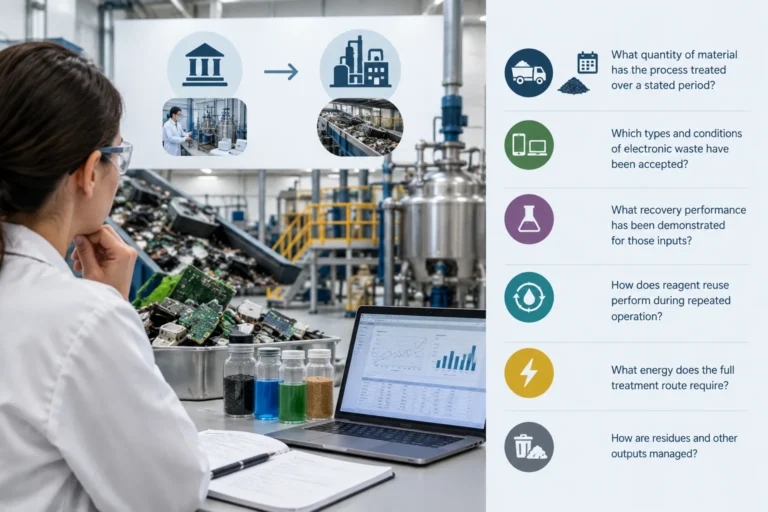
The university announcement describes planned integration into Lithium Universe’s Precious Metals Recycling Division. A plan to integrate technology is not the same as evidence that a commercial installation is operating at a stated scale.
When assessing later developments in gold and copper recovery from e-waste, useful questions include:
- What quantity of material has the process treated over a stated period?
- Which types and conditions of electronic waste have been accepted?
- What recovery performance has been demonstrated for those inputs?
- How does reagent reuse perform during repeated operation?
- What energy does the full treatment route require?
- How are residues and other outputs managed?
These are questions for evaluating evidence, not claims that the technology has failed any test. The licensing announcement does not settle them simply by describing the process or naming its commercial partner.
Environmental performance also needs a wider view than one processing stage. A claim about lower-temperature operation, for example, does not establish the effects of transport, preparation, separation and management of remaining materials. The boundary of any comparison matters.
For the same reason, avoiding particular substances should not be treated as proof that treatment has no environmental impact. The university’s stated advantages can be reported accurately without turning them into universal conclusions about every future installation.
Commercial readiness and local availability are separate matters too. A worldwide licence does not establish that a facility exists in Greater London, that a local collector supplies it, or that a customer can book that route.
There is no basis in this announcement to say that Premier Scrap Trading Ltd uses the Edinburgh process. Nor does it establish later commercial progress beyond the plans described. Keeping those limits clear makes the development useful news rather than an unsupported service promise.
Future announcements should therefore be read for their actual evidence: what was tested or commissioned, where it happened, and which operating results were reported.
Does better recovery mean higher scrap payments?
The licence announcement does not establish higher payments for customers. A promising recovery method and the price offered for a particular load are connected only if actual treatment and purchasing arrangements make that connection.
Three different ideas often become mixed together. The first is the metal contained within an item. The second is the amount that a suitable treatment process can recover. The third is the amount a collector may offer for an eligible load. They are not interchangeable measures.
A complete electronic device is not automatically priced as though its entire weight were clean copper. Its overall weight includes whatever else forms the device. Even knowing that gold or copper is present does not establish a payable amount for the whole item.
For accepted scrap metals, grade, condition, weight and current demand remain relevant to value. Material identification matters because two loads that look broadly similar may not have the same composition or preparation requirements. A photograph can help an enquiry, but it does not replace confirmation of the actual material.
The company’s scrap metal price information is a more relevant starting point for an eligible collection enquiry than a technology headline. Ask for current terms for the material you have, rather than applying a reported research benefit to an unrelated load.
No price is quoted here because the licence announcement does not provide a verified customer price change. It also does not establish that every electronic item has resale value or that a collector will accept it.
A future commercial process might influence treatment economics, but demonstrating that would require evidence about actual operations and purchasing arrangements. It would still not mean that every customer receives the same benefit.
The sensible question is therefore specific: what can the intended collector accept, how will that load be assessed, and what terms apply at the time? Keep the collection decision separate from assumptions about the value of metals inside equipment.
Electronic equipment and loose scrap need different checks
Recognising metal inside an electrical item does not establish that the whole item belongs in an ordinary scrap collection. The accepted category needs to match what is being handed over, not merely one material contained within it.
Loose copper, cables, complete computers, phones and circuit boards are different descriptions. Acceptance of the first two does not establish acceptance of the others. If an item remains complete, describe it that way rather than calling it copper scrap.
Premier Scrap Trading Ltd’s published collection information, checked on 15 October 2026, lists copper, cables and other scrap metals. That does not establish a general electronics collection service. Electronic equipment and uncertain mixed-material items need a separate acceptance decision.
Old washing machines and fridges are not accepted. Do not include them in a proposed load on the assumption that their metal content makes them suitable. Ask about any other unusual item before arranging movement or collection.
Collection and treatment also serve different purposes. A collector’s role in taking an accepted load does not prove which recovery technology will eventually be used. The Edinburgh announcement concerns specialist treatment, not a universal route for everything containing metal.
The company’s explanation of scrap recycling in London provides broader context for metal recycling. For a specific electronic item, however, confirmation of acceptance remains essential; a general recycling description cannot settle an individual enquiry.
This distinction helps avoid two common mistakes: combining uncertain electronics with confirmed scrap, and dismantling equipment in an attempt to make it fit an accepted category. Neither is necessary for the initial conversation.
A clear description preserves the information the collector needs. Where the proposed service is unsuitable, establish another appropriate route rather than assuming that the presence of recoverable gold or copper overrides the collection requirements.
How to plan a clear-out without assuming everything is scrap
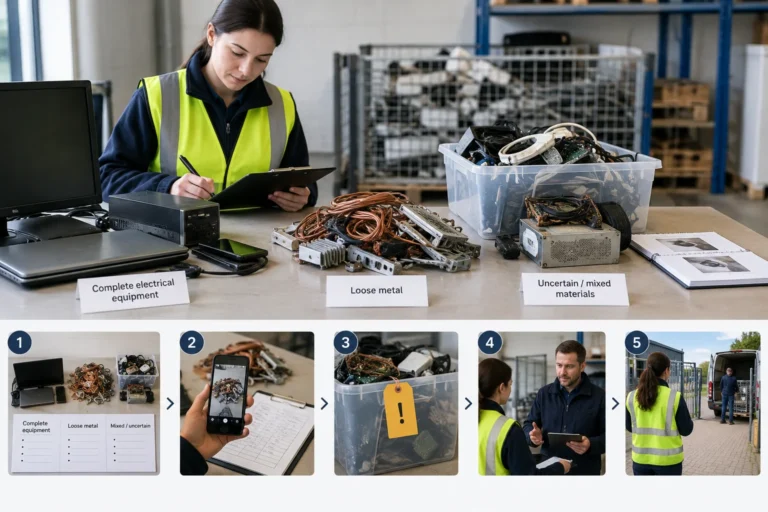
A useful clear-out starts with information, not dismantling. The aim is to make the proposed load understandable before anyone agrees to collect it. The following five steps help separate straightforward metal enquiries from items requiring further assessment.
- Make an inventory separating complete electrical equipment, loose metal and uncertain mixed-material items.
- Record useful descriptions, approximate quantities and photographs where safe, including whether equipment remains complete.
- Flag items needing a separate acceptance decision. Do not dismantle equipment, remove batteries or attempt metal extraction.
- Ask the intended collector which categories can be accepted and which need another appropriate route before moving or combining loads.
- Agree access and handover arrangements after acceptance has been confirmed, without assuming a guaranteed collection time.
For an office clear-out in Brent, this could mean identifying redundant electronic equipment separately from loose metal left by maintenance work. The location makes the planning example relevant to Greater London; it does not indicate local deployment of Edinburgh’s technology.
The inventory need not be complicated. Its purpose is to prevent a description such as “mixed office scrap” from concealing several different material categories. Approximate quantities are useful for discussion, but should not be presented as measured weights unless they have actually been measured.
Photographs should show the items as they stand, where it is safe to take them. There is no need to open equipment or expose internal parts for a basic collection enquiry. If a label or model description is readily visible, it may help explain what the item is.
Keep uncertainty visible rather than guessing. An honest description such as “complete electrical equipment, acceptance not yet confirmed” is more useful than assigning it to a metal category because part of its casing looks familiar.
Acceptance should come before combining loads. If some materials need another route, discovering that while everything remains identifiable makes planning clearer. It also avoids treating an initial enquiry as approval for every item on the premises.
Access information should describe practical conditions, not just give an address. Explain where the accepted material is located and whether the proposed handover involves stairs, restricted access or other constraints. Discuss arrangements rather than assuming the collector can manage any situation.
The company’s collection enquiry details provide a way to discuss the inventory and practical arrangements. Make clear which materials you want assessed, rather than relying on a general description of the premises.
For businesses, this planning sequence sits alongside waste responsibilities. An agreed collection is not a substitute for classification, carrier checks or records. Those decisions need attention before the load leaves the premises.
The result should be a confirmed plan for identified materials, with unresolved items kept out of the agreed load. That is more useful than trying to recover metals yourself or treating the technology announcement as permission to combine everything.
Business waste checks before anything leaves the premises
This section applies to businesses. It should not be read as a statement that every business-waste requirement applies identically to householders. The following points reflect official guidance checked on 15 October 2026; check the current guidance before arranging a transfer.
GOV.UK’s business waste guidance explains responsibilities including safe storage, checking the waste carrier’s registration and completing a waste transfer note for each departing load. Hazardous waste carries additional responsibilities, so an ordinary transfer note should not be assumed to resolve every case.
Before handover, check these distinct points:
- The waste has been identified and classified appropriately.
- Storage arrangements keep the waste safe before collection.
- The intended carrier’s registration has been checked.
- The required transfer records are ready for the load.
- Any hazardous-waste requirements have been addressed.
Electrical equipment needs particular attention when it becomes waste electrical and electronic equipment, usually shortened to WEEE. The term describes the waste category; it does not tell you that every item has the same classification or can use the same treatment route.
The Environment Agency’s guidance on when electrical equipment becomes WEEE explains the need for correct classification and waste controls. Businesses must also assess relevant hazardous properties and persistent organic pollutants. These are substances that remain in the environment for long periods.
Do not guess those characteristics from an item’s appearance or from its visible metal content. Where classification or the appropriate route is uncertain, seek suitable advice. An item can contain useful metal while still needing controls that a simple description such as “metal scrap” fails to capture.
Carrier registration and acceptance answer different questions. Registration checks concern who handles the waste; acceptance confirms whether the proposed service is suitable for the described load. Neither should be used as a substitute for the other.
Businesses should carry out the relevant current registration and authorisation checks for their chosen provider. A company name, collection advertisement or recycling article is not a substitute for verifying that the proposed arrangements are suitable for the waste concerned.
A collection receipt also serves a different purpose from the waste records required for a transfer. Do not assume that a record of weighing or payment contains everything needed for business-waste compliance. Confirm which documents apply to the classified load before handover.
The practical objective is an appropriate transfer with accurate information and the necessary records, not merely removal from the premises.
What to confirm when arranging scrap metal collection in London
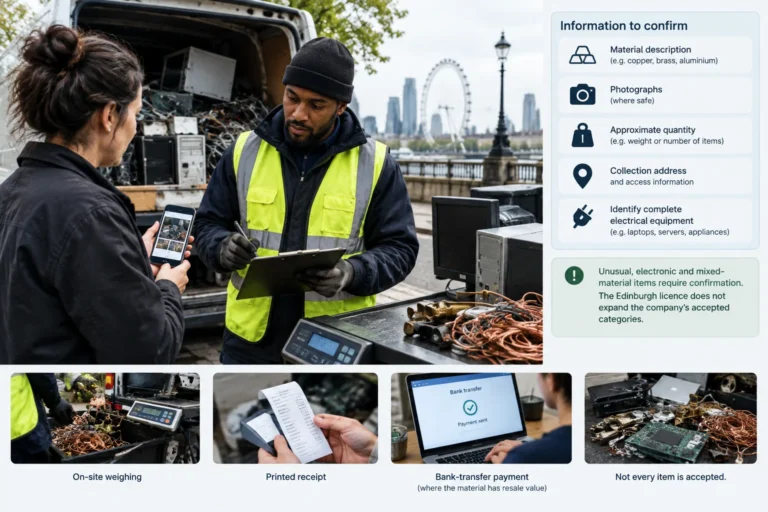
Premier Scrap Trading Ltd provides scrap metal collection in London through a mobile service across Greater London, according to company information checked on 15 October 2026. Unusual, electronic and mixed-material items require confirmation; the Edinburgh licence does not expand the company’s accepted categories.
A useful enquiry includes the material description, photographs where safe, approximate quantity, collection address and access information. Identify complete electrical equipment explicitly. That gives the company a basis for discussing acceptance without assuming that all the contents of a clear-out belong in one collection.
The stated service arrangements include on-site weighing, a printed receipt and bank-transfer payment where the material has resale value. Not every item or load qualifies for payment. Confirm acceptance and current terms before treating an enquiry as an agreed collection.
If the proposed load changes after that discussion, explain the additions before handover. Approval for identified copper or cables should not be treated as approval for electrical equipment added later. Keeping the description current helps preserve the distinction between accepted scrap and materials needing another route.
Gold and copper recovery from e-waste is a useful example of research moving towards commercial application. Its immediate lesson for customers is more modest: collection, classification and specialist treatment are different stages, and each needs the right information.
There is no need to extract metals yourself or assume every electronic item can be collected. Start with an accurate description and confirm the appropriate route.
Call +44 7931 361 034 to discuss your scrap metal, confirm what can be collected and ask for current prices.
Related collection information
Sources and further reading
- Edinburgh Innovations: University licenses e-waste gold and copper recovery technology
- GOV.UK: Dispose of business or commercial waste
- Environment Agency: When electrical and electronic equipment becomes WEEE
- Premier Scrap Trading Ltd: Collection information and exclusions
- Premier Scrap Trading Ltd: Scrap metal prices
Questions about the licence and collection
Who licensed Edinburgh’s gold and copper recovery technology?
The University of Edinburgh licensed its Gold Copper Diamide Extraction process to Lithium Universe under an exclusive worldwide licence announced on 28 May 2026.
Does the Edinburgh licence establish an operating recovery facility in London?
No. The announcement describes planned integration into Lithium Universe’s Precious Metals Recycling Division. It does not establish an operating London facility.
What does hydrometallurgy mean?
Hydrometallurgy uses liquid-based chemistry to separate and recover metals. It is a specialist processing activity, not a method for household metal extraction.
Will this technology increase the payment for my scrap?
The announcement does not establish higher customer payments. An eligible load’s value depends on its material, grade, condition, weight and current purchasing terms.
Can computers and circuit boards be booked as ordinary scrap metal?
Do not assume that they can. Confirm complete electronic equipment and circuit boards separately, because acceptance of copper or cables does not establish acceptance of electronics.
Should I dismantle electronics before asking about collection?
No. Describe the equipment as it stands and provide photographs where safe. Do not dismantle it, remove batteries or attempt extraction to prepare a collection enquiry.
Does Premier Scrap Trading Ltd accept old washing machines and fridges?
No. The company’s collection information, checked on 15 October 2026, excludes old washing machines and fridges. Confirm other unusual, electronic or mixed-material items before arranging collection.
What should a business check before transferring unwanted electronics?
A business should confirm acceptance, classify the waste correctly, check the carrier’s registration and arrange the required records. Official guidance checked on 15 October 2026 also requires appropriate assessment of hazardous properties and persistent organic pollutants.