


Keep surplus secure and ownership clear
To reduce your exposure to copper cable theft, keep legitimately owned surplus secure, clarify cable ownership and leave installed or unidentified equipment alone. If you suspect theft or damage, prioritise safety and use official reporting routes. When recycling scrap cable, agree the collection beforehand and keep clear weighing and payment records.
These precautions help householders, tradespeople and property managers separate three tasks: protecting their materials, responding to suspicious activity and arranging legitimate recycling. None requires approaching network equipment or investigating a suspected offence yourself.
Copper cable theft: what the evidence actually shows
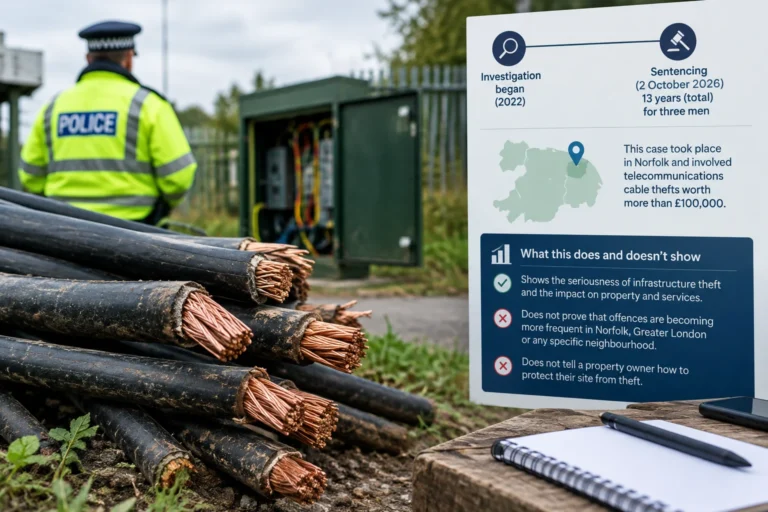
A reported theft can demonstrate serious harm without proving that offences are becoming more frequent. To establish an increase, you need comparable figures for a defined place and period. A headline, one prosecution or several accounts of disruption cannot establish that trend alone.
On 2 October 2026, Norfolk Police reported sentences totalling 13 years for three men following telecommunications cable thefts worth more than £100,000. The investigation began in 2022. That distinction matters: a recent sentencing date does not mean the offences formed a newly committed series.
The case illustrates the seriousness of infrastructure theft. It does not, by itself, establish a current increase across Norfolk, Greater London or any individual neighbourhood. Nor does it tell a property owner how likely their stored cable is to be targeted.
The practical response does not depend on claiming an increase. Loose surplus can be stored more carefully, responsibility for releasing it can be clarified, and legitimate transactions can leave a useful paper trail. These are proportionate precautions rather than promises that theft will be prevented.
When reading a report, distinguish the publication date from the dates of the offences. Also check whether a figure describes incidents, stolen material, affected customers or convictions. Those measures answer different questions and cannot simply be substituted for one another.
For readers, the most useful question is therefore not whether every alarming headline describes a new trend. It is whether your materials are secure, their ownership is understood and everyone involved knows what to do if something goes missing.
Why copper attracts thieves and why damage goes beyond its value
Openreach identifies copper’s monetary value as a reason its cables attract thieves. Copper can have value as a recyclable metal, but that does not make installed cable an available resource. Removing it can damage working infrastructure and interrupt services used by people beyond the immediate location.
In its announcement dated 21 May 2026, Openreach reported widespread disruption from copper theft. It said more than 100,000 people across the UK had experienced landline or broadband disruption since April 2024, with 153 kilometres of cable stolen. These are attributed operator figures, not measurements of theft in London.
The distinction between metal value and wider damage is important. A cable’s potential scrap value says little about the consequences of losing the connection it provides. A business may depend on that connection for everyday work. A household may depend on it for communication. Repairing the network is separate from replacing the stolen metal.
These consequences also explain why apparently redundant equipment should not be treated casually. A cable can look old, untidy or unused without being available for removal. A service change elsewhere does not establish who owns a particular length or whether it remains connected.
For legitimately owned scrap cable, valuation is a different question. The type of material, recoverable metal content, insulation, condition and quantity affect the assessment. Market conditions also change. A headline copper price is not automatically the price payable for a mixed load of insulated cable.
Use scrap metal price information as a starting point for an enquiry, not a fixed promise. Describe what you actually hold and ask how it will be assessed. There is no basis here for claiming that every cable has resale value.
Equally, copper’s value does not establish that a particular price movement caused a particular offence. The evidence supports a financial incentive and documented disruption, not a forecast of crime at your property.
Protect stored cable without touching installed equipment
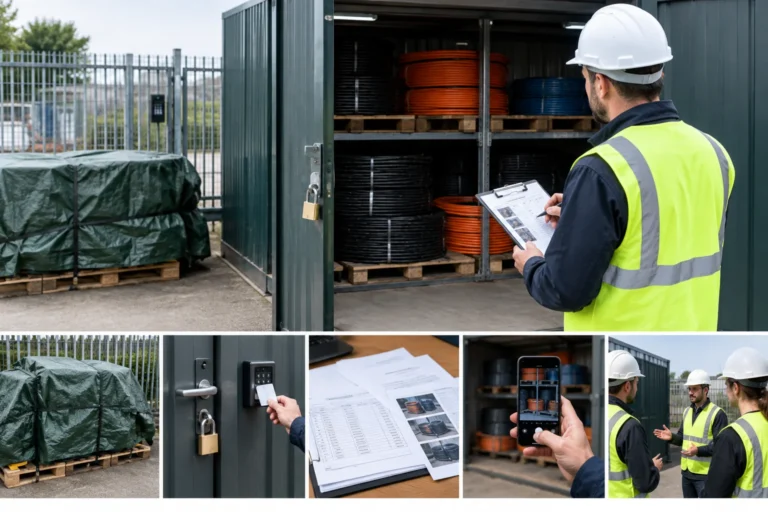
Start by separating loose materials you legitimately control from everything still installed or awaiting identification. Your own surplus stock can be managed as stock. Network equipment, unidentified cable and materials belonging to another contractor require a different response: leave them alone and clarify responsibility.
For stored cable, practical precautions should address visibility, access and accountability:
- Keep loose cable out of public view where a suitable secure storage space is available.
- Restrict access to the storage area and make responsibility for keys or entry clear.
- Retain purchase records, job references or other documents explaining where the cable came from.
- Keep a simple record of the material held, including photographs taken from a safe position.
- Agree who may authorise the release of cable for collection or recycling.
These measures work together. A locked storage area is less useful if nobody knows who may open it. A stock record is less useful if materials regularly move without anyone noting the change. The aim is an understandable arrangement, not unnecessary administration.
For a householder, this may mean keeping leftover renovation cable inside a suitable locked space rather than beside an accessible driveway. Ask the electrician which loose materials belong to you and which they intend to retain. Do not assume that everything left after a job is yours to sell.
A workshop may need clearer control over shared storage. Separate usable stock from material already designated for recycling. Otherwise, one person may release cable that another still needs for a job. Record who has authority to make that decision, particularly where several businesses share premises.
On a refurbishment site, responsibility can be divided between the property owner, principal contractor and individual trades. Clarify those arrangements before materials accumulate. A collection booking should identify the person entitled to release the load, rather than relying on whoever happens to be present.
Consider the period between sorting and collection as well. Moving scrap cable outside early may make loading easier, but it can also leave it exposed. Agree a practical handover arrangement that keeps the material secure without obstructing entrances, exits or shared routes.
If plans change, tell everyone responsible for the material. A postponed collection should not leave loose cable outside overnight because another person believes it has already gone. Update the storage record after an authorised handover so ordinary movements are not mistaken for unexplained losses.
Do not turn a security review into an inspection of installed cables. Never cut, strip, test or remove equipment to decide whether it is scrap. Openreach’s damage and safety information provides the appropriate route for concerns about its network.
Finally, avoid treating these precautions as a guarantee. They help you control legitimately owned materials and notice discrepancies. They do not justify confronting someone, entering restricted areas or taking risks to protect replaceable property.
What to do if cable theft or damage is suspected
Put personal safety ahead of identifying what has happened. Do not confront suspected offenders, follow them or approach damaged cable. Stay away from restricted infrastructure, open access points and unidentified equipment. You do not need to establish the cable’s condition yourself before raising a concern.
Separate what you observed from what you suspect. You may have seen people removing cable, discovered missing stored material or noticed damaged network equipment. Those observations are useful. A conclusion about ownership or whether work is authorised may require investigation by someone else.
Record details only when you can do so safely. The location, approximate time and a plain description of what you saw may help. Note whether the concern involves your own stored materials or equipment in a public or shared area. Do not move closer merely to obtain a photograph or vehicle detail.
For concerns involving its infrastructure, consult Openreach’s official cable theft reporting information. Follow the directions on that page rather than relying on an old screenshot or a contact number passed between neighbours. Suspected crime belongs with the police; network damage should also reach the relevant operator.
A service fault and suspected theft are not interchangeable descriptions. A connection may fail for reasons unrelated to crime. Conversely, visible theft or damage can require attention even if your own connection still works. Describe the evidence accurately rather than waiting for every part of the incident to become clear.
If your stored cable is missing, preserve the records you already hold. Purchase documents, stock notes and earlier photographs may help explain what was taken. Avoid disturbing a potentially relevant area unnecessarily, and follow the reporting authority’s instructions about further information.
A recycler is not a substitute for the police or network operator. Do not arrange a collection of questionable material simply to clear a space while ownership or an incident remains unresolved. Pause the recycling enquiry until the appropriate party has clarified what can happen next.
The same boundary applies after an incident appears to end. Cable left behind by unknown people does not become yours because they have gone. Keep your distance from unidentified material and report its location through the appropriate official route.
Check cable ownership before treating it as scrap
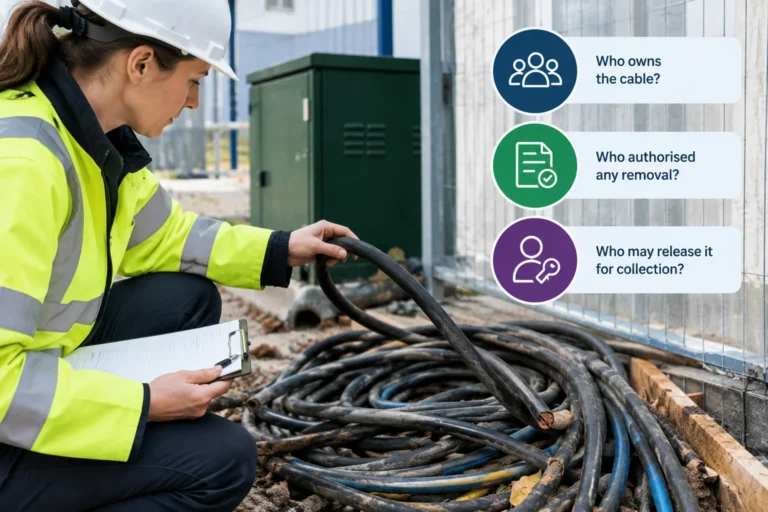
Cable ownership depends on entitlement, not appearance. A length that looks discarded may still belong to a network operator, contractor, customer or another occupier. Its presence on premises you own or manage does not automatically establish permission to remove or sell it.
Before arranging recycling, answer three practical questions: who owns the cable, who authorised any removal, and who may release it for collection? These questions are related, but they are not identical. Someone may have permission to carry out work without having authority to sell the resulting material.
For a landlord, the relevant agreement may involve the tenant or contractor who commissioned the work. For a tradesperson, the customer may retain ownership of removed materials. For a site manager, the contract may allocate responsibility differently between trades. Clarify the actual arrangement rather than assuming a standard answer.
Keep an appropriate record of that clarification. A purchase invoice, job reference, written instruction or confirmation from the entitled owner can help explain the material’s origin. The record should identify the relevant materials clearly enough to avoid confusion with other stock or equipment on the premises.
Where several loads have accumulated, avoid treating one person’s permission as authority over everything in storage. Establish which cable belongs to which job or owner. If only part has clear authorisation, keep the unresolved portion out of the collection arrangement until its status is established.
Openreach makes a specific distinction for its infrastructure. It says recovered waste cables follow controlled processing arrangements and are not offered directly to scrap dealers by its contractors. An explanation that cable came from network work should therefore prompt clarification, not an assumption that it is freely available.
Do not use apparently obsolete technology as a shortcut around ownership checks. Age, weathering, disconnection claims and a change in building use do not transfer ownership. Nor does the effort involved in collecting or storing material create permission to sell it.
If the origin remains uncertain, pause the arrangement. Ask the property owner, commissioning party or relevant operator to clarify responsibility. A legitimate collection can wait for that answer; uncertainty is not resolved by having the material weighed.
Finally, ownership evidence and identity verification serve different purposes. Documents showing who you are do not prove that every item you present belongs to you. Equally, a purchase record does not replace a dealer’s separate obligation to verify the supplier’s identity. Prepare for both questions where relevant.
Identity checks, dealer records and traceable payment
The legal guidance discussed here concerns England and Wales, including London. It should not be treated as a description of every UK jurisdiction. Before a transaction, consult the official guidance directly and confirm the applicable requirements with the dealer.
The Home Office supplementary guidance on scrap metal dealers describes requirements to verify suppliers’ full names and addresses. It also explains transaction records that dealers must retain for three years. This is a summary of that published guidance, not confirmation of a fresh legal review on 16 October 2026.
For purchases, the methods described in the guidance are electronic transfer or a non-transferable cheque. These provide traceable payment arrangements. Ask how an eligible payment would be made before collection, rather than assuming every collector follows the same operational process.
Confirm the dealer’s requirements for identity documents in advance. Do not rely on a general article to decide that one particular document will be sufficient. Asking beforehand helps avoid an unsuccessful handover when the materials, supplier and required records cannot be matched.
You can also consult the official scrap metal dealer register. Compare the business identity you are dealing with against the relevant entry. Where details are unclear, seek clarification rather than treating a familiar trading name or vehicle sign as verification.
A register search has limits. A listing does not establish ownership of the load, verify every statement made by a collector or prove every aspect of compliance. Keep the separate questions separate: business identity, relevant authorisation, material ownership and the transaction record.
Company practice should also be distinguished from legal requirements. Premier Scrap Trading Ltd’s published service information describes on-site weighing, a printed receipt and bank-transfer payment for eligible material. Confirm those arrangements directly before booking; this description does not establish a currently verified licence or guarantee that a particular load qualifies for payment.
Before handover, understand what the weighing and receipt will show. Ask questions if the material description, weight or payment explanation is unclear. Retain the receipt alongside ownership permission and relevant correspondence, so the transaction can be understood later without relying on memory.
For a business, make sure the person keeping the records receives the collection documents. The colleague arranging access may not handle accounts or stock records. Agreeing that handover beforehand helps keep the material description, weighing information and payment reference together.
Traceable payment does not mean a fixed value. Acceptance, grading and market conditions remain relevant. Neither identity checks nor a bank transfer turn unsuitable material into an accepted load or guarantee that every item attracts payment.
Prepare legitimate scrap cable for an agreed collection
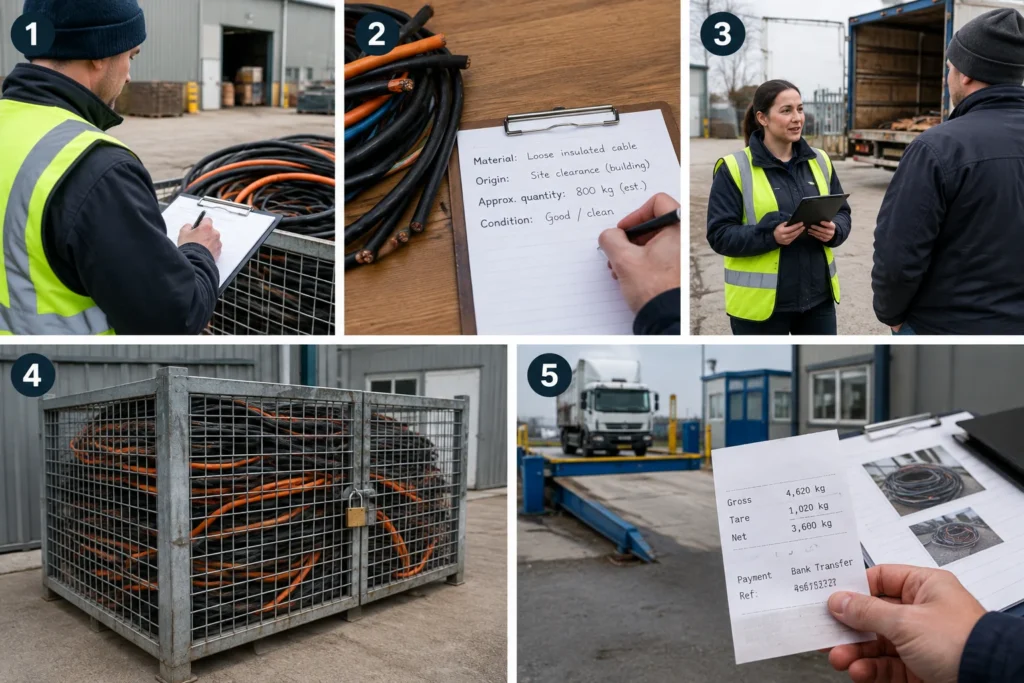
Once ownership and safe availability are clear, organise the collection around the material you actually hold. Follow these five steps:
- Confirm that you own the loose cable or have permission to release it, and that it is safely available.
- Describe the material, its origin, approximate quantity and condition.
- Confirm acceptance, access arrangements and any information needed for the handover.
- Keep the agreed material secure until collection takes place.
- Retain the weighing receipt, payment information and relevant ownership records.
Give a realistic description rather than trying to identify every metal yourself. Explain whether the load consists of loose insulated cable, mixed offcuts or other surplus. If photographs would help, take them only of safely accessible loose material. Do not uncover, disturb or approach installed equipment to improve an enquiry.
The company’s published acceptance information includes cables and excludes old washing machines and fridges. Confirm acceptance of your particular cable and any unusual or mixed materials before booking. A listed category does not guarantee acceptance or payment for every load. Do not add other items without checking their suitability.
Collection access matters as much as the material description. Explain where the cable is stored and whether access involves shared entrances, stairs or site controls. Agree who will be present and who may authorise release, particularly when the person enquiring will not attend.
For a refurbishment in Southwark or a workshop clear-out in Sutton, the practical Greater London takeaway is the same: keep legitimately owned surplus secured until an agreed collection. These are examples of reader circumstances, not evidence of local theft levels or confirmation of a particular collection address.
Read the company’s metal recycling information for context, alongside its business background. For a collection planned on or after 16 October 2026, confirm current acceptance, availability, weighing and payment arrangements directly rather than treating this article as a dated service verification.
If the material or access changes after booking, explain the difference before collection. A larger mixed load or different storage location may need fresh agreement. Keep the confirmed material identifiable so unrelated stock or another contractor’s cable is not released by mistake.
Responsible recycling begins before the vehicle arrives. Secure storage reduces unnecessary exposure, clear ownership avoids an improper handover, and good records explain what happened afterwards. Keep those safeguards even when the amount seems small or clearance feels urgent.
For scrap metal collection in London, call Premier Scrap Trading Ltd on +44 7931 361 034 or enquire about a collection online to discuss your materials, confirm arrangements and ask for current prices.
Related recycling advice
Sources and further information
- Norfolk Police: Men jailed for theft of Openreach cables
- Openreach: Partnership to combat metal theft
- Openreach: Report cable theft
- Openreach: Damage, health and safety
- Home Office: Scrap Metal Dealers Act 2013 supplementary guidance
- Environment Agency: Scrap metal dealer register search
- Premier Scrap Trading Ltd: Mobile scrap metal collection
Questions about cable security and recycling
Does a recent conviction prove that copper cable theft is increasing?
No. A conviction establishes the outcome of a particular case. Demonstrating an increase requires comparable offence figures covering defined periods and locations.
Can I recycle cable left behind by a contractor?
First establish who owns it and obtain permission from the person entitled to release it. Material left on your property does not automatically become yours.
Is apparently disconnected cable safe to collect?
Appearance does not establish whether cable is disconnected, safe or available for recycling. Leave installed or unidentified cable alone and seek clarification from its owner or operator.
What information helps with a scrap cable enquiry?
Describe the cable’s origin, approximate quantity, condition and collection access. Photographs can help when they show loose material that is already safely accessible.
Do identity checks prove that a seller owns the cable?
No. Identity checks establish who the supplier is. Ownership and permission to sell are separate matters, so retain relevant purchase records or written authorisation.
Does every type of cable have a resale value?
No. Value depends on the material, recoverable metal content, condition, quantity and market conditions. Acceptance and any payment must be confirmed for the actual load.
Should I contact a recycler about damaged network cable?
Report damaged network equipment through the operator’s official safety route. A recycling enquiry does not replace reporting suspected theft or a network hazard.
Can old washing machines or fridges be included in a collection?
Premier Scrap Trading Ltd’s published acceptance information excludes old washing machines and fridges. Confirm the suitability of other mixed or unusual materials before arranging collection.