


Preparing a useful collection enquiry
A useful enquiry about roofing metal offcuts explains the material, existing batches, approximate quantity, attachments, access and any outstanding collection requirements. These six details help a collector assess suitability and discuss arrangements without treating an uncertain description as a confirmed metal grade or valuation.
This guide covers detached metal already removed by competent tradespeople. It does not explain roof access, cutting, dismantling or heavy lifting. The aim is to communicate what you already know, not to create extra handling work before making contact.
For roofing scrap metal collection, an honest description is more useful than unsupported precision. You can say that the metal type is unconfirmed, the weight is unknown or an attachment has not been identified. Those gaps become questions for the collector rather than assumptions carried into a booking.
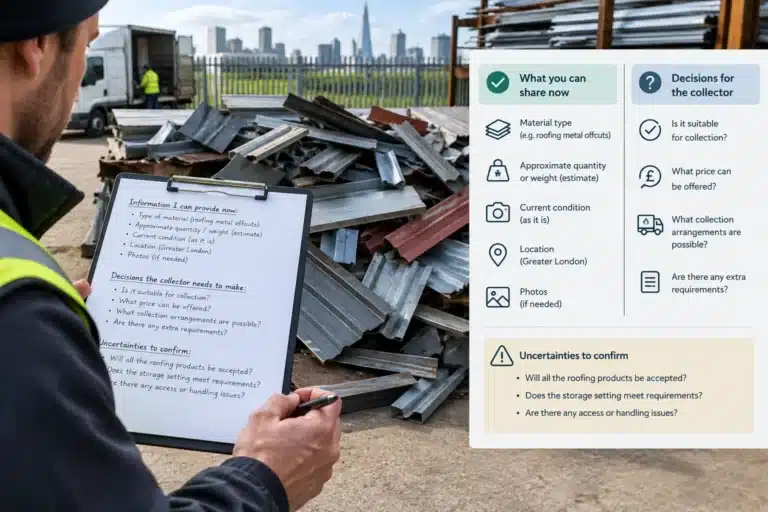
What should a roofing metal offcuts enquiry include?
The six tips below are practical recommendations, not a published company checklist. They help you organise an enquiry, but they do not establish that a particular load will be accepted. Suitability, pricing and the collection arrangements still need confirmation.
Premier Scrap Trading Ltd provides scrap metal collection in London. Company information recorded for this guide on 21 October 2026 describes Greater London coverage. That service description is a starting point for discussion, not confirmation that every roofing product or storage setting is suitable.
Good roofing scrap enquiries distinguish information you can provide now from decisions the collector must make. Describe the detached material as it currently stands, keep uncertainties visible and ask what else is needed. You do not have to identify every alloy, measure every piece or prepare the load yourself before asking a question.
The most useful first message connects the material description with its current setting. A clear photograph without an explanation may leave the composition uncertain. A precise product name without access information may leave collection arrangements unresolved. These details work together, rather than replacing one another.
1. Identify the material without guessing
Start with the strongest description you already have. This might be an existing supplier label, a product description or an identification supplied by the tradesperson who removed the metal. Explain where that information came from, especially when several products were used on the same roof.
A documented description and a visual impression are not equivalent. If you only think a piece resembles a particular metal, keep that uncertainty in the enquiry. Calling it unidentified metal is clearer than presenting a guess as a confirmed grade.
For roofing metal offcuts, product information may describe more than the metal alone. A label could refer to a finished roofing component with a coating or backing. Pass on that description as it stands rather than shortening it to a metal name and losing a relevant qualification.
The company’s accepted material categories, checked on 21 October 2026, include copper, aluminium, lead, zinc, stainless steel and steel. This supports asking about those categories. It does not establish that every roofing product containing them is suitable for collection.
If identification remains uncertain, ask what evidence would help. You may already have a product reference, an invoice description or a note from the roofing contractor. None should be treated as proof that every piece in a mixed batch has the same composition.
Photographs can supplement the description if requested. They should show detached metal at ground level in its existing collection setting. Take them only from an accessible, safe position, without moving pieces or entering a restricted area to improve the view.
A general view can explain the setting, while an existing visible label may provide useful detail. Do not assume a photograph settles composition, weight or acceptance. Avoid cutting, scraping, burning or chemical testing to produce an answer. The useful outcome is an accurate description of roofing metal offcuts, including what remains unknown.
If another person identified the material, distinguish their description from your own observations. You can pass on what the contractor said while explaining that you have no supporting product label. This preserves useful information without making it sound independently verified.
2. Describe each existing batch separately
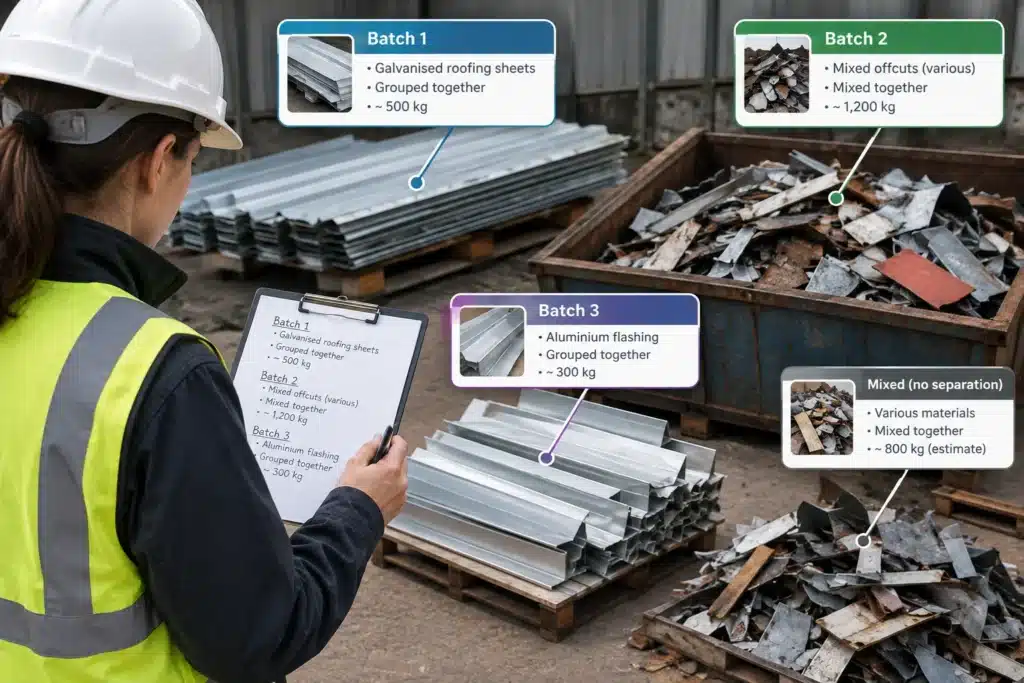
Describing batches separately means organising your message, not physically sorting the material. If detached pieces already sit in different places or groups, explain those groups individually. If everything is mixed together, say so rather than suggesting that the load has been separated.
This distinction matters when one group has a known product description and another does not. A reliable label for one batch should not become a blanket description for everything awaiting collection. Keep each piece of evidence attached to the batch it actually describes.
For each existing group, useful information includes:
- The material or product description already known, including any uncertainty.
- Whether the pieces are already grouped together or mixed with other contents.
- The approximate quantity, if known, and how that estimate was made.
- Any visible attachments or backing associated with that group.
- The group’s present location within the property or site.
These details give roofing scrap enquiries a clearer structure without requiring a technical inventory. A short description of each existing group is easier to follow than one sentence combining known metal, unidentified pieces and unrelated waste.
Where roofing metal offcuts are mixed, describe the mixture as accurately as existing information allows. Do not claim that a mixed batch will automatically be accepted or rejected. Ask whether the collector needs further information before deciding.
You do not need to move, dismantle or repackage pieces merely to make the enquiry look more organised. If a batch cannot be viewed fully from a safe position, explain that limitation. An incomplete but accurate description is preferable to a confident account based on parts you cannot see.
Keep the same batch descriptions in later messages so the collector can tell which group a photograph or clarification concerns. This avoids an uncertainty about one batch being mistaken for an update about the whole load.
3. Distinguish approximate quantities from verified weights
A useful quantity description does not have to be an exact weight. You might know an approximate piece count or have dimensions recorded in existing project information. State what you know and identify anything approximate, including whether the count covers the whole batch.
Only call a weight measured if an actual measurement exists. If a figure comes from a supplier document, a calculation or someone’s estimate, explain that basis. Do not present it as the collection weight or assume it represents the detached material now awaiting assessment.
For roofing metal offcuts, a product’s original dimensions may not describe the remaining pieces. Similarly, information about the material ordered for a job may not establish how much remains. Keep purchase records, approximate quantities and verified measurements distinct.
If the weight is unknown, say so. Do not lift awkward pieces or arrange an improvised weighing exercise just to make the first enquiry more precise. Ask what quantity information the collector needs at this stage and how the material will be weighed.
The company’s scrap metal price information, checked on 21 October 2026, describes weighing, a printed receipt and payment by bank transfer where material has resale value. It also directs customers to ask for the latest prices. These arrangements do not establish a value for an unassessed roofing batch.
Metal type and weight affect the discussion, while grade, condition and current market conditions can also affect pricing. Ask which description or grade any preliminary indication assumes. If identification is uncertain, make sure that uncertainty remains visible when discussing potential value.
A price indication is not the same as a final payment figure. No numerical rate is reproduced here because the price page does not provide a clear price-update date for treating its figures as current quotations.
Roofing scrap metal collection should therefore begin with a clear account of the quantity information available, not a speculative payout calculation. Ask how the final assessment and weighing relate to any initial discussion. Do not assume every offcut has resale value or that an estimate commits either party to a particular outcome.
4. Mention coatings, backing and other attached materials
A metal name alone may not describe the complete roofing product. Tell the collector about visible attachments, layers or residues rather than assuming they are irrelevant. Their effect on acceptance needs confirmation for the particular batch.
This is especially important when product information names the main metal but says little about the finished component. Roofing metal offcuts may still have features that are not captured by a short label. Report what is visible and distinguish that observation from any assumption about composition.
Useful observations include:
- Visible fixings or brackets still attached to the metal.
- Backing or another layer bonded to the surface.
- Sealant or other residue whose identity is known or uncertain.
- A visible coating, with an existing product description if available.
- Different materials remaining joined in a single assembly.
The purpose is not to diagnose the attachment yourself. A dark residue, coloured surface or unfamiliar backing cannot be reliably identified from appearance alone. If its composition is unknown, describe it that way rather than naming a substance without evidence.
Ask whether the attachment affects suitability and whether further product information would help. A collector may need to consider the actual roofing component, not simply whether the main metal appears on a general accepted-material list.
Do not remove fixings, strip coatings, break assemblies apart or handle suspected hazardous material to improve the description. This guide does not provide instructions for those tasks. If safe assessment or further work is needed, it should not be improvised as part of preparing an enquiry.
Photographs, where requested, should document what is already safely visible. They are supporting information, not confirmation that an unidentified layer is harmless or acceptable. If a surface or backing cannot be seen, say that rather than moving the material to expose it.
For roofing metal offcuts with uncertain attachments, ask whether the batch can be considered as it currently stands and what additional information is needed. That keeps acceptance separate from any assumptions about preparation or treatment.
Keep descriptions specific to the affected pieces. If backing is visible on only part of a batch, explain that limited observation rather than describing every piece as backed. Equally, an unobstructed view of one surface does not establish what is present elsewhere.
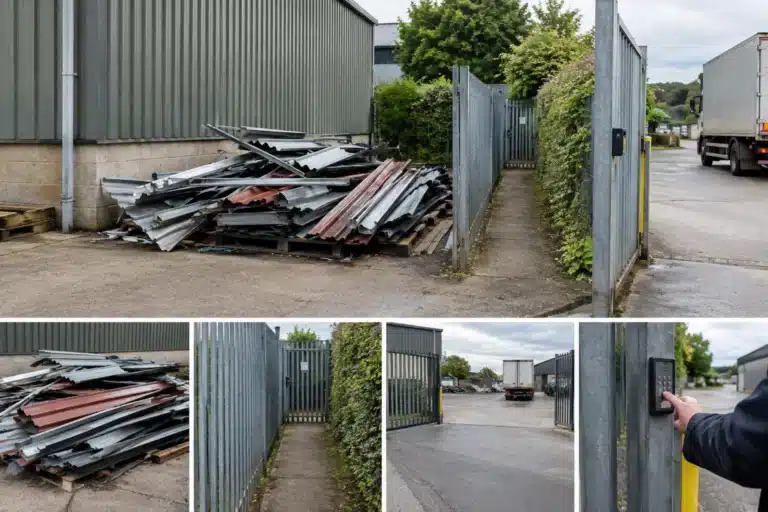
5. Explain where the offcuts are and how access works
Describe where the detached material is stored now. State whether it is at ground level and identify known steps, gates, narrow routes or other restrictions. Do not replace this description with a general statement that access is easy.
The collector needs the actual setting, not just the property’s address. Material in an accessible external space presents a different enquiry from material behind a locked gate or beyond a restricted route. Describe the conditions without assuming what equipment, staffing or vehicle arrangements will be available.
For roofing scrap metal collection, include known vehicle-access constraints and any arrangements controlled by a landlord, site manager or other person. Explain if access depends on someone being present. Ask the collector to confirm what can be accommodated rather than promising arrangements on their behalf.
For a property in Ealing, provide the postcode and actual access details. The locality alone does not tell anyone whether there are steps, a shared entrance or restrictions on reaching the material. Across Greater London, the practical point is to describe the individual property rather than assume an area name establishes collection feasibility.
Report the existing route; do not relocate heavy pieces to make the description simpler. If an obstruction or restriction may affect collection, explain it and ask how the arrangements should be assessed. Do not assume that moving the offcuts yourself is a necessary preparation step.
Separately, HSE’s workplace manual-handling guidance, checked on 21 October 2026, explains that employers should avoid hazardous manual handling where reasonably practicable, assess unavoidable operations and reduce injury risks. This is general workplace guidance, not Premier Scrap Trading Ltd’s collection policy.
The same HSE guidance states that manual-handling law does not set specific weight limits. A weight figure therefore cannot establish that an awkward roofing piece is safe for everyone to lift. Do not interpret a quantity estimate or the collector’s interest in a batch as a handling assessment.
Access information should help the collector understand the setting without becoming a set of lifting instructions. State uncertainties about the route as clearly as uncertainties about the metal. Before booking, ask for confirmation that the proposed arrangements suit the actual storage location and access conditions.
If you are not at the property, distinguish what you know personally from information supplied by someone else. An old photograph or earlier description may not show the current route. Explain that limitation and ask which details need confirmation before an appointment can be agreed.
6. Confirm requirements for roofing scrap enquiries
The final stage is to resolve questions, not assume that a detailed enquiry amounts to acceptance. A collector may still need clarification about the material, attachments, quantity or access. Make those outstanding points explicit before treating the conversation as a booking.
Useful confirmation questions for roofing scrap metal collection include:
- Are the described batches suitable, including their attached materials?
- Is further identification or a photograph needed before a decision?
- How will weighing and any eligible payment be handled?
- What is the current pricing basis, and what remains subject to assessment?
- Are the described access conditions suitable for the proposed collection?
- Which seller identification and any applicable waste paperwork are needed?
- What availability can be confirmed, and are any arrangements still outstanding?
These questions are prompts for discussion, not a statement that every enquiry follows the same company procedure. They also do not establish a universal paperwork checklist. Ask what applies to your circumstances, particularly when arranging collection for a business, a managed property or someone else’s project.
Keep three different decisions separate. First, an enquiry shares information and asks questions. Next, suitability needs confirmation for the material described. Finally, a booking requires agreement about the collection arrangements. These are useful distinctions, not a claim about a formal company workflow.
A request for current pricing does not establish a guaranteed valuation. Likewise, asking about availability does not reserve an appointment. Make sure you understand which details have been agreed and which depend on further information or assessment.
If preparation is requested, clarify exactly what that means before agreeing. Do not interpret a general request to make material accessible as instructions to cut, dismantle or lift heavy roofing products. Explain any limits on what can safely be done and ask for an appropriate arrangement.
Keep unrelated items out of assumptions about the booking. Company information recorded for this guide on 21 October 2026 states that old washing machines and fridges are not accepted. Their presence at the same property does not make them part of an enquiry about roofing metal offcuts.
Where several people are involved, identify who can answer material questions and who controls access. A householder may know the storage location while the roofing contractor holds the product information. Passing on those distinctions can prevent an unanswered question from being mistaken for confirmation.
Before ending the conversation, check that any revised details still describe the actual batch. If new information changes the metal identification, attachments or access conditions, explain the change. A clear update is more useful than allowing an earlier assumption to remain attached to the proposed collection.
Bring the details together in one clear enquiry
You can bring these points together without writing a technical report. Use a short factual description, retain important uncertainties and finish with the questions that need answers. The following is suggested wording with placeholders, not a customer quotation:
I am enquiring about detached roofing metal offcuts at [postcode]. The known material description is [description and its source], although [remaining uncertainty]. There are [existing batches], currently stored at [location]. The quantity is [approximate count or existing measurement], and the weight is [unknown or measured, with its basis].
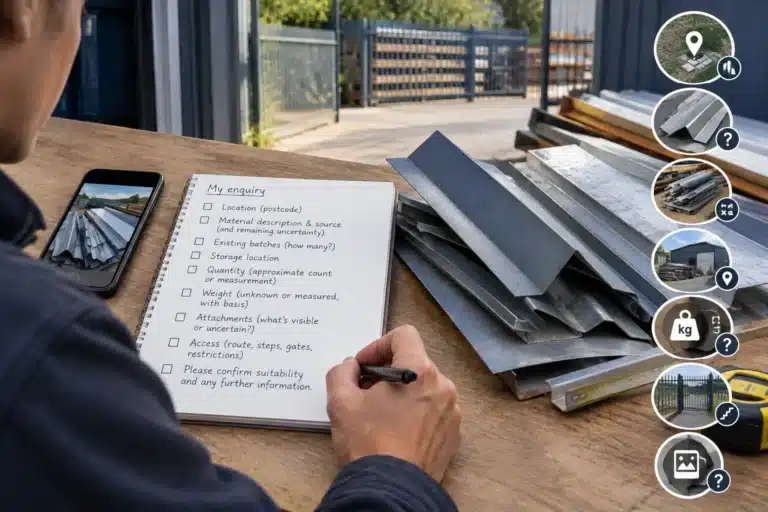
The visible attachments are [description or uncertainty]. Access involves [known route, steps, gates or restrictions]. Please confirm whether the batches are suitable, what further information you need, and how pricing, weighing, paperwork and collection arrangements would be agreed.
Leave information marked unknown when it is genuinely unknown. You do not need to fill every gap before making contact, and you should not create extra handling work to complete a message. The important outcome is a shared understanding of what is available and what still requires confirmation.
Keep your description available for any follow-up conversation. If the collector asks about a particular batch, use the same reference and explain any new information. That makes it easier to distinguish a clarification from a change in what is being offered for collection.
Call Premier Scrap Trading Ltd on +44 7931 361 034 or book a collection online to discuss your roofing metal offcuts, confirm what can be collected and ask for current prices.
Call 07931 361034 or book a collection with Premier Scrap Trading Ltd to confirm materials and current prices.
Related collection advice
Sources and further information
Frequently asked questions
Can I enquire if I do not know which metal I have?
Yes. Describe it as unidentified metal and share any existing product information. Ask which details or ground-level photographs would help, rather than guessing the composition.
Do I need an exact weight before contacting a collector?
You can explain that the weight is unknown. Provide an approximate piece count or existing dimensions if available, clearly distinguishing estimates from measurements.
Are all roofing metal offcuts suitable for collection?
Acceptance needs confirmation for the particular batch. A general material list does not establish suitability for every roofing product, coating, backing or mixed assembly.
Can photographs establish the scrap value?
Photographs can help explain the material and collection setting, but they do not establish a verified weight or necessarily confirm the metal grade. Ask how any preliminary price indication will be assessed.
Should I remove backing or fixings before enquiring?
Describe the attachments first and ask whether they affect acceptance. Do not assume stripping, cutting or dismantling is necessary to make an enquiry.
What access information helps with roofing scrap metal collection?
Give the postcode, present storage location and known steps, gates, narrow routes or vehicle restrictions. Ask the collector to confirm suitable arrangements before assuming collection is possible.
What identification or paperwork should I prepare?
Ask which seller identification and any applicable waste paperwork are needed for your circumstances. Sending photographs or receiving a price indication does not establish that those requirements are complete.
Does Premier Scrap Trading Ltd accept old washing machines or fridges?
No. Company information recorded for this guide on 21 October 2026 states that old washing machines and fridges are not accepted. Do not include them as assumed additions to a roofing enquiry.