


Which scrap metal collection photos should I send?
Your scrap metal collection photos should show the whole load, visible materials and attachments, quantity and scale, and the existing access route. Add a short written description so the collector understands what is included, where it is and what remains uncertain.
These four views are practical recommendations, not mandatory company requirements. They help explain an enquiry to Premier Scrap Trading Ltd about scrap metal collection in London. They cannot establish a confirmed material grade, weight, acceptance decision, price or booking.
For householders and businesses across Greater London, the useful outcome is a clearer conversation before arrangements are discussed. A photograph can show a mixed pile or a narrow entrance quickly. Your message supplies the context that the camera misses, including items outside the frame and restrictions beyond the visible doorway.
Take photographs only from an existing safe position. Do not move, lift, dismantle, disconnect or rearrange anything to improve a picture. If part of the load is inaccessible or hidden, describe that limitation instead.
Example message to send with scrap metal collection photos
“Photo 1 shows the three loose frames for collection. The shelf behind them is staying. Photo 2 shows the hinges still attached. In photo 3, the doorway gives an idea of size. Photo 4 shows the shared entrance and the step down to the pavement. I can confirm the frame count. I don’t know their weight.”
1. Show the whole load
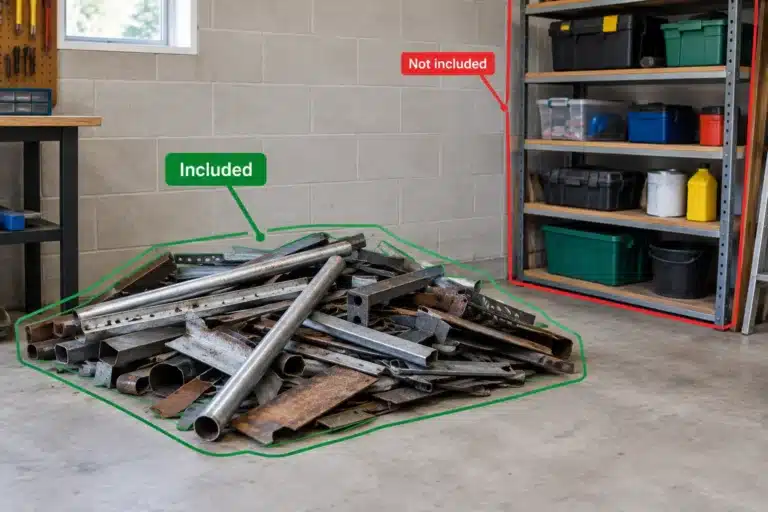
Start with an overview of the metal included in your enquiry. Use the existing viewpoint that explains the load most clearly without needing to handle anything. This first view answers a simple question: what are you asking the collector to consider?
The distinction matters in garages, stores and workshops, where scrap often sits beside equipment or possessions that are staying. A photograph alone may not show where the proposed collection begins and ends. State which pictured objects are included and identify anything nearby that is not.
For example, a householder might photograph loose metal beside storage shelving. Their message could say: ‘The loose metal beside the shelving is included; the shelving and its contents are staying.’ This is a hypothetical example, but it shows how one sentence can prevent a broad overview from becoming misleading.
Keep the description tied to visible features. ‘The loose pieces on the floor beside the shelves’ is clearer than ‘everything there’. If the picture includes unrelated tools, containers or furniture, make their status explicit rather than assuming the recipient will recognise them as separate.
The overview does not have to prove the total quantity. Its purpose is to establish scope. The later scale view adds context about the apparent extent of the load, while written counts explain what you actually know.
If there are additional items elsewhere, mention them. A single photograph of one storage area should not imply that it shows the complete enquiry when another group remains out of sight. You can explain that the image covers only the visible portion and describe the remainder separately.
Do not rearrange a crowded space to obtain a comprehensive picture. If no safe viewpoint shows everything, say so and ask whether more information would help. An acknowledged gap is better than a photograph that appears complete but is not.
The company’s information about scrap collection and recycling provides background on the service. For the enquiry itself, focus on showing what is present and defining what you want considered, rather than assuming everything visible can be collected.
2. Show materials and attachments
A closer view can show details that disappear in an overview. Photograph visible surfaces, existing labels, cable insulation and attached non-metal parts where these are already accessible. Leave the objects in their current condition.
This view should help explain materials and attachments, not turn appearance into a confirmed identification. Colour, shape and a familiar use may suggest a material, but they do not establish the composition of the whole object. Paint, coatings and mixed construction can obscure what lies underneath.
A hypothetical workshop enquiry might describe ‘possibly aluminium offcuts with plastic attachments; grade unknown’. That wording separates a reasonable suspicion from a verified fact. It also alerts the recipient to the attached parts rather than presenting the pieces as clean, identified metal.
If an existing label is readable from your safe position, include it. Explain which object it belongs to if the image contains several pieces. A label on one item should not be treated as identifying every similar-looking item nearby.
There is no need to expose a fresh surface, remove coverings or separate components for a photograph. If a covering prevents identification, write that the material beneath it is unknown. Where attachments are visible but unfamiliar, describe their appearance without guessing their composition.
As checked on 21 October 2026, the company’s what we collect information lists copper, brass, aluminium, lead, zinc, stainless steel, steel, cables and car batteries. These categories provide a starting point for discussion, not confirmation that every object containing one of those materials is suitable.
The same information states that old washing machines and fridges are not accepted. A detailed photograph does not change those exclusions. For other uncertain or mixed items, ask about suitability rather than relying on a resemblance to something listed.
When different materials appear together, identify which part your description concerns. For example, ‘the pale metal pieces have dark attached fittings’ is more precise than labelling the entire group as one metal. The collector can then discuss the uncertainty without your message overstating what the photograph proves.
3. Give quantity and scale some context
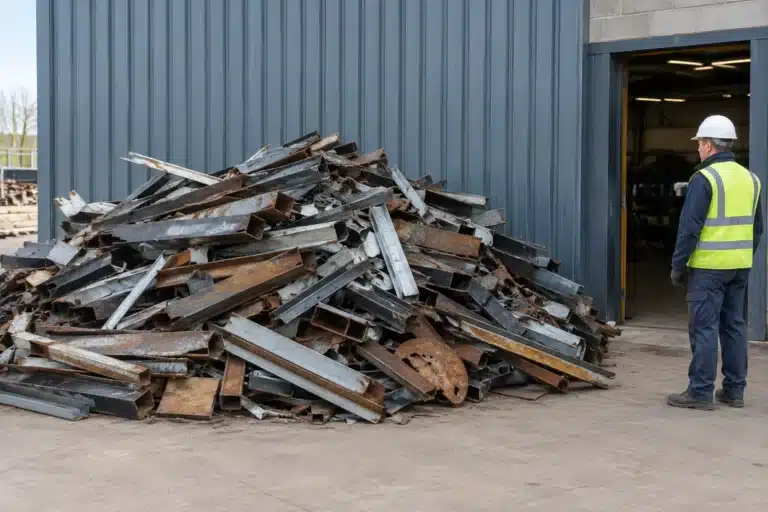
The third view helps communicate the apparent extent of the load. Where possible, include an existing fixed reference, such as a doorway already visible beside it. This is different from the overview: the overview defines the included items, while this photograph gives their size some context.
Do not place an object beside the metal or move pieces into a line for comparison. There is also no need to climb for a wider angle. If the current safe viewpoint offers no useful reference, explain quantity and scale through the information you already have.
Known item counts can be helpful, provided you distinguish them from estimates. Existing documented dimensions may also add context. If a count or dimension is unknown, say so rather than converting an impression from the photograph into a stated measurement.
For example, several metal lengths might be visible while others remain stored behind them. A useful message would distinguish ‘the pieces visible in this photograph’ from ‘the additional lengths stored out of sight’. Add a total only if you know it, and make clear whether that total includes both groups.
Think about what the edge of the image leaves unresolved. A long piece may extend beyond the frame, or a container may hide part of its contents. Describe those limitations rather than allowing the recipient to assume that the visible portion represents the whole.
Perspective can make nearby objects appear larger than those further away. Overlapping pieces can conceal their number, and a photograph may not reveal whether a component is hollow or solid. These limits mean that apparent size cannot establish actual weight.
Keep approximate information clearly labelled. ‘Quantity approximate’ or ‘dimensions not known’ tells the recipient how much confidence to place in the description. It is better to acknowledge that uncertainty than to supply a precise-looking figure with no basis.
This view is therefore a communication aid, not a measurement. Its value comes from pairing visible context with a careful account of what is known, estimated or outside the frame.
4. Show the existing access route
The fourth view shows the relevant doorway, gate or approach from an existing safe position. It helps explain where the metal is located in relation to the route, but it needs written context to be useful.
A photograph of an open doorway does not establish that every item can pass through it. Nor does a clear entrance show what lies around a corner, on another floor or beyond a shared passage. Describe those parts of the access route even when they are absent from the image.
Useful details include the floor level, steps, tight turns, shared entrances and locked gates. Mention known parking restrictions too, without assuming that a visible space will be available or suitable when a collection is discussed.
For a hypothetical workshop in Hackney, the enquiry could explain that the pictured offcuts are upstairs and the doorway leads to a shared route. The practical question is whether the collector can confirm feasibility and arrangements. The location alone does not establish availability for that address.
Be specific about which entrance the image shows. A building may have a public entrance, a shared gate and a separate internal doorway. Identifying the photograph as ‘shared street entrance’ or ‘doorway beside the storage area’ avoids leaving the recipient to infer their relationship.
If access depends on another person opening a gate or permitting entry, mention that arrangement. State what you know and what still needs confirmation. Do not present a possible route as an agreed means of access.
For workplaces, HSE’s manual handling guidance, checked on 21 October 2026, explains that employers must avoid hazardous manual handling where reasonably practicable, assess unavoidable operations and reduce injury risks. It does not set a universal legal weight limit.
Those employer duties should not be presented as identical legal obligations for householders. For this photographic checklist, the boundary is straightforward: document the existing situation without attempting to demonstrate carrying, clear a route or alter the load. An access photograph starts a discussion; it is not an assessment that the collection can proceed.
What scrap metal collection photos cannot confirm
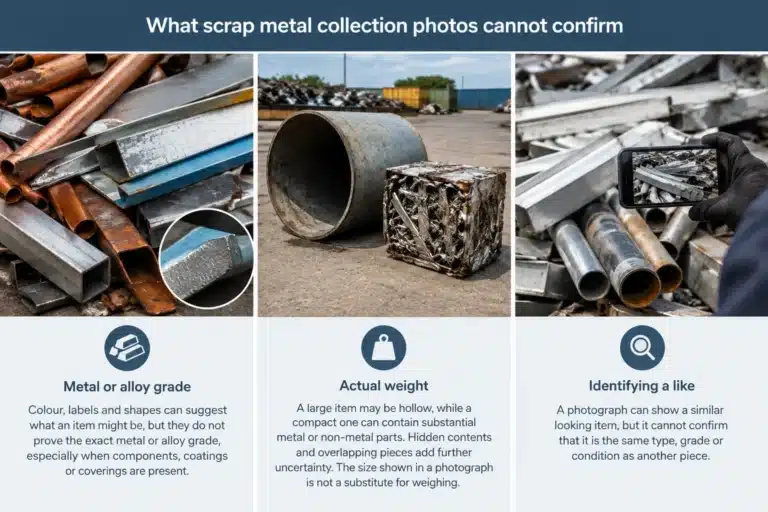
Good photographs can reduce ambiguity, but they leave several separate questions unresolved. Understanding those limits helps you interpret any discussion that follows without treating an initial enquiry as a completed assessment.
First, images cannot confirm every metal or alloy grade. Visible colour, labels and shapes may contribute useful clues. They do not necessarily prove the composition of an entire item, particularly when different components, coatings or coverings are present.
Second, photographs cannot establish actual weight. A large object may be hollow, while a compact one may contain substantial metal or non-metal parts. Hidden contents and overlapping pieces introduce further uncertainty. The size shown in a photograph is not a substitute for weighing.
Third, identifying a likely material does not confirm acceptance. An item may need further discussion because its construction, condition or attached parts remain unclear. The company’s exclusions still apply, and an uncertain item should remain an enquiry rather than being described as approved for collection.
Fourth, photographs do not establish a confirmed price. Material, grade, condition, weight and current demand affect scrap value. Consult the company’s scrap metal price information and ask about the particular load rather than applying a general figure to its apparent size.
As checked on 21 October 2026, Premier Scrap Trading Ltd describes weighing materials and making eligible payments by bank transfer. This does not mean that every pictured item has resale value. A clear image cannot remove the need to establish what the material is and what quantity is actually present.
Finally, an enquiry does not secure a collection appointment. Providing a postcode, photographs and preferred availability helps explain your request, but the relevant arrangements still need confirmation. Do not treat submission of the form as acceptance of a date or time.
Short uncertainty labels can keep your message accurate:
- ‘Material unknown’ where appearance does not support identification.
- ‘Quantity approximate’ where you have an estimate rather than a known count.
- ‘Attachments visible but not identified’ where components remain unclear.
Use these labels alongside the relevant description, not as a replacement for it. A recipient still needs to know which photograph or group of items the uncertainty concerns.
A useful enquiry, confirmation of suitable materials, agreed collection arrangements and an eligible payment are distinct matters. These distinctions are not a prescribed company workflow. They simply prevent a photograph from being asked to prove more than it can, while keeping the conversation focused on what needs clarification.
Details to send with your photographs
The written message connects the four views. It should identify the load, explain uncertainties and supply practical information that the photographs cannot show. Keep it concise enough to scan, but specific enough that the recipient does not need to guess what each image means.
- Postcode and contact details: give the location of the proposed collection and a way to reach you.
- Included items: state what you want considered and which nearby objects are staying.
- Known quantities: provide reliable counts or existing documented dimensions, and label estimates.
- Material uncertainty: distinguish confirmed information from suspected or unknown materials.
- Attached parts: mention visible insulation, coverings and non-metal components without altering them.
- Current location: identify the room or storage area and the floor level.
- Access restrictions: describe steps, shared routes, gates and known parking constraints.
- Preferred availability: explain when access could be arranged, subject to confirmation.
Refer to photographs in a consistent way. ‘Overview’, ‘material detail’, ‘scale view’ and ‘entrance’ may be enough. If you use file names or numbers instead, make sure the message matches them. A note about upstairs storage should not appear to describe a different image of ground-floor items.
A hypothetical householder message could read: ‘The overview shows loose metal beside the shelving. Only the loose pieces are included. The material is unknown, and some pieces are partly hidden. The metal is currently in [location and floor level]. The entrance photograph shows [relevant entrance]; access restrictions are [details or unknown].’
This example leaves fields for facts the householder actually knows. It does not invent a quantity or imply that someone has already accepted the load. The exclusion of the shelving is just as important as the description of the loose metal.
A contrasting workshop message could say: ‘The detail photograph shows mixed offcuts, possibly aluminium, with attached plastic parts. The grade and total weight are unknown. Additional pieces are outside the frame. Access uses a shared route, with arrangements still to be confirmed. Please advise what further information is needed.’
That example concentrates on mixed construction and access rather than repeating the householder’s situation. Where a workshop has reliable records, it can add relevant information from them while identifying which items those records cover.
Preferred availability is not an agreed appointment. If access depends on a keyholder, permission or another business, say that it needs coordination. Do not supply a firm collection time on behalf of the company.
Keep unnecessary personal information out of the images. Do not include identity documents or paperwork simply to add detail to a scrap enquiry. Focus the photographs on the load and relevant surroundings.
Missing information is not a reason to take a risk. An enquiry can openly acknowledge that a measurement is unavailable, an item is obscured or a view cannot be obtained safely. Clear limits give the recipient a useful starting point for follow-up questions.
Send the enquiry and confirm the arrangements
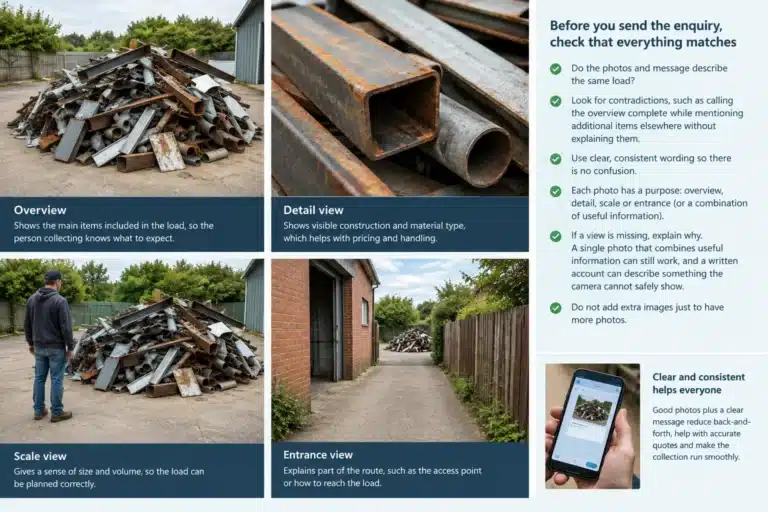
Before submitting, check that the photographs and message describe the same load. Look for contradictions such as calling the overview complete while mentioning additional items elsewhere without explaining them. Correct the wording rather than trying to make the pictures do all the work.
Give each selected image a purpose. The overview identifies the included items; the detail view shows visible construction; the scale view provides context; and the entrance view explains part of the route. These are useful categories, not a requirement to submit exactly four separate photographs.
If one view is missing, explain why. A photograph that combines useful information may still help, and a written account can describe something the camera cannot safely show. Do not obtain an extra image merely to complete the set.
Follow the file requirements displayed on the company’s contact form when you submit. Those instructions govern the files you can upload. If a file is rejected or you cannot provide images through the form, contact the company to discuss how to describe the load instead.
After submission, keep the distinction between a request and confirmed arrangements clear. Suitable materials, access, current prices and availability may all need discussion. If something changes, such as the items included or the entrance available, explain that change rather than relying on the earlier photographs.
The strongest enquiry is not necessarily the longest one. It gives a truthful overview, makes uncertainty visible and leaves practical decisions open for confirmation. Your photographs support that explanation; they do not replace it.
Call +44 7931 361 034 or use the contact form to discuss your scrap metal with Premier Scrap Trading Ltd, confirm what can be collected and ask about current prices and availability.
Call 07931 361034 or book a collection with Premier Scrap Trading Ltd to confirm materials and current prices.
Questions about collection photographs
Do I need exactly four photographs for a scrap collection enquiry?
No. The four views are practical suggestions, not company requirements. Send the useful photographs you can take safely and describe anything they do not show.
Can photographs establish the value of my scrap metal?
Photographs cannot establish a confirmed value.
What should I write if I cannot identify the metal?
Write ‘material unknown’ or describe it as a suspected material. Mention visible coverings and attachments without treating colour or appearance as proof of composition.
Should I move scrap metal to take a clearer photograph?
No. Photograph it from an existing safe position. Explain obscured items or missing views in your message rather than moving, dismantling or disconnecting anything.
Can I include old washing machines or fridges?
No. Premier Scrap Trading Ltd does not accept old washing machines or fridges, as checked on 21 October 2026. Photographs do not change these exclusions.
What if my scrap is upstairs or behind a shared entrance?
State the floor level, steps, shared access and any restrictions. Include an access route photograph if safely possible, then ask the collector to confirm feasibility.
Does sending photographs confirm a collection appointment?
No. An enquiry and preferred availability do not establish a booking. Confirm suitable materials, access and collection arrangements directly with the company.
What should I do if the contact form rejects my photographs?
Check the file requirements displayed on the form. If you cannot submit suitable images, contact the company to discuss another way to explain the load.