


The link between recycling and steel supply
Electric arc furnaces could reduce the UK’s reliance on imported steel by helping domestic steelmakers use more steel scrap. However, furnace capacity alone cannot deliver self-sufficiency: scrap quality, suitable production inputs and demand all matter. For customers arranging recycling, the practical priorities remain identifying materials, preparing them sensibly and obtaining a quotation for what they actually have.
The government’s steel strategy aims to restore domestic production to supplying 40–50% of UK demand. That is an ambition for a larger domestic contribution, not a commitment to eliminate imports. It also does not mean that level of production has already been achieved.
The opportunity matters because the UK generates substantially more steel scrap each year than it currently uses domestically. Increasing domestic use could connect recycling more closely with UK manufacturing. Yet a national supply figure does not tell a steelmaker whether a particular load meets its requirements.
The UK Steel Strategy provides the policy context. Its publication record says the strategy first appeared on 19 March 2026, with corrected documents replacing earlier versions on 14 October 2026. Targets and forecasts therefore need to be read as such, rather than as reports of completed industrial change.
For a householder, workshop or building contractor, this distinction keeps the story useful. More domestic recycling capacity could create opportunities, but it does not establish a collection price or a destination for individual items. Understanding the industrial picture helps explain why clear descriptions and sensible separation matter, without making customers responsible for a steelworks’ technical assessment.
Where electric arc furnaces fit into steel recycling
An electric arc furnace uses electrical energy to melt metallic feedstock. Steel scrap can form part of that feedstock, allowing recovered metal to return to steel production. The furnace is one stage in a wider chain, not a substitute for collection, sorting and preparation.
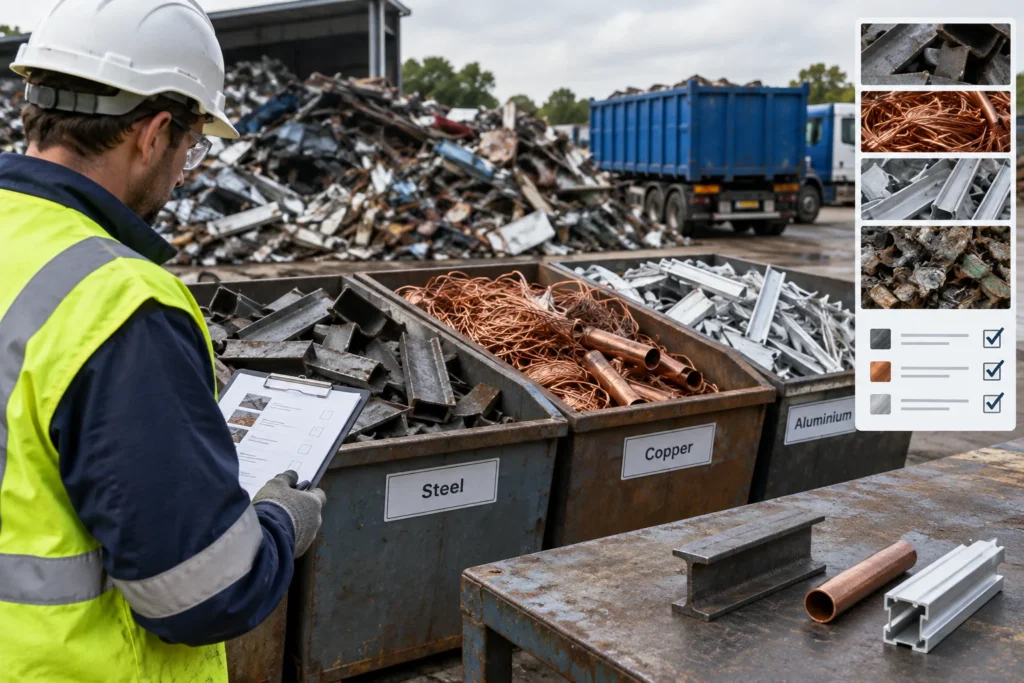
For customers, that chain starts with identifying what is available. A collection might contain steel sections alongside copper pipe, aluminium offcuts or brass fittings. These are different material categories. Their presence in the same collection does not mean they should enter the same steelmaking process.
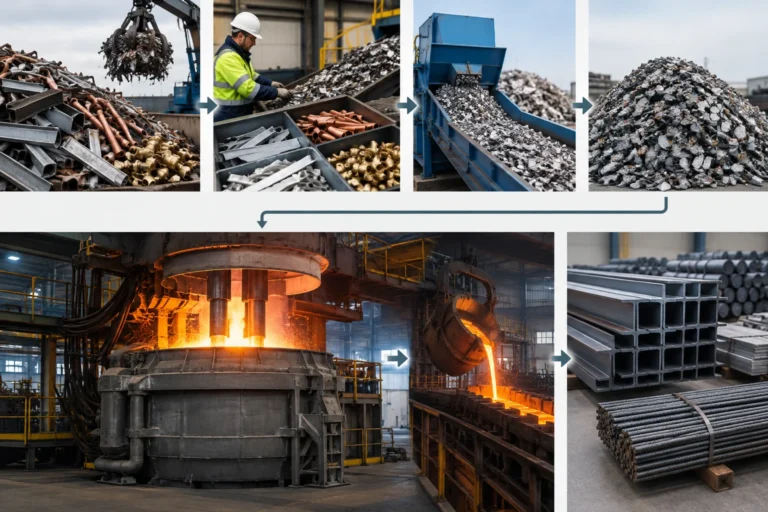
After collection, material may need further assessment and preparation before it becomes suitable feedstock. Producing finished steel then involves requirements beyond simply melting a mixed load. The intended product and its specification influence what inputs a steelmaker can use.
This explains why additional furnace capacity creates an opportunity rather than an automatic outcome. A furnace needs suitable material, and the supply chain must connect available scrap with the requirements of production. More equipment does not make every discarded metal item suitable for every steel product.
The government strategy links furnace development with greater demand for scrap, particularly higher-quality grades. That relationship is important, but it should not be read backwards. A customer cannot assume that a collection will reach a particular new furnace merely because domestic capacity is expanding.
Nor should electric arc furnaces become shorthand for every kind of metal recycling. Copper, brass and aluminium have their own recycling routes. Keeping these categories distinct makes an enquiry clearer and avoids confusing the steelmaking story with the treatment of all metals.
For a broader explanation of the collection side, Premier Scrap Trading Ltd’s metal recycling information provides relevant background. The useful distinction is between recovering material and determining its eventual industrial use. Customers can help with the first stage through accurate information; they should not be expected to certify the final production route themselves.
Why a large scrap supply is not enough on its own
The government strategy cites annual UK steel scrap generation of around 10–11 million tonnes, compared with domestic use of about 2.2 million tonnes. Those figures show a substantial difference between material arising and material used by domestic steelmakers.
They do not show that every tonne outside domestic use is immediately available for a new furnace. The figures alone do not establish the material’s location, condition, grade or existing destination. Nor do they establish a verified export total or the amount going to disposal.
Three questions sit behind the headline comparison. How much scrap arises? How much is suitable for a given steelmaking requirement? How much can domestic facilities process and use? A larger answer to the first question does not automatically resolve the other two.
It also matters that these are annual flows. Scrap generation describes material arising over a period, not a single stockpile waiting beside a steelworks. Treating the annual total as an immediately accessible reserve would give a misleading impression of how supply works.
The distinction is familiar at a smaller scale. A contractor may describe a clearance as several loads of metal, but that description does not establish how much suitable steel it contains. Other metals, attached components and non-metal building waste may need separate consideration.
That example does not provide a national estimate. It illustrates why weight and suitability answer different questions. A large quantity can be commercially relevant without matching a particular steelmaker’s specification, while a more clearly identified batch can be easier to assess.
Domestic processing capacity is another separate issue. Collecting scrap and having facilities able to use it are not the same achievement. Increasing use requires a workable connection between the recovered material and the production process, rather than simply a larger collection total.
The strategy’s figures therefore support a clear conclusion: the UK has scope to examine greater domestic use of recovered steel. They do not establish that the whole difference can become additional UK steel output, tonne for tonne, without qualification.
For customers, the practical lesson is to describe the actual material rather than rely on a broad label such as mixed scrap. Photographs, approximate quantities and an explanation of where the metal came from give a collector more useful information. They still leave the technical assessment to the appropriate stage of the recycling chain.
Why scrap quality matters as much as quantity
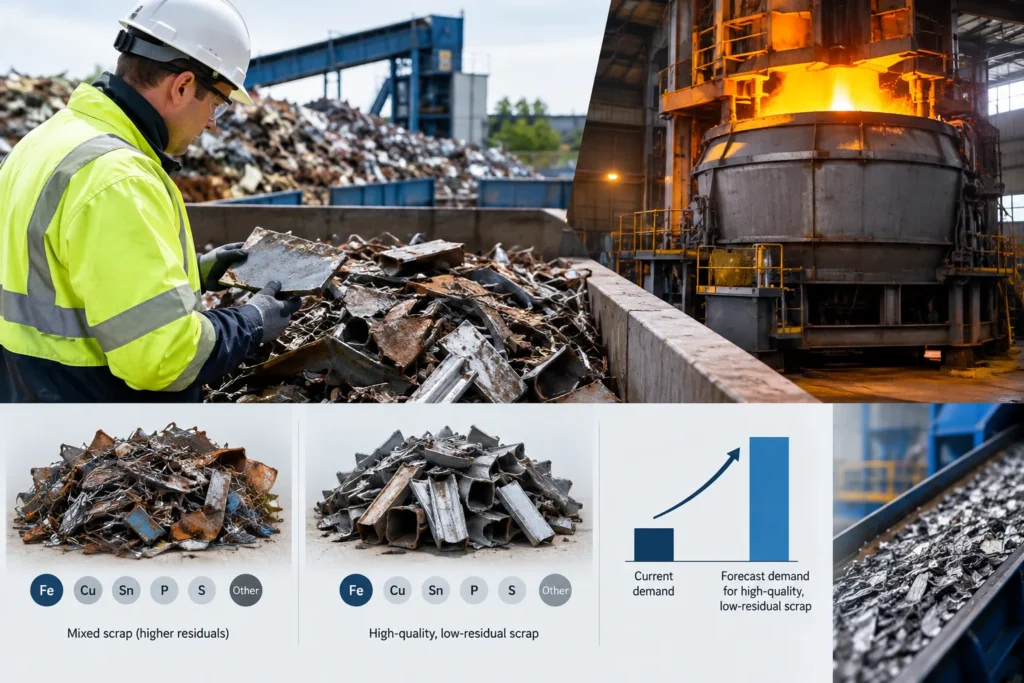
Scrap quality is central to the opportunity. The government strategy cites Hatch estimates suggesting demand for high-quality, low-residual scrap could increase seven- to eightfold as new electric arc furnaces come online. This is a forecast linked to furnace development, not a measured increase already delivered.
Low-residual scrap means material with low levels of unwanted elements for the intended steel product. The important point is suitability, not whether a piece looks clean or valuable. Different production requirements can make the composition of the input significant.
For this reason, the forecast should not be applied indiscriminately to every mixed collection. It concerns a particular quality requirement. It does not establish an equivalent increase in demand for every discarded steel item, still less for every category of non-ferrous metal.
Customer sorting can help keep materials identifiable. Separating accessible steel from clearly different metals and building waste can make an enquiry easier to assess. But this is basic presentation, not industrial certification. A tidy pile does not prove that the material meets a steelworks’ chemical specification.
Customers should therefore avoid trying to achieve a technical grade through improvised dismantling. Cutting apart unfamiliar equipment or removing unknown components is not a necessary response to this forecast. Explain what is present and ask what the collector needs to know before moving or altering anything uncertain.
Scrap quality also does not remove every need for primary material. The strategy says certain steel grades require primary iron alongside scrap. It identifies imported pig iron or direct reduced iron as short-term sources of that input.
That creates an important distinction between importing finished steel and importing inputs used to make steel domestically. A UK steelworks can increase domestic output while still relying on some imported material. Describing both situations simply as import dependence can hide a meaningful difference.
Equally, replacing some finished steel imports does not necessarily mean creating a wholly domestic supply chain. The question is not just where the furnace stands, but what it needs to produce the required steel. That qualification belongs alongside any claim about greater national resilience.
The practical conclusion is measured. Electric arc furnaces could make suitable recovered steel more important to domestic production. Customers can support accurate assessment through clear separation and descriptions, while collectors, processors and steelmakers determine the material’s appropriate use. No customer should be promised a particular furnace destination on the strength of basic sorting alone.
What the forecasts say—and what remains uncertain
A separate analysis from the Energy and Climate Intelligence Unit, published on 6 October 2026, examines the longer-term balance between steel demand and domestic production. Its figures are modelled outcomes, not guaranteed consumption or a confirmed production schedule.
ECIU’s analysis of the UK’s scrap gap projects steel consumption growing by 54% by 2050. It also identifies a 7.3-million-tonne gap between demand and the expected domestic production pipeline. Both figures need their attribution and modelling context.
The underlying point is straightforward: domestic production can rise while a supply gap remains. If demand also grows, additional output does not necessarily remove the need for imports. More capacity and greater import dependence are not simple opposites when the size of the market changes.
These projections should not be combined casually with the government’s 40–50% domestic supply ambition. One describes a policy aim; the other comes from a modelling exercise about future demand and the production pipeline. They should not be treated as interchangeable measures with identical assumptions.
Neither establishes that steel imports will disappear. Nor does either tell a customer what a collection will be worth next month. National industrial projections operate at a different scale from a quotation for a specific batch of metal.
When reading subsequent announcements, distinguish the status of each figure. A target describes an intended result. A forecast estimates what could happen under assumptions. An announced project describes a development plan, while operating output concerns steel actually being produced.
Those distinctions also prevent planned furnaces from being presented as already operational. A report about future capacity does not, by itself, confirm commissioning or production. Project-specific claims need their own current evidence rather than an inference from a national strategy.
The strategy publication record is useful for checking document versions and amendments. Its October correction date matters when comparing accounts of the policy. It does not turn every associated forecast into a newly verified fact.
For a customer deciding whether to clear a workshop or refurbishment site, the sensible response is not to wait for a predicted national outcome. Assess the materials available now, ask for current terms and avoid treating a long-range projection as a reason to expect a particular payment.
What this means for your scrap payment
A forecast of greater national scrap demand does not establish what an individual customer will receive. The value of a collection depends on the actual material, grade, condition, weight and current demand. A headline about steelmaking cannot replace that assessment.
This is especially important where a load contains several metal categories. A workshop clearance may include steel, copper and aluminium, each needing appropriate identification. A forecast about high-quality steelmaking scrap should not be used as a price forecast for the entire load.
Condition and presentation also need context. Keeping materials identifiable can help assessment, but sorting alone does not guarantee a better price. Nor should customers spend time dismantling complex items on an assumption that the resulting components will necessarily have greater resale value.
Premier Scrap Trading Ltd’s scrap metal price information explains its material categories and payment arrangements. Business information checked on 15 October 2026 includes on-site weighing and a printed receipt, with bank-transfer payment where the material has resale value.
A useful enquiry should therefore establish both whether the material can be collected and whether a payment applies. These are separate questions, and neither should be assumed from the fact that an item contains metal.
No numerical price examples are needed to make the industrial story useful. Prices move, and an undated example could distract from the grade and condition of the actual material. Ask for a current quotation rather than treating a general article as a standing offer.
When discussing an estimate, describe attached materials and anything you cannot identify. A photograph of the whole load can provide context that a close-up misses. The purpose is an informed assessment, not to suggest a grade or value that has not been established.
Also make clear whether your description covers the whole clearance or only its steel content. An estimate for one material should not be read as an assessment of everything on site. Keeping that scope clear helps both parties understand what still needs checking before collection.
Preparing steel scrap for collection in Greater London
For a refurbishment in Wandsworth, the national story translates into a practical task: make the available metal easier to assess without undertaking unnecessary or unsafe work. The useful starting point is the material on site, not an assumption that national furnace plans have changed its value.
You do not need to identify a precise industrial grade before making an enquiry. Clear descriptions and photographs are more useful than guessing. Explain whether you have loose sections, offcuts, fittings or a mixed clearance, and flag anything you cannot confidently describe.
Use these four preparation steps in sequence:
- Identify likely steel items and flag uncertainty. Describe what the items are and where they came from. Tell the collector about unfamiliar components, attached materials or anything whose metal type is unclear.
- Separate accessible materials where safe. Keep loose steel apart from clearly different metals and building waste when you can do so without difficult handling or dismantling. Leave separation that needs specialist equipment to an appropriate person.
- Leave hazardous, fixed or complex items undisturbed. Ask for advice before altering unfamiliar equipment or material still attached to a structure. Do not cut, burn, strip or dismantle items simply to change how they appear in a quotation.
- Gather photographs and approximate quantities. Show the overall load and useful details. Explain whether your quantity is an estimate, and provide enough context for the collector to discuss acceptance and any further assessment needed.
These steps help communicate what is available. They do not certify scrap quality, guarantee acceptance or establish a price. They also do not determine whether collected steel will eventually enter a UK furnace. Those decisions depend on requirements further along the recycling chain.
Keep the limits of identification clear. A customer can often distinguish a loose steel section from a copper pipe, but a complicated assembly may contain several materials. It is better to report that uncertainty than to describe the entire item as a single confirmed grade.
Business information checked on 15 October 2026 states that old washing machines and fridges are not accepted by Premier Scrap Trading Ltd. Other unusual, hazardous or mixed materials require confirmation rather than an assumption that any metal-containing item is suitable. Mention such items at the enquiry stage, not after arrangements have been agreed.
For a larger site clearance, photographs can also show how the metal is stored. This helps separate the question of material suitability from the question of access. A suitable metal type does not, by itself, establish that the proposed handling arrangements are practical.
If the clearance changes after your first enquiry, update the description before confirming arrangements. Added equipment or a larger mixed load may raise questions that the original photographs did not cover. The collector needs information about the material actually awaiting collection, not an earlier version of the clearance.
The aim is straightforward preparation, not extra processing by the customer. Leave technical grading and uncertain handling questions for discussion. A clear account of the load is more useful than an optimistic description based on national headlines about steel demand.
Confirm the collection details before booking
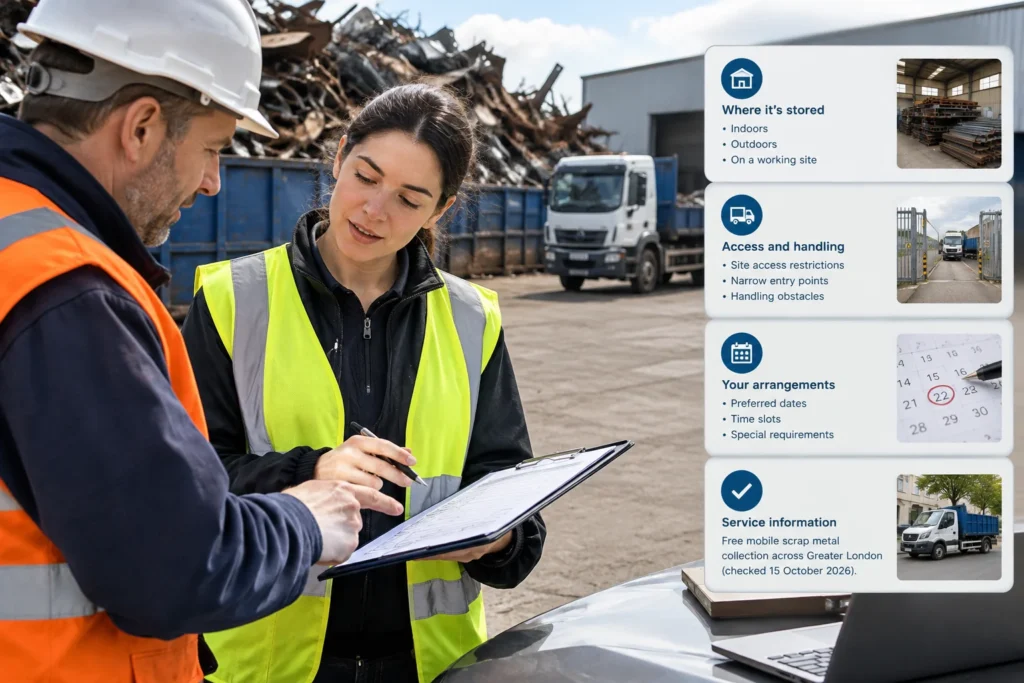
Industrial change is worth understanding, but a useful collection enquiry concerns the material available now. The key questions are what can be accepted, how it can be accessed and what arrangements need confirming. A forecast about future furnace demand cannot answer those questions.
Alongside the material description, provide these logistical details:
- Where the metal is stored, including whether it is indoors, outside or within a working site.
- Any access restrictions or handling obstacles that could affect collection arrangements.
- Your preferred arrangements, making clear which dates or practical requirements need confirmation.
Service information checked on 15 October 2026 states that Premier Scrap Trading Ltd provides free mobile scrap metal collection across Greater London. Arrangements include on-site weighing, a printed receipt and bank-transfer payment where the material has resale value. Confirm acceptance, availability and applicable arrangements for your particular load rather than assuming a time slot or payment.
Agreeing those details is more useful than making assumptions from a general service description. An enquiry is the opportunity to resolve uncertainty about both the material and the practical arrangements before committing to a collection.
The wider conclusion remains qualified but useful. Electric arc furnaces could support greater domestic use of recovered steel and reduce some reliance on imported finished products. Scrap quality, primary iron requirements and changing demand mean they are not a simple route to self-sufficiency.
For customers, accurate information is the practical contribution: describe the material honestly, prepare it sensibly and obtain current terms. For scrap metal collection in London, call Premier Scrap Trading Ltd on +44 7931 361 034 or enquire about a collection online to confirm what can be collected, discuss availability and ask for current prices.
Sources and further reading
Questions about furnaces and scrap recycling
Could electric arc furnaces make the UK self-sufficient in steel?
They could support greater domestic production, but self-sufficiency is not assured. The government strategy aims for domestic production to supply 40–50% of UK demand, while recognising a continuing role for imports.
Does all collected metal go into steelmaking?
No. Steelmaking requires suitable metallic feedstock. Copper, brass and aluminium are separate recycling categories, and a mixed metal collection should not be treated as a single steelmaking input.
What does low-residual scrap mean?
It means scrap with low levels of unwanted elements for the intended steel product. Basic customer sorting and appearance cannot certify that material meets a steelworks’ technical specification.
Is all UK scrap that is not used domestically being wasted?
No. The difference between scrap generated and scrap used domestically does not establish its destination. It should not be described as landfill, an available stockpile or a verified export total without separate evidence.
Will new furnaces increase the payment for my scrap?
A national demand forecast cannot establish an individual payment. A quotation depends on the actual material, grade, condition, weight and current demand; some items may have no resale value.
Should I identify the exact steel grade before requesting collection?
You do not need to certify an industrial grade yourself. Describe the items, provide photographs and mention attached materials or uncertainty so the collector can assess what needs checking.
Does Premier Scrap Trading Ltd accept old washing machines and fridges?
Business information checked on 15 October 2026 states that old washing machines and fridges are not accepted. Confirm other unusual, hazardous or mixed items before making collection arrangements.
What collection and payment records does Premier Scrap Trading Ltd provide?
Business information checked on 15 October 2026 includes on-site weighing and a printed receipt, with bank-transfer payment where the material has resale value. Confirm the arrangements for your particular load before booking.