


What market forecasts mean for your load
Aluminium scrap supply forecasts do not, by themselves, mean your scrap is worth more or that you should delay collection. The evidence discussed here does not establish a UK shortage or a higher collection value for an individual Greater London load. Identify your material, explain its condition and quantity, and request a current assessment.

Does an aluminium scrap shortage forecast mean your metal is worth more?
A forecast concerns a defined market over a stated period. Your enquiry concerns actual material at a particular location. Those questions may be connected, but they are not interchangeable. A prediction about US supply cannot establish the value of aluminium removed during a London refurbishment.
Even the phrase aluminium scrap shortage needs qualification. It could concern a particular grade, a buyer’s requirements or a limited period. Without those details, it is too broad to guide a selling decision. It also says nothing definite about whether your items meet a buyer’s needs.
Three distinctions help: what the forecast measures, whether the metal is commercially usable, and how your load will be assessed. Keeping these separate prevents a market headline from becoming an unsupported price expectation.
That does not make supply news irrelevant. It makes it a starting point for questions rather than a reason to assume a better return. Ask about current terms for the material you actually have, rather than treating a prediction as an offer.
A useful answer should also distinguish a general market movement from an individual valuation. Even where a report accurately describes its own market, your load still needs identification and weighing. Its condition and any mixed components remain relevant. The practical outcome is therefore a better-informed enquiry, not a price conclusion drawn before anyone has assessed the aluminium.
What aluminium scrap supply evidence actually measures
The evidence covers an industry event, a short-term sentiment survey and a longer-term resource projection. These are different kinds of information. Reading them together requires attention to geography, definitions and time horizon, rather than choosing whichever appears most favourable to sellers.
ReMA’s official Roundtables programme places the event in Chicago on 16–18 September 2026, with an aluminium discussion scheduled for 18 September. An agenda verifies that a discussion was scheduled. It does not, on its own, verify a particular forecast or identify who made it.
| Evidence | Geographical scope | Time horizon | What it can establish |
|---|---|---|---|
| Evidence ReMA Roundtables programme | Geographical scope Event in Chicago, US | Time horizon 16–18 September 2026 | What it can establish Event dates and scheduled topics, not a shortage prediction. |
| Evidence AMU recycler survey | Geographical scope Overseas market respondents; not a UK supply assessment | Time horizon Three-month outlook published on 24 September 2026 | What it can establish Respondents’ expectations, not a measured surplus. |
| Evidence ReMA commissioned availability study | Geographical scope United States | Time horizon Through 2040 | What it can establish Projected end-of-life availability against domestic recycled aluminium consumption. |
AMU’s survey published on 24 September 2026 reported that three quarters of responding recyclers expected an oversupplied market over three months. That is a finding about expectations. It does not prove that a surplus occurred, nor does it describe UK collection conditions.
Meanwhile, ReMA’s yearbook describes commissioned research projecting that available US end-of-life aluminium would grow faster than domestic recycled aluminium consumption through 2040. Its availability measure includes metal not yet recovered, including construction material left in place.
These findings need not contradict one another. A long-term estimate of recoverable material cannot settle a short-term question about ready-to-use scrap. Likewise, a survey can indicate changing sentiment without establishing physical stock levels. Neither provides a direct valuation for a London seller.
The distinction matters whenever a headline compresses several questions into one. Before applying it to your decision, establish whether it describes expectations, potential resources or material actually available to buyers.
Why aluminium scrap availability is not the same as usable supply
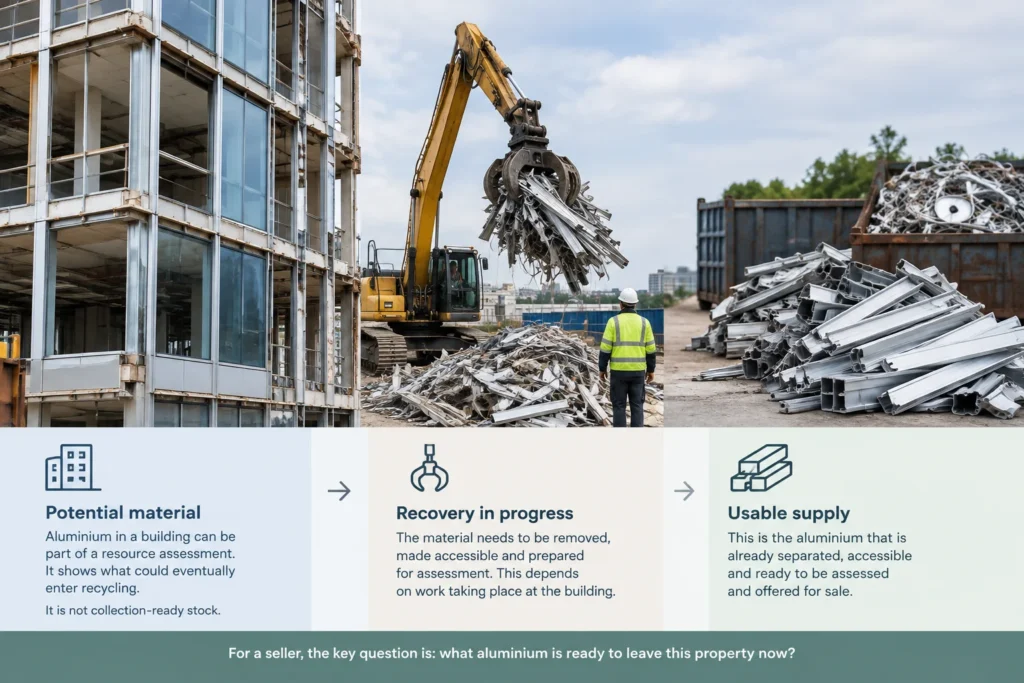
Potential material is not collection-ready stock
Aluminium scrap availability can describe potential material rather than metal already offered for sale. A resource assessment may identify aluminium that could eventually enter recycling. That does not mean someone has removed it, made it accessible or prepared it for a buyer.
The construction example in ReMA’s yearbook makes this distinction concrete. Aluminium remaining in a building may appear within a broad availability estimate. It is not equivalent to a stack of separated offcuts ready for assessment. Recovery depends on the material actually becoming available through work on that building.
For a seller, the useful question is narrower: what aluminium is ready to leave this property now? Material still serving a purpose should not be treated as collection stock merely because a market forecast discusses recoverable metal.
Different sources create different enquiries
End-of-life aluminium comes from products or components reaching the end of their use. Fabrication offcuts arise while making or fitting something. A refurbishment can produce both, but their condition and accompanying materials may differ.
Separately stored offcuts present a different identification question from removed components with other materials attached. The distinction does not automatically establish a grade or price. It tells you what information to provide and what the collector may need to clarify.
Keep descriptions specific. “Aluminium offcuts with no known attachments” communicates more than “metal waste”. If you are unsure whether an item is aluminium, say so. An uncertain description is more useful than a confident but inaccurate label.
Usable supply depends on the buyer’s requirements
Collected metal still needs to suit its intended recycling route. A broad total for aluminium cannot show whether the available material matches a particular requirement. Separate aluminium items and mixed loads therefore need different explanations when you make an enquiry.
This is why attachments and condition matter. A collector needs to understand what is present, not just the name of the main metal. Describing the whole item helps avoid an assessment based on an incomplete picture.
Primary aluminium is another separate category: it is newly produced metal rather than recovered scrap. A shortage involving primary aluminium is not, by itself, evidence of a shortage of aluminium scrap. Any relationship between the two requires supporting market evidence, not an assumption that the terms mean the same thing.
Would tighter scrap supply necessarily benefit recyclers?
No automatic benefit follows. “Recycler” can describe businesses doing different work, from collecting material to preparing it for another buyer. A change that helps the holder of suitable scrap does not necessarily help every business involved in moving and processing it.
A seller may focus on the amount offered for a load. A collector must also consider the terms on which it acquires that material and the work required to handle it. A processor needs material that meets the requirements of its next buyer. These are related commercial decisions, not identical ones.
Consider a hypothetical rise in a downstream selling price. If the cost of acquiring suitable scrap also rises, the selling-price movement alone does not establish a greater return for the recycler. The preparation needed for a mixed load adds another consideration. No margin figure can be inferred from the headline.
Equally, a business holding suitable material might find a tighter market relevant to its next enquiry. That is a possibility to investigate, not a promise that every aluminium-containing item becomes more valuable. The material still needs identification and an assessment under current conditions.
The contrasting evidence reinforces this caution. AMU’s respondents expressed a short-term expectation of oversupply, while ReMA’s commissioned study examined longer-term potential availability. Neither supports a blanket statement that all recyclers face scarcity or stand to gain from it.
For customers, the practical distinction is between a market argument and an actual collection offer. Ask what the assessment covers and what remains uncertain. A discussion of demand should not leave you assuming that an unweighed, unidentified load has an agreed value.
There is no basis here for claiming that Premier Scrap Trading Ltd benefits from a predicted shortage. Its relevant role is to discuss suitable materials and collection arrangements. A customer enquiry can establish those practical details without relying on a claim about the company’s position in an overseas market.
When reading future reports, look for the missing commercial detail: whose material, which grade, which market and which period? Those questions help distinguish a conditional opportunity from a conclusion that the evidence cannot support.
What overseas forecasts can tell London sellers
For Greater London sellers, international reports are context rather than local measurements. The US evidence discussed here does not establish a shortage, stronger demand or a collection price in London. It also cannot show whether a particular load will be accepted.
Imagine a refurbishment in Camden producing aluminium offcuts and removed fittings. The useful task is to describe those materials separately, identify any attachments and explain how much is available. Applying an overseas shortage forecast to the whole pile would leave the important collection questions unanswered.
This is an illustrative customer situation, not evidence of a measured market trend in Camden or a promise about a particular collection address. Confirm arrangements for the actual location when making an enquiry.
Grade, condition, weight and current demand all matter to an individual assessment. A market report may discuss only some of those factors. It cannot tell a collector whether your material is correctly identified, how much it weighs or what other components are attached.
Use the company’s scrap metal price information as a starting point for a current discussion, not as a substitute for describing your load. No numerical price is quoted here because a general market explanation cannot establish a suitable figure for your material.
Timing is another practical decision. If material needs clearing, consider collection arrangements alongside your space and handling needs. This evidence does not justify speculative stockpiling or identify the best day to sell. Waiting for a forecast to come true could simply leave the original clearance task unresolved.
For recurring business scrap, keep clear records of what arises and how it is stored. That can make later enquiries more precise without requiring you to predict the market. For a one-off household or refurbishment clearance, a straightforward description and current assessment address the immediate question more directly than a long-range outlook.
Check what aluminium you have before requesting a quote
A useful enquiry describes the material as it stands. You do not need to assign a technical grade you cannot verify. Start with what you know, distinguish uncertainties and explain anything that could affect identification or handling.
The company’s price page, checked on 15 October 2026, includes aluminium examples such as sheet, gutters and automotive parts. These are examples for discussion, not blanket acceptance categories for every condition or assembly. Individual items still need confirmation, particularly where other materials remain attached.
- Describe the items: explain what they are and whether they are offcuts, removed components or a mixture.
- Separate certainty from guesswork: identify known aluminium and flag anything whose metal type is uncertain.
- Disclose mixed components: mention attached materials and other metals rather than describing only the aluminium content.
- Give available quantity information: provide an approximate amount and say whether any stated weight is measured or estimated.
- Explain access: describe where the material is stored and any constraints relevant to moving it.
Clear photographs can support these details. An overall view helps explain the load, while closer views may show attachments or mixed components. Photographs do not guarantee remote identification, acceptance or a final valuation. Treat them as supporting information for the conversation.
If materials are already separate, keep them identifiable where that is safe and practical. Do not turn preparation into a dismantling project. There is no need to remove structural components, tackle hazardous items or carry out risky separation simply to make an initial enquiry.
Explain uncertainty instead. If a component remains fitted or is difficult to access, say so before arrangements are agreed. A collector needs an accurate picture of what is ready for collection, not an assumption that every item shown can be removed.
Unusual, hazardous or mixed materials require confirmation. An item containing aluminium is not automatically an accepted aluminium load. The company information checked on 15 October 2026 states that old washing machines and fridges are not accepted. Their metal content does not change that exclusion.
The company’s metal recycling information provides broader service context. Use it alongside a specific enquiry rather than treating a general recycling description as approval for an unusual item. Accurate disclosure helps both sides identify questions before a collection is arranged.
How to arrange collection without relying on a market headline
Once you can describe the aluminium, move from market context to the collection itself. The following five steps cover the practical sequence. They are not a valuation formula, and completing them does not establish that every item is suitable or has resale value.
- Send the load details. Provide the material description, photographs where available, approximate quantity and collection location. Make clear which details are estimates.
- Confirm suitability. Discuss the particular items, attached components, mixed materials and access constraints. Resolve uncertainties before assuming that collection can proceed.
- Ask about current price information. Clarify what the assessment covers and whether it remains subject to identification, condition and measured weight.
- Agree the arrangements. Confirm the collection details and any requested preparation. Do not assume a particular date or time until it has been agreed.
- Understand the collection outcome. Confirm how weighing, the receipt and any eligible bank-transfer payment will be handled for your material.
Each step answers a different question. Description establishes what you believe you have. Suitability establishes whether it can be considered for collection. Current price information addresses the material rather than a general overseas forecast. Arrangements establish the practical plan.
Keep the distinction between an initial indication and a confirmed assessment clear. If the quantity is estimated or the metal remains uncertain, ask how those uncertainties will be resolved. This is more useful than assuming that a figure discussed before inspection applies regardless of what is present.
The company information checked on 15 October 2026 describes on-site weighing, a printed receipt and bank-transfer payment where the material has resale value. Confirm how these apply to your enquiry. A general description of the process does not mean every load will produce a payment.
Collection timing also needs agreement. A market headline cannot establish availability, and an initial conversation should not be treated as a reserved slot. Explain any relevant clearance deadline early so that arrangements can be discussed realistically.
For further practical questions, consult the company’s collection FAQs. Where your load differs from a general example, ask about that difference directly. The aim is a shared understanding of the actual material, not simply completion of a checklist.
Use supply forecasts as context, not a collection quote
The central distinction is straightforward: a forecast is not a stock count, potential availability is not usable scrap, and neither is a valuation of your load. Aluminium scrap supply news becomes useful when its definitions, location and time horizon are clear.
The available evidence does not justify assuming a shortage in Greater London. It also does not establish that delaying collection will improve your return. Different market measures can point in different directions because they answer different questions.
For a seller, the more useful decision process starts with accurate material information. Identify what is ready, disclose attachments and uncertainty, and ask for current terms. That turns a broad market discussion into questions a collector can actually answer.
Aluminium scrap availability may matter to the wider industry over many years. Your immediate concern is whether your particular material is suitable, how it will be assessed and what arrangements can be agreed. Keep those practical questions at the centre of the enquiry.
The company information checked on 15 October 2026 describes Premier Scrap Trading Ltd’s free mobile scrap metal collection in London for domestic and business customers across Greater London. Suitable materials and collection arrangements need confirmation; the service does not imply universal acceptance or a guaranteed collection time.
Call 07931 361 034 or book a collection online to discuss your scrap metal, confirm what can be collected and ask for current prices.
Questions about aluminium scrap forecasts and collection
Should I delay selling aluminium because of a shortage forecast?
An overseas forecast alone is not a sound reason to delay collection. Consider your clearance needs, available storage and a current assessment of the material rather than assuming its value will rise.
Can aluminium be widely available while a particular scrap grade is scarce?
Yes. Potentially recoverable aluminium is not necessarily collected, sorted or suitable for a particular buyer. A broad availability estimate cannot establish the supply of every usable grade.
Is an aluminium scrap shortage confirmed in Greater London?
The event programme, overseas survey and US availability projection discussed here do not establish an aluminium scrap shortage in Greater London.
Can photographs establish the value of my aluminium?
Photographs can support an initial discussion, but they may not establish the metal, grade, condition or weight. Ask which details need confirmation before relying on an assessment.
Should I remove attachments before requesting collection?
Describe attachments first and ask what preparation is appropriate. Do not undertake hazardous dismantling, remove structural components or attempt risky separation to obtain an initial assessment.
Does every aluminium-containing item have resale value?
No. Acceptance and value depend on the particular material and its assessment. Mixed or unusual items need confirmation, even when aluminium forms part of the item.
Does Premier Scrap Trading Ltd accept old washing machines or fridges?
No. The company’s information checked on 15 October 2026 states that old washing machines and fridges are not accepted.
Is collection free, and how are eligible payments handled?
The company information checked on 15 October 2026 describes free mobile collection, subject to confirming suitable materials and arrangements. It also describes weighing, a printed receipt and bank-transfer payment where the material has resale value.