


How to set up a metal-sorting station in a London workshop

Where should a metal offcut go when a fabrication or repair job ends? A metal-sorting station gives staff a clear answer for recognisable scrap and a separate place for anything that needs checking. It also makes the contents easier to describe when arranging a collection. A labelled container alone does not establish whether everything inside can be collected or has resale value.

Start with the metals your workshop actually produces, the routes staff use and the space available. The goal is a repeatable process: identify an offcut while its origin is known, store it safely, flag uncertainty and review the resulting scrap before transfer.

What should a workshop metal-sorting station achieve?

The first test is whether a worker can choose the right destination while an offcut’s origin is still clear. At a cutting bench, a stock label or job sheet may identify a metal. After several shifts in an unmarked bin, similar-looking pieces become harder to describe. A convenient, labelled destination reduces the temptation to leave scraps in a mixed pile for someone else to identify.

The second aim is to preserve useful separation. GOV.UK advises businesses to keep different waste types separate to prevent contamination and to store waste safely. In a workshop, that points towards containers for recurring, identifiable metals rather than a container for every possible alloy. The arrangement should reflect actual work: a repair shop producing occasional brass fittings needs a different layout from a fabrication shop producing regular steel sections.

Give uncertainty a clear destination too. A marked checking point allows staff to flag an unfamiliar part instead of guessing. Decide who will investigate it, and retain useful details about its originating job or stock. This point is not a general-purpose bin, nor does it replace the separate assessment and storage needed for potentially hazardous waste.

A workable metal-sorting station keeps the surrounding workspace usable. Check routes to benches and exits, room to handle full containers and whether anyone has to reach into sharp offcuts to read a label. The layout must still work when containers approach their practical fill limits, not just when they are empty.

Finally, imagine explaining the scrap to a collector. Can someone distinguish known steel from uncertain assemblies, describe attachments and estimate what has accumulated? That information supports an accurate collection enquiry and responsible waste transfer. Workshop scrap metal sorting is successful when everyday decisions produce an honest account of the material, not simply tidy-looking bins. Neither careful sorting nor a clean container guarantees acceptance, payment or a particular collection arrangement.

Plan scrap metal storage: location and containers

Walk through an ordinary job before deciding where the metal-sorting station belongs. Note where offcuts arise, how far staff carry them and whether the route crosses another work activity. A central storage position may be convenient for removal but too remote from a busy bench. Where suitable, a smaller labelled container near the point of work can feed into the main station under an agreed handling routine.
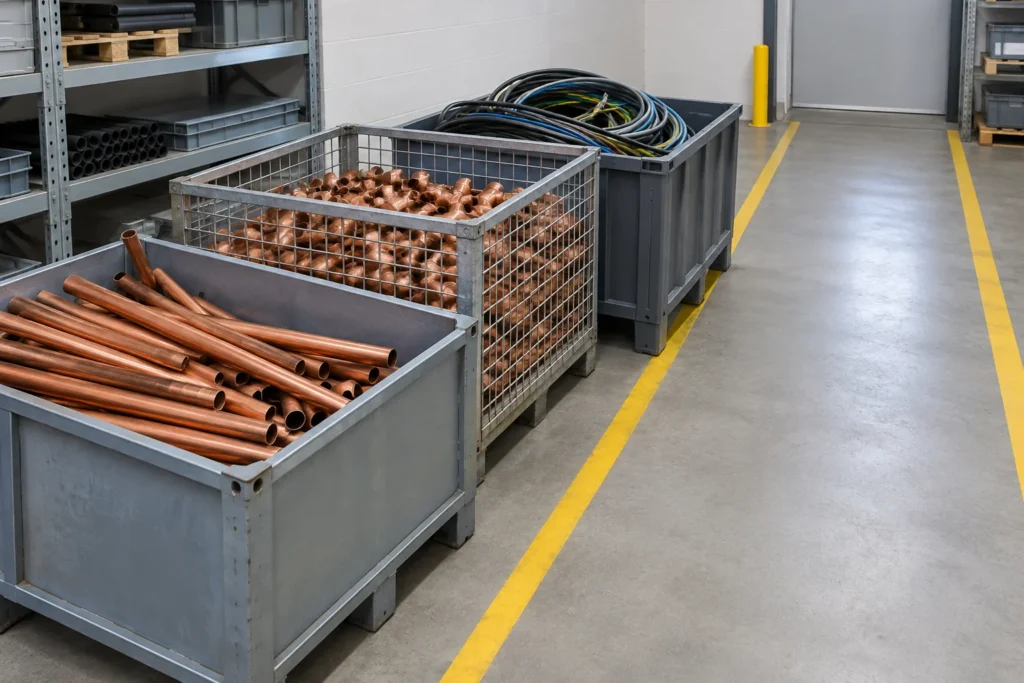
Containers of pipe, fittings and cable beside a clear access route
Leave the route to the containers clear.

Choose containers according to contents and how they will be moved when full. Dense metal offcuts can make a modest-looking container difficult to handle. Long sections may project into a passage; cut sheet and short pieces can expose sharp edges. Set a practical fill limit and decide how staff should handle oversized pieces rather than allowing them to lean against the nearest wall.

HSE guidance on steel and other metal stock identifies handling, storage and sharp-edge hazards relevant to workshop scrap. Apply the workshop’s own assessment to the weight, shape and movement of its material. A container suitable for small aluminium pieces may not be appropriate for long steel sections. Consider stable positioning, sound container condition and the means of moving a full load without improvised lifting.

GOV.UK says business waste should be stored safely and securely in suitable, clearly labelled containers. Check whether fragments could escape and whether outdoor scrap needs protection from weather. If rain could create contaminated run-off, suitable covering and storage arrangements matter. Keep labels readable after containers have been moved, and make somebody responsible for noticing damaged containers or missing covers.

Test the proposed position during normal work. Can staff see the label while carrying an offcut? Is there room to deposit it without dropping metal across a walking route? Can the container leave the area without moving other stock first? Adjust the arrangement if those tasks prove awkward. A layout that relies on people stepping over scrap or lifting a full bin unexpectedly is not practical scrap metal storage.

Reserve accessible space for the checking point as well as confirmed metal streams. If an uncertain part has nowhere contained and clearly marked to go, it may end up in the nearest labelled bin. Balance short routes from work with safe handling, secure storage and the ability to review the contents before collection.


Label the metal streams staff can recognise

Build labels around regular output, not a theoretical catalogue of metals. Depending on the workshop’s jobs, useful streams might include steel, stainless steel, aluminium, copper or brass. Give a metal its own container when it arises often enough and staff can identify it consistently. Put the description where someone approaching with an offcut can read it, including on another side if containers are accessed from more than one direction.
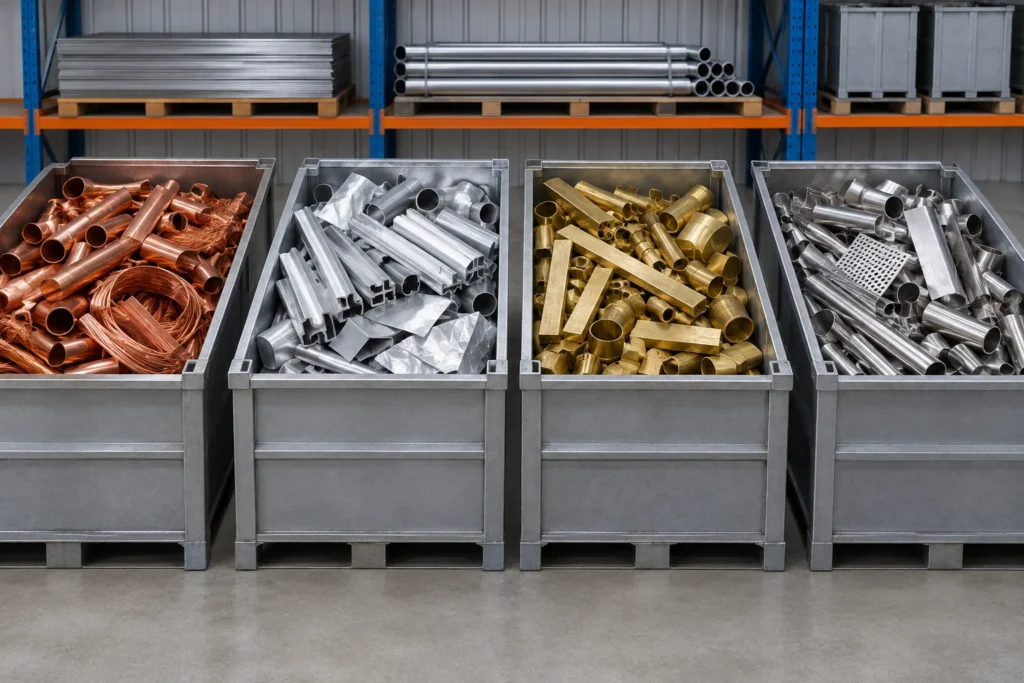
Separate containers for copper, aluminium, brass and stainless steel at a metal-sorting station
Choose labels that match the materials the workshop handles regularly.

Use plain words rather than a code only one employee understands. ‘Steel offcuts’ gives an immediate instruction. Where grade affects identification but appearance is inconclusive, keep any available stock description or job information. Do not turn a visual guess into a stated alloy grade. A clearly marked checking point is preferable to a specialist label that staff cannot apply confidently.

Keep insulated cable identifiable as cable instead of adding it to a container labelled clean copper. Assemblies with attachments also need an accurate description. Premier Scrap Trading Ltd lists steel, stainless steel, aluminium, copper, brass and cables among its material categories. Those broad categories do not establish that every grade, cable type or mixed assembly can be collected in the same condition; check the specific material when enquiring.

Give staff a simple decision rule: use a known-metal container only when the offcut matches its label. Otherwise, use the checking point and record anything known about the source. If an unfamiliar component may be hazardous, follow the separate assessment and storage arrangements rather than treating the checking point as an ordinary scrap destination.

Review the labels as jobs change. Regular aluminium sections may justify a dedicated container that was unnecessary last month. Conversely, numerous nearly empty specialist bins may take up space without improving sorting. If staff repeatedly confuse streams, look at the container positions and wording. A shorter route or clearer description may solve more than another bin.

The result should be a more accurate account of workshop scrap. Separate what workers actually know, keep cable and attached components identifiable, and leave uncertain grades open for review. A metal-sorting station tailored to recurring work is easier to explain and maintain than one copied unchanged from another premises.
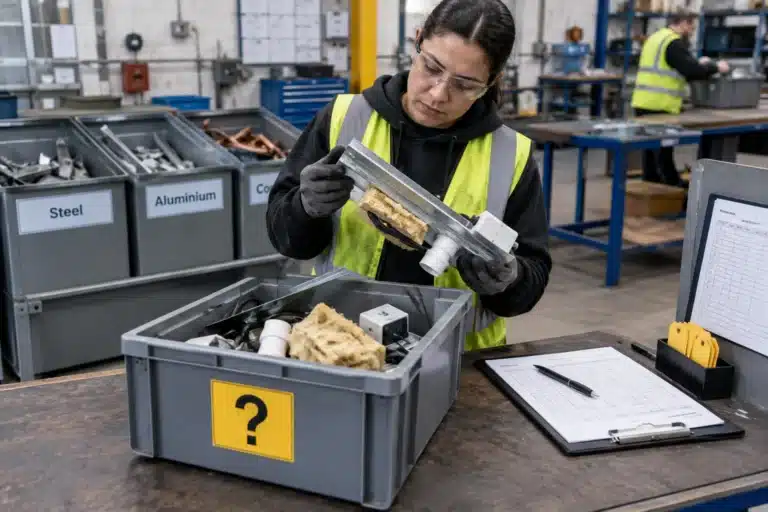
Keep contamination and uncertain items out of sorted containers

At a metal-sorting station, a worker examines an unidentified part above a bin marked with a question mark

Check more than the main visible metal before sorting an offcut. Insulation, plastic fittings, timber, attached equipment, coatings or residues may affect how the material should be described. Staff need not dismantle an assembly simply to make it fit a label, particularly if doing so creates a handling risk. They do need a way to identify that the piece is not the same as a clean, known offcut.

A contained, marked checking point helps keep unknown assemblies out of confirmed streams. Ask workers to retain useful information: the originating job, any stock description and visible attachments or concerns. Assign someone to resolve each question. They may identify the metal, seek further information or arrange another route. Without follow-up, the checking point becomes a mixed container with a different name.

Potentially hazardous waste belongs outside the ordinary sorted-metal workflow. GOV.UK guidance for producers and holders of hazardous waste covers separation, safe storage and the requirements that apply when it is collected. If a part may contain hazardous material, or its contents cannot be established, assess it and check the appropriate route and documentation before transfer. A metallic outer casing is not proof that the whole assembly is ordinary scrap.

Compare a cut piece from labelled aluminium stock with an assembly removed during a repair. The first can be placed in an established stream if its identity is known. The second may include sealed components or residues requiring investigation. Holding it for assessment improves the description; it does not imply that the assembly will eventually be accepted for a standard scrap collection.

Look for patterns of accidental mixing. Packaging in a steel container may show that the general-waste point is poorly placed. Cable repeatedly deposited with clean copper may indicate a missing label or insufficient space. Fix the reason behind a mistake rather than merely asking staff to be more careful. Do not ask anyone to search through a full container of sharp or unknown offcuts without considering the handling risk.

Separation makes exceptions visible. Even where a collector ultimately decides how a particular load can be handled, the workshop can say what it knows and what still needs checking. Scrap metal storage becomes more dependable when potentially hazardous waste has its own appropriate process and ordinary metal streams remain accurately described.

Build sorting into the daily workshop routine

Containers help only if the sorting habit survives busy shifts and changes in staff. Put a brief instruction where people deposit offcuts, explain the checking point and identify who resolves uncertain material. The following five checks are practical workshop recommendations, not a prescribed legal inspection timetable:

  1. Identify the offcut at the job. Use available stock labels or job information while its origin is clear; flag anything whose metal or contents cannot be identified.
  2. Match the label. Deposit a known offcut in its corresponding container, and keep insulated cable identifiable as cable rather than clean copper.
  3. Check safe placement. Observe the container’s practical fill limit and keep projecting or sharp material from obstructing access.
  4. Flag exceptions. Record unfamiliar attachments and send uncertain material for review, subject to separate controls for anything potentially hazardous.
  5. Review the metal-sorting station. Check labels, container condition, visible mixing, unresolved questions and access before collection is arranged.

Set a review frequency that fits the amount of scrap generated. A busy cutting area may need attention within a shift, while a smaller repair operation might use a closing check. Name someone who can act on exceptions. A note about an unknown alloy is helpful only if a person takes responsibility for checking the relevant job details or obtaining advice.
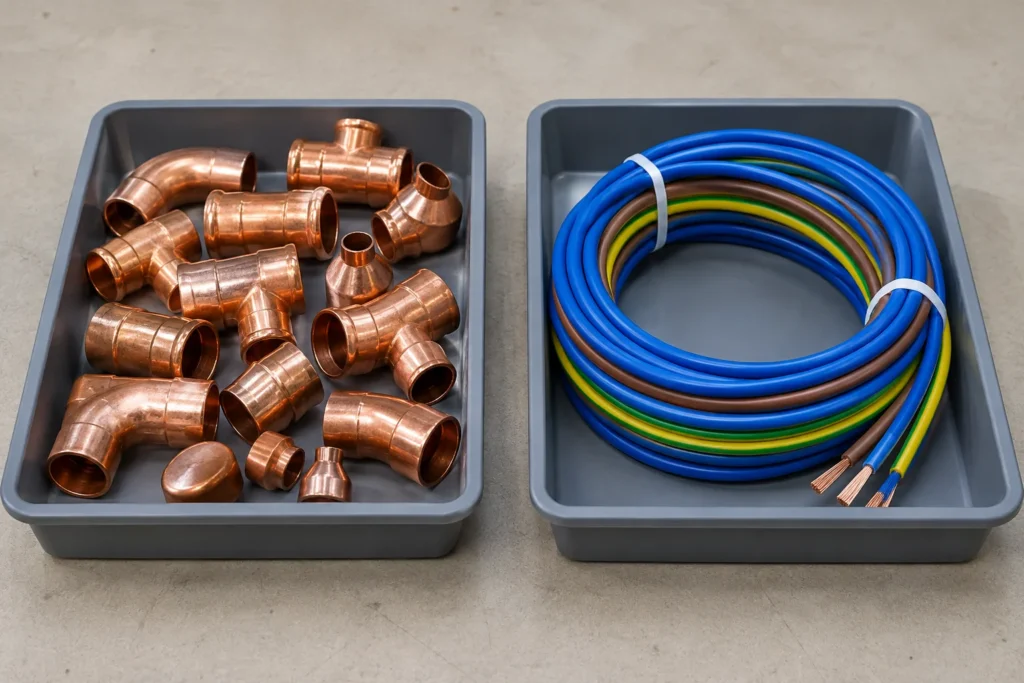
Copper fittings and insulated cable in separate trays on a workshop bench
Separate trays give the next shift a clear place to put fittings and cable.

If the wrong offcut appears in a container, do not assume a worker should rummage through sharp metal to retrieve it. Consider whether the problem can be corrected safely under the workshop’s handling arrangements. If it cannot, record the uncertainty and raise it when describing the load. Early checks should prevent last-minute hazardous handling, not cause it.

Keep notes proportionate to the question. A job number, stock description or note about an attachment may be enough to resolve an individual offcut. If the same mistake keeps occurring, change the label, location or instruction rather than relying on people to remember an exception. Good workshop scrap metal sorting gives staff permission to say that they do not know.

Use routine reviews to spot a layout that no longer fits production. A pile beside an almost empty bin may signal that the container is inaccessible or poorly sized. Correct the cause and the metal-sorting station becomes easier to use during ordinary work.

Check the metal-sorting station before arranging collection

Walk around the containers with someone familiar with recent jobs. Confirm that the contents still match each label and note significant attachments, mixing or uncertain grades. Check the separate holding point rather than quietly including its contents in an identified metal stream. Estimate quantities from container sizes and any bulky pieces stored separately. An estimate helps an initial enquiry; it does not replace assessment or weighing.

Prepare a straightforward description: which metals are identified, which cable is present, what attachments remain and what is unknown. Mention long or heavy pieces and explain any access constraints. If steel offcuts have become mixed with assemblies, describe that change. Calling a load clean metal when nobody has checked it makes the collection discussion less useful.

The GOV.UK waste duty of care code of practice says a waste holder should take reasonable steps to check that the next holder is authorised to accept the waste and provide an accurate written description when transferring it. Plan for those responsibilities before handover. Ask about the authorisation relevant to the proposed transfer rather than assuming a collection vehicle or business name establishes it.

For non-hazardous business waste, check GOV.UK guidance on waste transfer notes and arrange the applicable documentation. One process should not be assumed to cover every material found at the station. Potentially hazardous waste needs separate assessment, safe storage, an appropriate collection route and a check of applicable consignment requirements. Keep unresolved material out of an agreed ordinary scrap load until its position is clear.

Update the description if more material accumulates after the first conversation. Perhaps a container previously holding identifiable sections now contains attached fittings, or a repair job has produced additional cable. Ask whether the proposed arrangements still suit the actual contents. Workshop metal collection works better when the account provided is current, rather than based on an earlier photograph of tidy bins.

Make one person responsible for communicating the current description. Another worker should still be able to locate the relevant containers and identify anything under review. This check connects day-to-day sorting with responsible transfer while leaving acceptance and any eligible value to discussion of the particular material.

Put the layout to work in a Greater London workshop

Imagine a small repair workshop in Lewisham with two benches and limited storage. Regular jobs produce short steel pieces, occasional aluminium sections identified from stock and insulated cable. Rather than using a single mixed bin by the door, the team puts a suitably sized steel container along a normal work route. Aluminium has a separate label, cable remains identifiable, and unfamiliar assemblies have a marked checking point.

A worker cuts a piece from known aluminium stock and deposits the offcut in the aluminium container. Later, another worker removes a metal-cased assembly from equipment but cannot establish what an attached component contains. The assembly stays out of the ordinary metal streams while the responsible person reviews available job information and the appropriate route. Its visible casing does not justify describing the whole assembly as clean aluminium.

At the end of the day, the nominated colleague checks whether labels remain readable, containers are usable and loose offcuts have an appropriate destination. Steel is approaching its practical fill limit, cable is separately identifiable and one assembly remains unresolved. The workshop can then describe the confirmed streams and approximate quantities in a collection enquiry, while asking a separate question about the assembly.

This is an illustrative Greater London routine, not a claim about measured local demand or a confirmed collection booking. A workshop with different regular metals would choose different labels. Its exact container sizes, handling arrangements and storage position would depend on its premises and assessment. Copying the example without checking actual work routes and scrap would defeat the purpose of the station.

Space matters on an ordinary busy day. Workers should not have to move one full container to reach another or lay long sections across the checking point. If storage is limited, fewer accessible, properly described containers may be more useful than many specialist bins that no one can reach. A clear route for recording uncertain material also prevents the smallest workspace from becoming a mixed-metal guessing game.

The practical takeaway is a sequence rather than a postcode-specific formula: identify offcuts while their source is known, keep exceptions visible, check safe storage and describe the actual material before transfer. Those decisions apply to workshops across Greater London without assuming that every premises produces the same scrap or can use the same collection arrangements.

What to confirm when booking workshop scrap collection

Use the metal-sorting station check to make a specific enquiry. Name the identified metals, give an approximate quantity and explain how the scrap is stored. Mention cable, attached components, heavy containers, long sections and unresolved assemblies. Ask which materials can be collected as presented and whether anything needs another route. The fact that an assembly contains a listed metal does not establish that the entire assembly is suitable for collection.

Premier Scrap Trading Ltd describes workshop collections and lists copper, brass, aluminium, stainless steel, steel and cables among its material categories. It states that old washing machines and fridges are not accepted, so arrange another suitable route for those appliances. Confirm unfamiliar grades, cable types and mixed assemblies before including them in a proposed workshop load.

Collection information and operating arrangements were checked on 23 September 2026. The business describes mobile scrap metal collection in London and across Greater London. Confirm the particular address, suitable materials and possible arrangement directly; the illustrative workshop does not establish a booking. Explain any difficult access or handling considerations at the outset so these can be discussed before a visit.

If potential value affects your decision, ask about current terms for the actual material. Grade, condition, weight and current demand can affect value, and sorting does not establish a fixed return. The company’s material and price information, checked on 23 September 2026, provides a starting point rather than a promise for a particular container. It says eligible material is weighed and payment is made by bank transfer; confirm what applies to your proposed load.

Before handover, agree what happens to anything that cannot be taken under the proposed arrangement. Keep potentially hazardous waste on its separate assessment and documentation route. If another job adds mixed material after the enquiry, update the description instead of relying on an earlier account. The metal-sorting station should help everyone distinguish confirmed scrap from material still under review.

A practical metal-sorting station gives staff a place for identifiable offcuts, a process for uncertainty and a clearer account for workshop metal collection. Call Premier Scrap Trading Ltd on 07931 361 034 or book a collection online to discuss suitable materials and scrap metal collection in London.

Further reading

Sources and guidance

Follow Premier Scrap Trading Ltd

Frequently asked questions

Identify the metals that regularly arise from work, provide clearly labelled containers for those staff can recognise, and establish a separate checking point for uncertain offcuts.

Keep them separate where both arise regularly and staff can identify them reliably. Hold an uncertain grade for checking rather than guessing.

Keep insulated cable identifiable as cable. Ask the collector whether the particular cable can be collected and how it should be presented.

Keep it out of known-metal containers, retain useful job or stock information, and have a responsible person assess its contents and appropriate route.

No. Assess and store it separately, and check the appropriate collection route and documentation before transfer.

Describe the identified metals, approximate quantities, container sizes, attachments, uncertain material and access arrangements. Confirm whether unusual material can be collected.

No. Any eligible value depends on the actual material, grade, condition, weight and current arrangements. Ask about the particular load.

No. Premier Scrap Trading Ltd states that it does not accept old washing machines or fridges. Arrange another suitable route for them.

Share this post:

Premier Scrap Trading Ltd

Premier Scrap Trading Ltd

London

I will be back soon

Premier Scrap Trading Ltd
We are based in London, and we provide fast, free and fair mobile scrap metal collection services to commercial and construction sites and domestic properties. Do not hesitate to contact us today for a free quotation. Let us know if you have any questions.
Start Chat with:
chat