


Digital waste tracking 2026 is a phased government service intended to record waste movements digitally. For London readers arranging a metal clearance, the most important confirmed starting point is 1 October 2026. From that date, permitted or licensed waste-receiving sites in England and Wales must report the receipt of waste through the relevant service.
That does not mean every householder, metal seller, landlord, contractor or collection business needs to use the service from October 2026. The first phase is directed at a particular group of receiving sites. Existing responsibilities relating to commercial waste, supplier records and traceable transactions continue separately.
This guide reflects official information checked on 3 August 2026. It is practical information, rather than legal advice. Its purpose is to help householders, landlords, tradespeople, construction teams and businesses understand the phased change before arranging scrap metal collection in London.

Premier Scrap Trading Ltd provides mobile collection across Greater London for domestic, trade and commercial customers. Clear information about the material, its origin, site access and any applicable documents can make a proposed collection easier to discuss. Customers do not need to become specialists in digital records before asking whether a load may be suitable.
What digital waste tracking 2026 means in London
Digital waste tracking is a government programme for creating more consistent digital records of waste movements. It is separate from the Scrap Metal Dealers Act 2013. Both can be relevant where metal is being transferred, but they have different purposes, operate through different requirements and do not begin at the same point for every party.
The first mandatory stage of digital waste tracking 2026 concerns permitted or licensed sites that receive waste in England and Wales. Official guidance states that these sites must report waste receipts from 1 October 2026. The requirement concerns the reporting of receipt at those sites; it is not a broad instruction for every person clearing unwanted metal from a property.
This distinction matters in Greater London because the source of a load can vary. A person clearing metal from their own shed or garden may be dealing with household waste. A tradesperson removing pipework during a refurbishment, a landlord managing a clearance, or an office disposing of surplus materials may instead be handling commercial waste. The address alone does not settle which responsibilities apply.
When considering digital waste tracking London arrangements, start with simple facts: where did the material arise, who is arranging the transfer, what does the load contain, and is it connected with a business activity? Those details can help identify whether wider duty-of-care paperwork is likely to be relevant. They also help a collection provider understand access, handling and material separation before a visit.
The service does not determine metal value. Scrap value can vary by type of metal, grade, cleanliness, condition, weight and current market demand. A recyclable item does not automatically have resale value. Readers looking for material categories or current price enquiries can consult the Premier Scrap Trading Ltd scrap metal prices page.
Digital waste tracking 2026 should therefore be viewed as a record-keeping development, not as a new price list or a replacement for every existing waste document. Customers can prepare usefully by giving an accurate description, keeping relevant business information together and confirming unusual items before a collection is arranged.
The confirmed timeline: October 2026, 2027 and later
The dates matter, but the scope attached to each date matters just as much. The following timeline is based on GOV.UK guidance checked on 3 August 2026. Organisations should read the official material directly when determining their own obligations.
| Stage | Timing | Confirmed position | Practical relevance |
|---|---|---|---|
| Receiving-site phase | 1 October 2026 | Permitted or licensed waste-receiving sites in England and Wales must report receipt of waste through the service. | Customers may be asked for clear material and collection information. |
| Collector phase public beta | Spring 2027 | A public beta is planned for carriers, brokers and dealers. | This is a later stage and does not make every collector subject to the October 2026 phase. |
| Collector phase mandatory use | October 2027 planned | Mandatory use is planned for carriers, brokers and dealers. | Relevant organisations should continue monitoring official updates. |
| Exemptions | Later phase | Waste exemptions are outside phase 1. | Do not assume every operator or waste activity is included at the start. |
Receiving sites without suitable software are expected to have a temporary spreadsheet submission route while they obtain appropriate software. The government expects that route to remain available until at least October 2027. This is operational information for affected sites rather than a process a householder would normally need to complete.
Official information also states that an annual registration charge of £26 will apply, once mandatory, to each legal entity creating or editing records in the service. It should not be treated as a general charge for customers booking a metal collection, or as a statement about the charges of a particular business.
The wording around the later stages is important. A planned public beta in spring 2027 and planned mandatory use from October 2027 are not grounds to assume a particular collector, dealer or carrier has a current service obligation. Roles, waste activities, registrations, sites and future guidance can all affect an organisation’s position.
For the latest detail on digital waste tracking 2026, use the GOV.UK digital waste tracking service guidance. Official guidance is the appropriate source for deciding whether a specific site, role or waste stream is within scope as the rollout develops.
Who needs to act now — and who does not
The clearest answer is that the mandatory phase beginning on 1 October 2026 applies to permitted or licensed waste-receiving sites in England and Wales. It is not a blanket requirement for every person involved in metal recycling or every customer arranging collection in London.
Householders clearing their own metal
A householder arranging the removal of metal from their own home is not generally completing business waste transfer documentation merely because the material is leaving the property. However, householders should take reasonable measures to ensure their waste is transferred to an authorised person. Keeping a note of who collected the material and checking arrangements before transfer are sensible precautions.
Describe anything mixed, damaged or unclear before booking. Electrical goods, liquids, insulation, sealed containers and items that may be hazardous need particular care. Do not rely on a photograph alone where contents or condition cannot be established. Premier Scrap Trading Ltd does not accept old washing machines or fridges, so they should be kept separate and handled through an appropriate disposal route.
Landlords, tradespeople and businesses
A clearance related to rental management, repairs, construction, an office, shop, workshop or other business premises may involve commercial waste. Work taking place at a house or flat does not automatically make its waste household waste. This is why landlords, tradespeople and property managers should consider whether waste transfer notes or other duty-of-care arrangements apply.
For these customers, useful preparation is more valuable than trying to predict every future reporting step. Identify the organisation responsible for the material, the full collection address, the nature of the metal and any non-metal contamination. Keep documents that apply to the transfer. The waste duty of care code of practice explains the wider responsibilities.
Collectors, carriers and site operators
Digital waste tracking 2026 does not allow a customer-facing guide to determine an organisation’s compliance position. A business may have separate responsibilities depending on its role, registration, permit, licence, exemptions, locations and waste activities. Organisations affected by the planned later collector phase should follow official updates and obtain suitable professional advice where necessary.
Nothing in this guide confirms that any named collection provider holds a particular permit, registration, software connection or reporting duty. It is best to discuss the actual materials and circumstances of a proposed collection directly, rather than making assumptions from a general rollout timetable.
Digital records and the Scrap Metal Dealers Act
The Scrap Metal Dealers Act remains relevant to scrap metal collection in London. It regulates aspects of scrap metal dealing, including supplier identity and address checks, transaction records and payment methods. Digital waste tracking is a separate programme for recording waste movements and receipts.
In practical terms, digital waste tracking 2026 does not replace applicable requirements under the Scrap Metal Dealers Act, and the Act does not itself create the phased digital tracking timetable. The same movement of metal can involve several legitimate records with different purposes: a transaction record, a weighing record, a business waste document and, where relevant, a digital tracking record.
Official supplementary guidance explains that dealers must verify a supplier’s name and address, keep prescribed transaction records and use traceable payment methods, including electronic transfer or a non-transferable cheque. For eligible material collected by Premier Scrap Trading Ltd, payment is made by traceable bank transfer after weighing. Whether material is eligible, and whether it has value, depends on the material and should be confirmed before collection.
Accurate names, addresses, dates, descriptions and weights are more than administrative details. They help establish a clear account of a legitimate transaction. They can also reduce confusion where a load contains several grades of metal, comes from a commercial clearance, or is handled by more than one party during a site handover.
Customers should have suitable identification and address information available where required, rather than expecting collection arrangements to bypass applicable checks. This supports a straightforward discussion and helps preserve records that are meaningful if questions arise later.
Read the Scrap Metal Dealers Act supplementary guidance for the official position. This article does not interpret the law for a particular transaction, supplier or business.
Waste transfer notes and commercial clearances
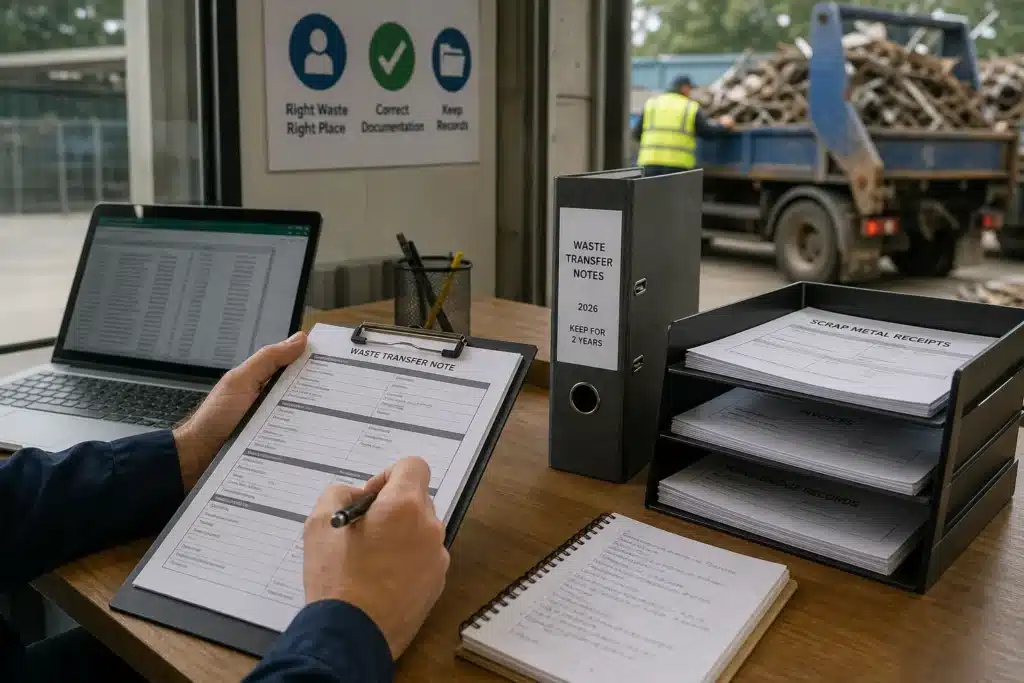
Waste transfer notes are often the best practical starting point for businesses arranging a metal clearance. For non-hazardous business waste, parties transferring waste generally need a waste transfer note or equivalent document and must keep a copy for two years. Depending on the circumstances allowed by guidance, this may relate to a single transfer or a season ticket arrangement.
Waste transfer notes are not interchangeable with a scrap-metal receipt, invoice, on-site weighing record or future digital service record. They can contain some of the same underlying facts, but each has a different practical or legal role. Keeping paperwork organised makes it easier to answer questions from a facilities manager, contractor, landlord or collection provider.
Before arranging a commercial collection, prepare the following information where applicable:
- The business name and full collection address, including access and loading details.
- A plain description of the material, such as mixed ferrous metal, copper pipe, brass fittings, aluminium frames, insulated cable or stainless steel.
- An honest indication of attached non-metal parts, packaging, liquids, contamination or unknown items.
- An estimated quantity, whether described as bags, a pile, a stack or an approximate weight.
- The proposed transfer date and the names of parties involved.
- Any existing transfer reference, site paperwork or contractor handover details.
Clear descriptions are useful because grades affect both handling and value. Ferrous metal is magnetic in many ordinary cases, while common non-ferrous categories include copper, brass, aluminium, lead and stainless steel. A mixed load can require more assessment than separated material. Do not cut sealed components, remove coatings or dismantle unfamiliar equipment merely to produce a tidier description.
Digital waste tracking 2026 may make well-organised information increasingly useful as later phases are introduced. It does not remove the need to check whether existing business waste paperwork applies now. The GOV.UK guidance on waste transfer notes provides practical information for business and commercial waste.
Where classification is uncertain, hazardous material may be present or the site has unusual conditions, seek suitable advice before transfer. An accurate cautious description is better than a confident label that does not match the actual load.
Preparing scrap metal for collection in Greater London
Good preparation supports safer handling, clearer conversations and more accurate material identification. It does not require customers to become metal experts. The aim is to make material accessible, describe its origin honestly and avoid mixing in items that have not been agreed in advance.
Sort only when it is safe and practical
Where practical, separate copper, brass, aluminium, lead, stainless steel, cable and car batteries into identifiable piles, containers or bags. This can help distinguish non-ferrous material from general ferrous scrap and make on-site weighing more straightforward. It may also reduce uncertainty when a collection is being assessed.
Do not strip cable or dismantle equipment if doing so creates sharp edges, exposes unknown contents or introduces another safety risk. Avoid cutting pressurised, sealed or potentially contaminated items. If material is unusual, damaged, mixed with non-metal components or may contain hazardous content, explain this before arranging collection.
Give realistic access information
Tell the collection provider about stairs, basement access, gates, parking limits, loading restrictions, site security and whether material is indoors or outdoors. On construction and commercial sites, identify a contact who can direct the collection and explain any induction, delivery booking or access procedure. These details are often as important as the material description in a busy London location.
Understand value without making assumptions
Digital waste tracking 2026 does not set scrap metal prices. Value can change with grade, cleanliness, quantity, weight and market demand. An item may be recyclable without having sufficient resale value for payment, and a mixed item may be more difficult to assess than separated material.
Premier Scrap Trading Ltd lists copper, aluminium, lead, brass, cables, car batteries and stainless steel among its material categories. For current information, see the scrap recycling in London guide and provide a clear description when contacting the business. Online information should not be treated as a fixed figure or as proof of the grade of a particular item.
Old washing machines and fridges are not accepted by Premier Scrap Trading Ltd. Keep these appliances out of a proposed metal collection. Confirm mixed, unusual or potentially hazardous materials beforehand, rather than assuming they can be included with ordinary scrap.
What digital tracking may mean for business sites
Construction, refurbishment and commercial clearances can involve several handovers. A site manager may identify surplus material, a contractor may move it, a facilities team may retain records and another person may arrange collection. Accurate information is useful through every stage, particularly as digital waste tracking 2026 develops beyond its first receiving-site phase.
Businesses can improve their process now by keeping a few core facts together: the site address, source of the material, description, estimated quantity, intended collection date and relevant contact. If a waste transfer note applies, make the description specific enough to be useful without claiming certainty that inspection cannot support.
For example, “mixed metal from office refit” gives limited information. “Mixed ferrous frames, copper pipe and insulated cable from office refit, with non-metal fittings attached” gives a clearer basis for discussing access, sorting, handling and relevant paperwork. It can help avoid a wasted visit where the actual load differs greatly from the booking description.
Teams should also decide who can approve a collection and who retains documents. This can be especially useful where a landlord, managing agent, contractor and tenant all have a role. A simple site file, shared folder or documented handover can reduce avoidable uncertainty. It is an operational measure, not a substitute for checking applicable legal duties.
For technical information about reporting waste receipt and software choices, operators should use the official report receipt of waste guidance. Businesses should make their own compliance and purchasing decisions based on their specific circumstances.
Arrange a scrap metal collection in London
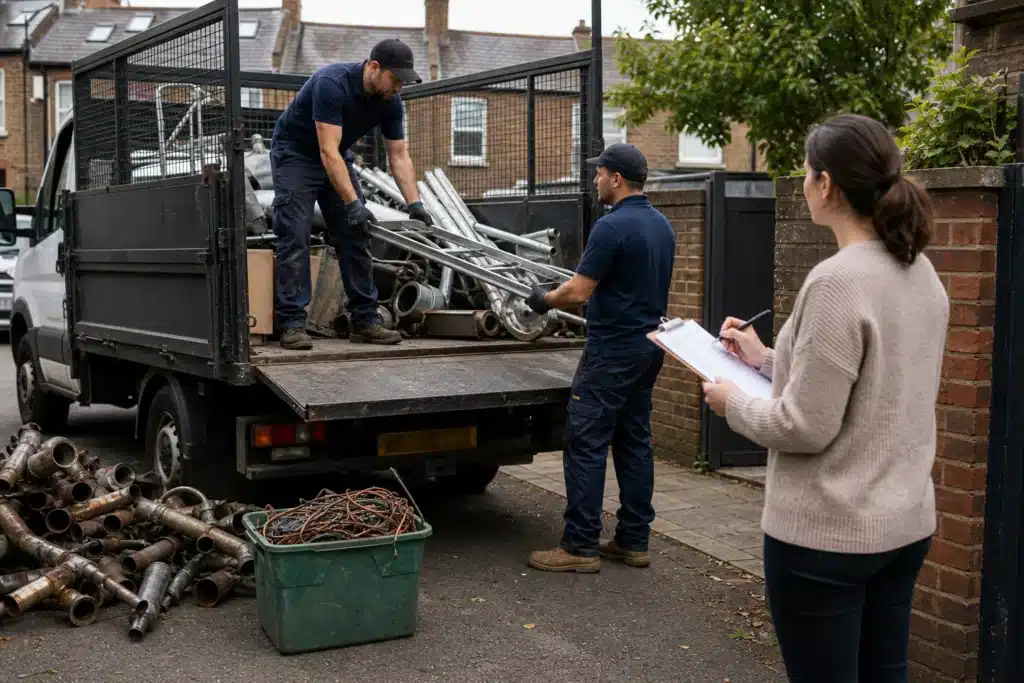
The practical response to digital waste tracking London changes is preparation rather than unnecessary concern. Separate materials where safe, describe the load clearly, make relevant commercial paperwork available and ask questions before booking. Householders should take reasonable care over who receives their waste, while commercial customers should consider whether waste transfer notes or other duty-of-care documents apply.
Premier Scrap Trading Ltd has provided mobile scrap metal collection across Greater London since 2008 for domestic, trade and commercial customers. Suitability depends on the material, access and circumstances, so details should be confirmed before arrangements are made. See the Greater London areas covered for service-area information.
Call 07931 361 034 or book a collection online with Premier Scrap Trading Ltd to discuss your scrap metal, confirm what can be collected and ask for current prices.
Related London scrap services
Digital waste tracking questions
Does digital waste tracking 2026 apply to every London householder?
No. The first mandatory phase from 1 October 2026 applies to permitted or licensed waste-receiving sites in England and Wales, rather than every householder.
When does digital waste tracking start in England?
The receiving-site phase starts on 1 October 2026 for permitted or licensed waste-receiving sites in England and Wales.
When will collectors use the digital waste tracking service?
A public beta for carriers, brokers and dealers is planned for spring 2027, with mandatory use planned from October 2027.
Does digital tracking replace the Scrap Metal Dealers Act?
No. Digital tracking and the Scrap Metal Dealers Act are separate regimes with different purposes and requirements.
What are waste transfer notes used for?
They document transfers of non-hazardous business waste and the parties involved generally need to retain a copy for two years.
Will digital tracking set scrap metal prices?
No. Metal value can still vary by material, grade, condition, contamination, weight and current market demand.
What should a business prepare before arranging collection?
Prepare the full collection address, a clear material description, estimated quantity, access details and any applicable transfer paperwork.
Are old washing machines and fridges collected?
No. Premier Scrap Trading Ltd does not accept old washing machines or fridges.